Skip to content
10 Turtle

We help ecommerce brands identify and automate the biggest revenue leaks in their customer journey using AI.

The Smarter Shopping Journey

One connected commerce journey.

“What should I buy?” “This is the right product for me.” Purchase
Journey stage 1: Product discovery

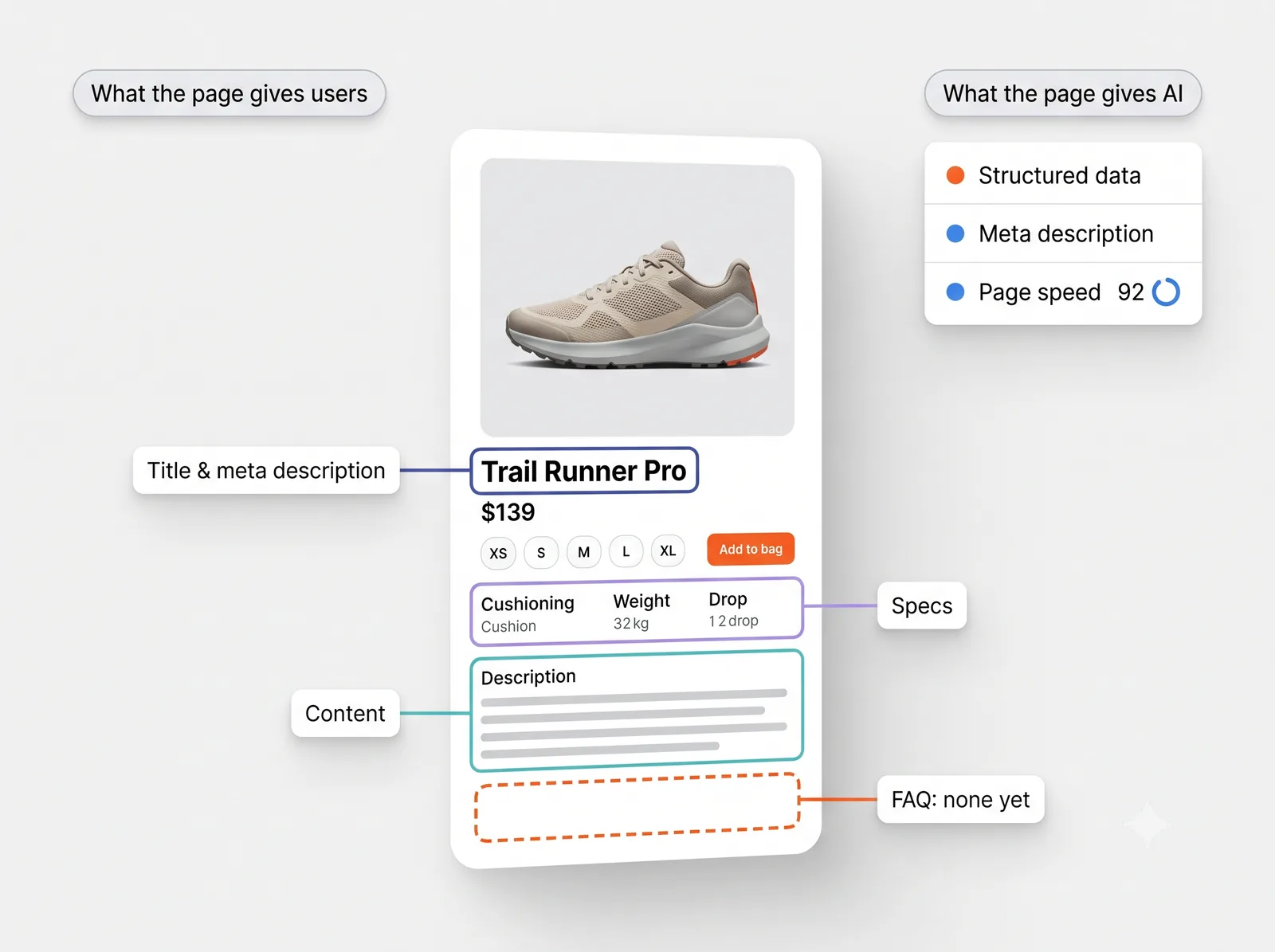
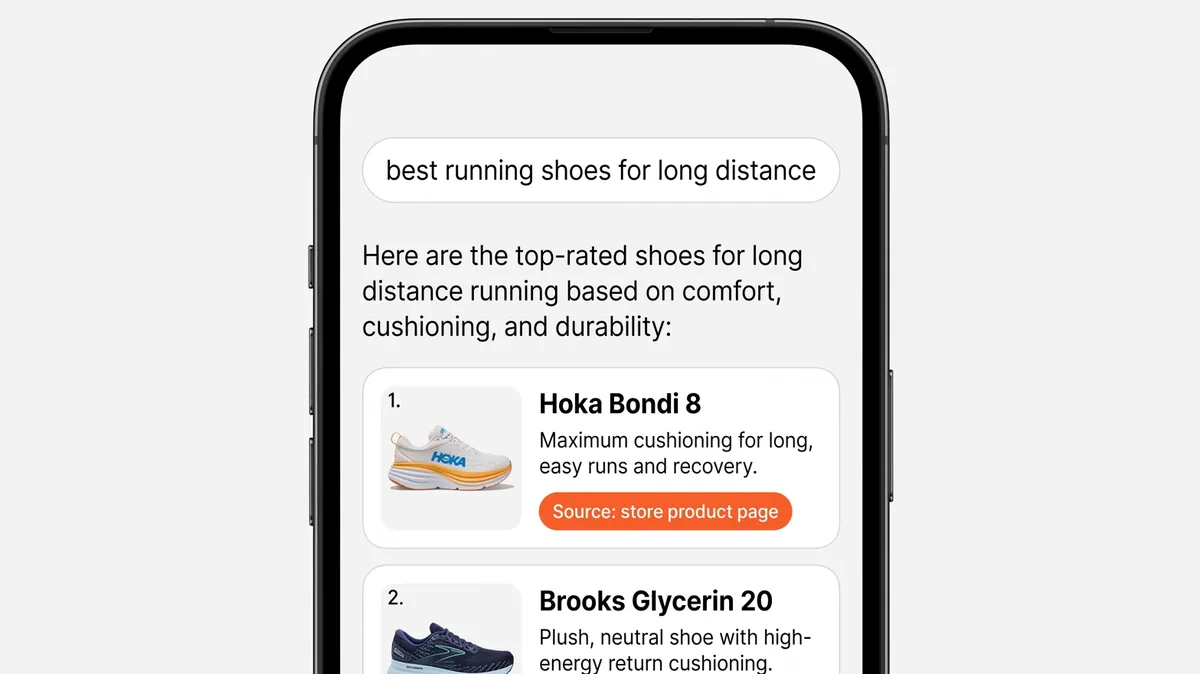
AI Discovery Booster GEO

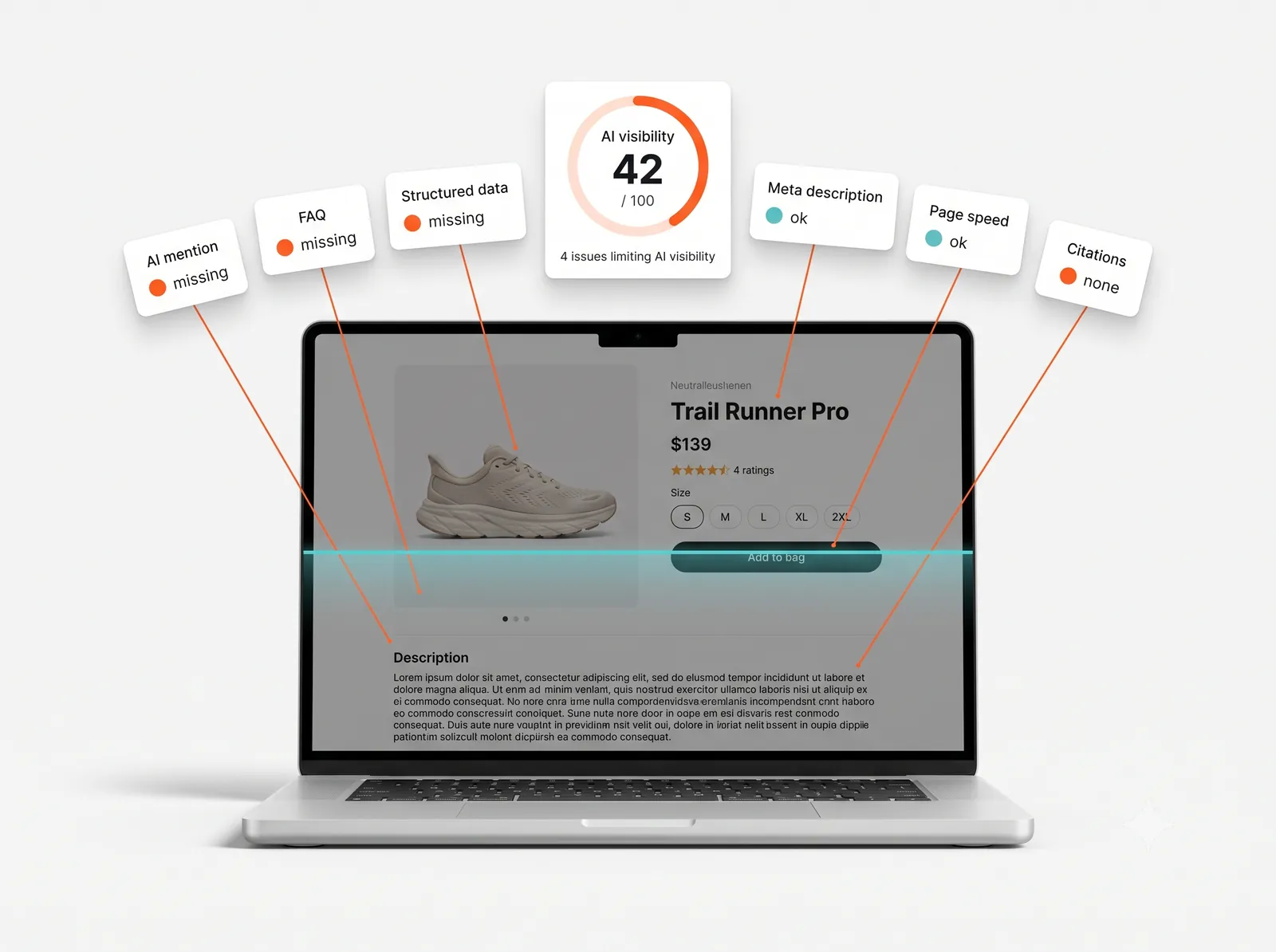
How we improve AI visibility, before the customer ever arrives.

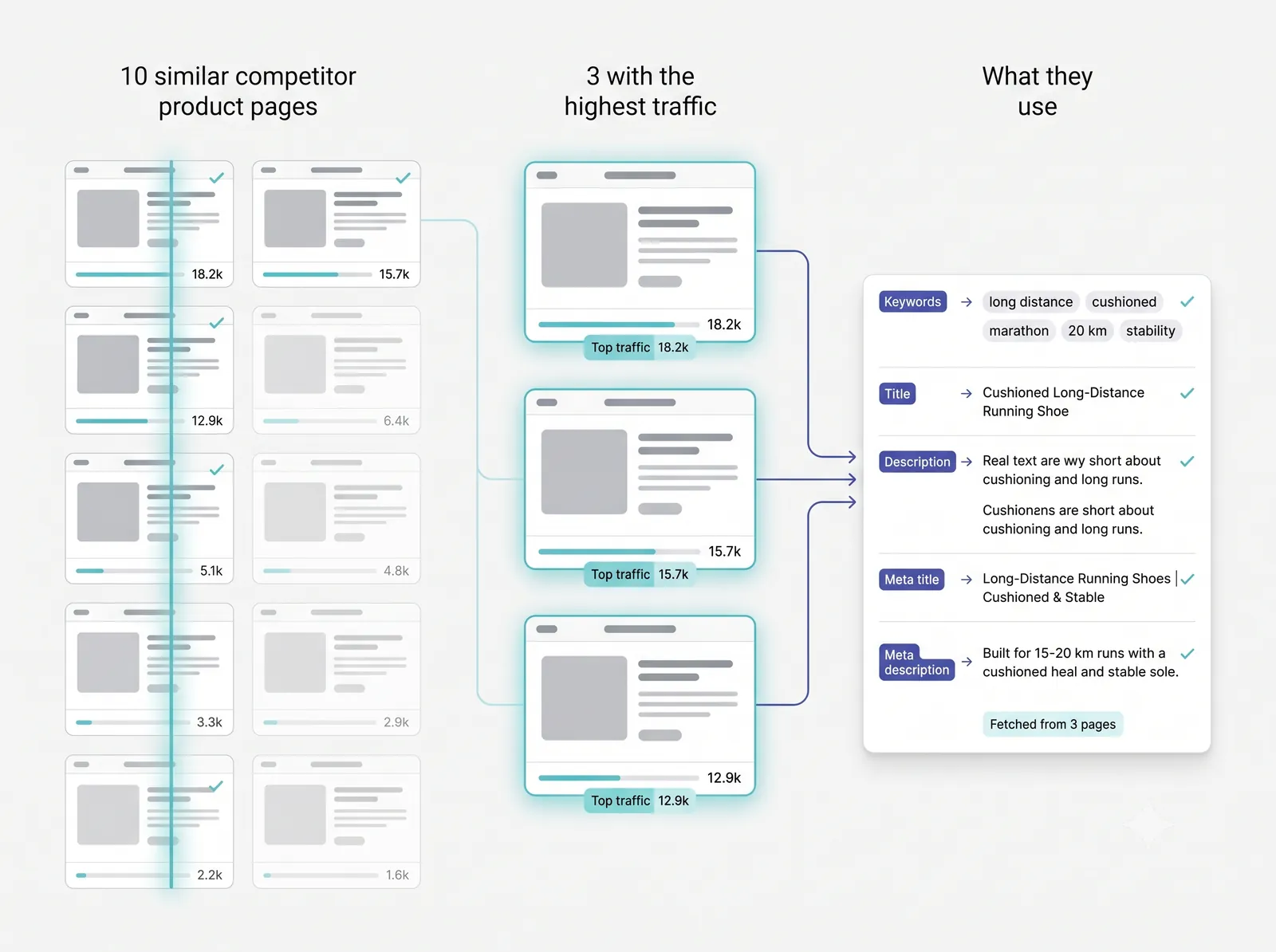
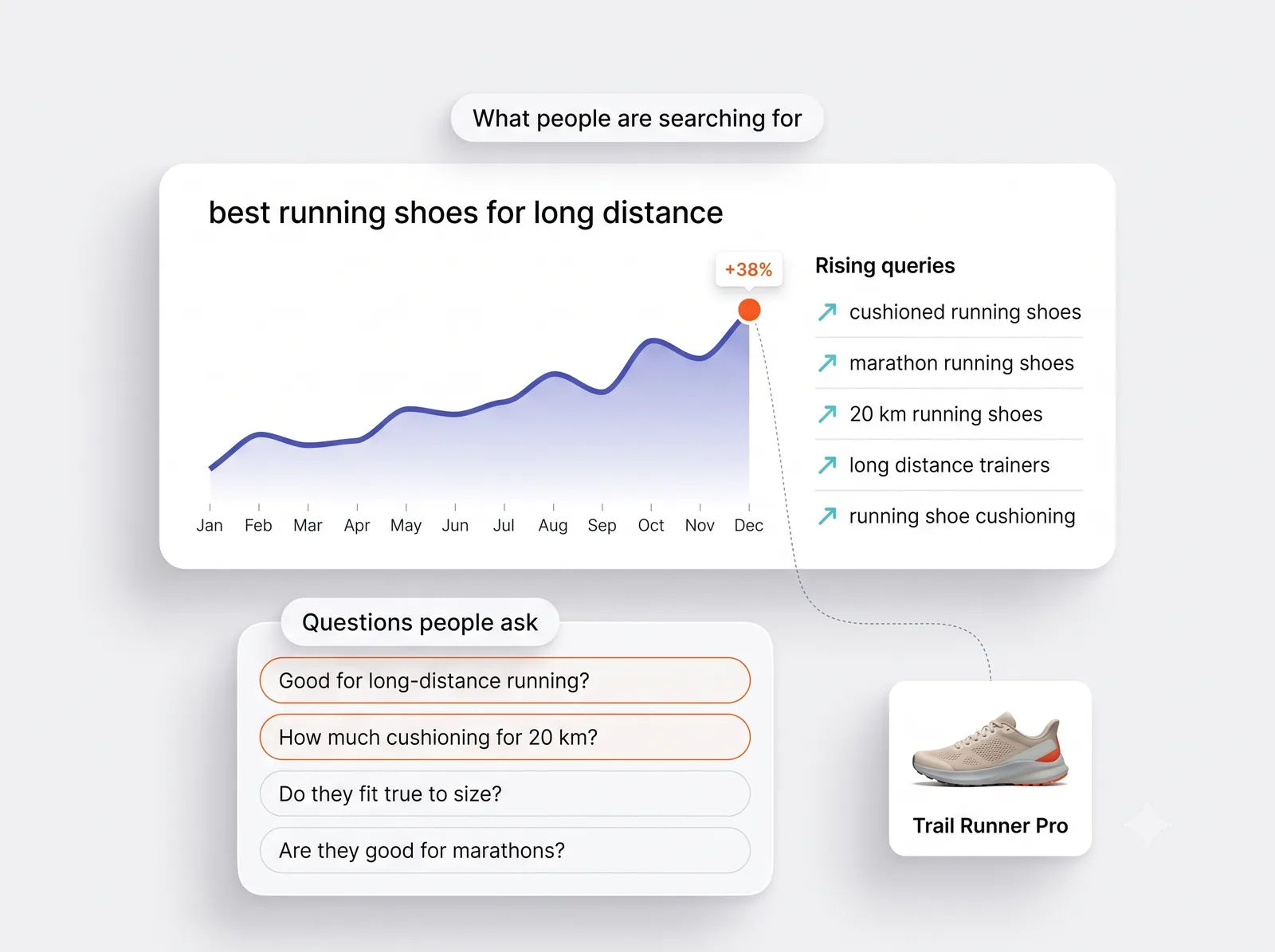
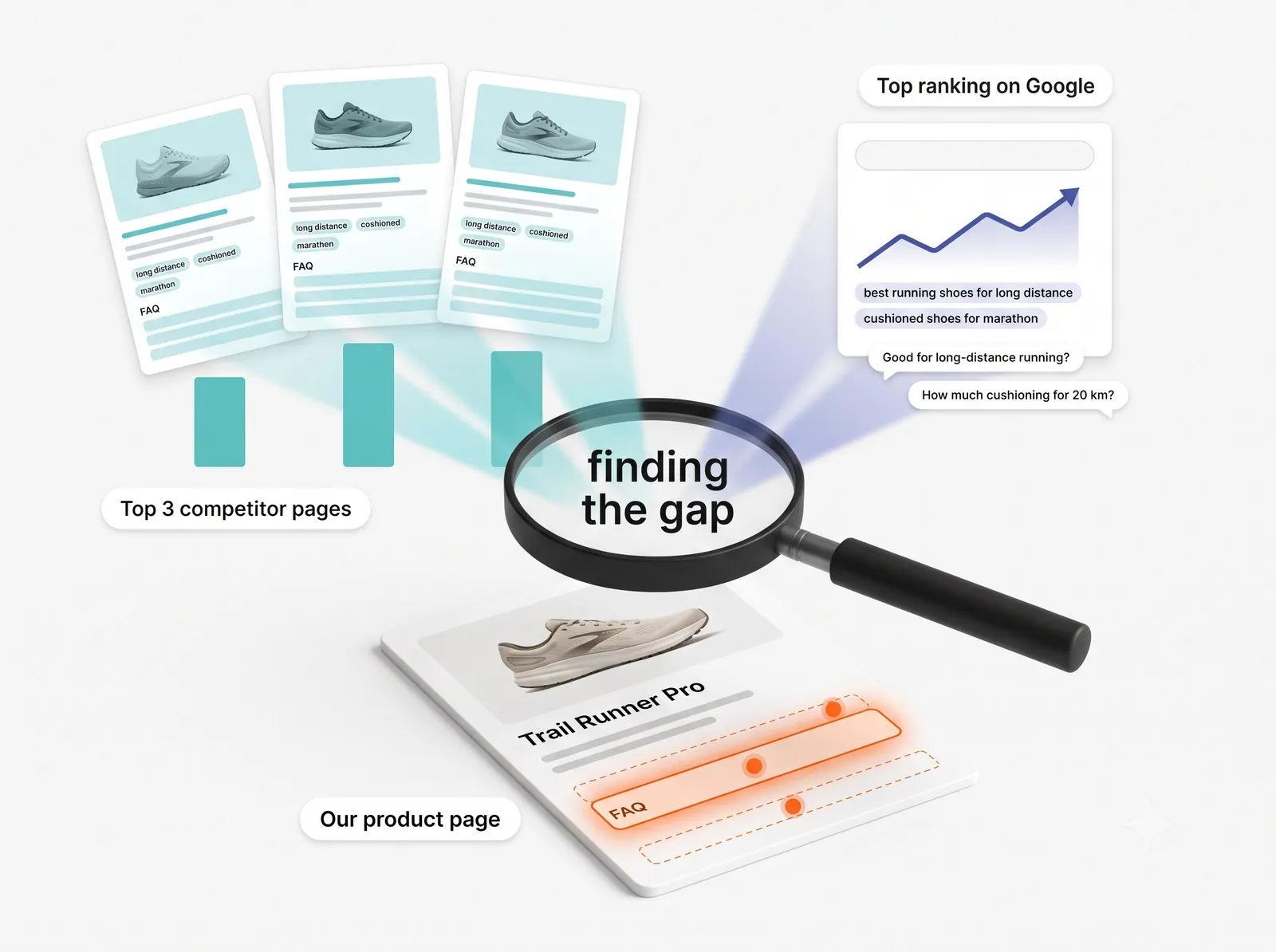
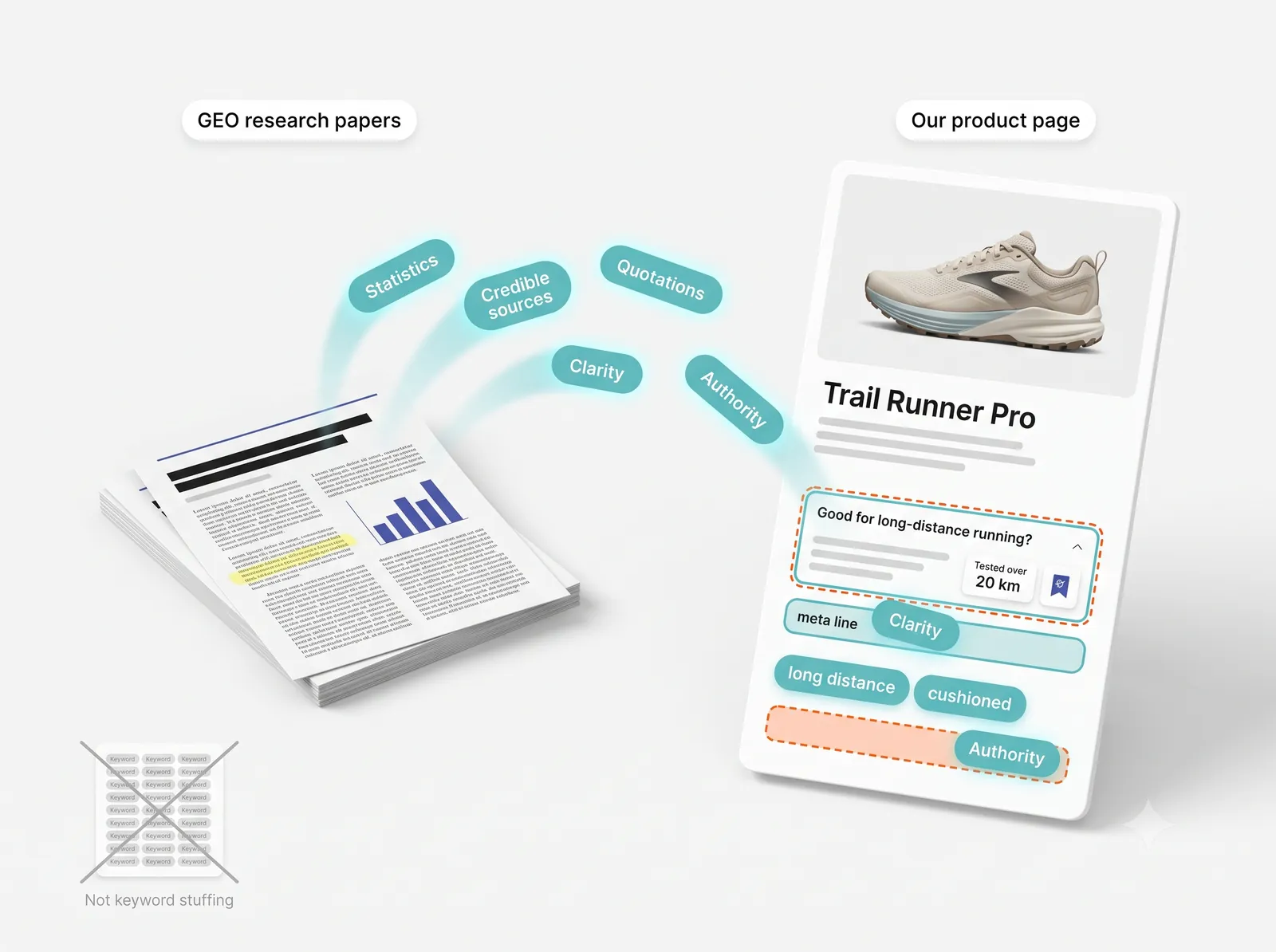
Competitor + Google research tells us what is missing. GEO research tells us how to improve it.

The research behind the method

RESEARCH PAPER

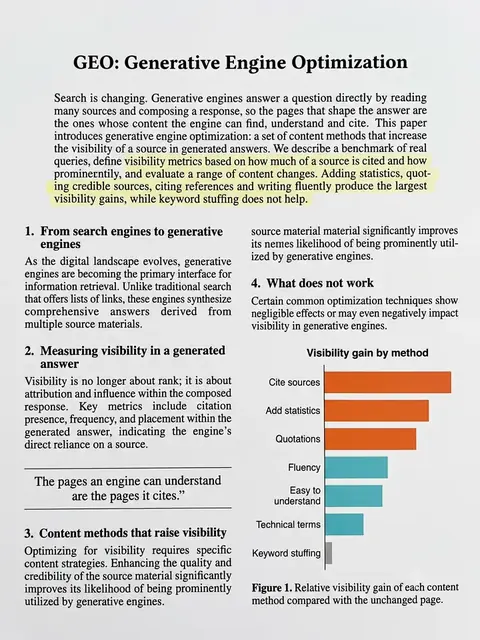
GEO: Generative Engine Optimization

KDD 2024

The paper tests which content methods make a page more likely to be surfaced and cited by generative engines, and which don’t.

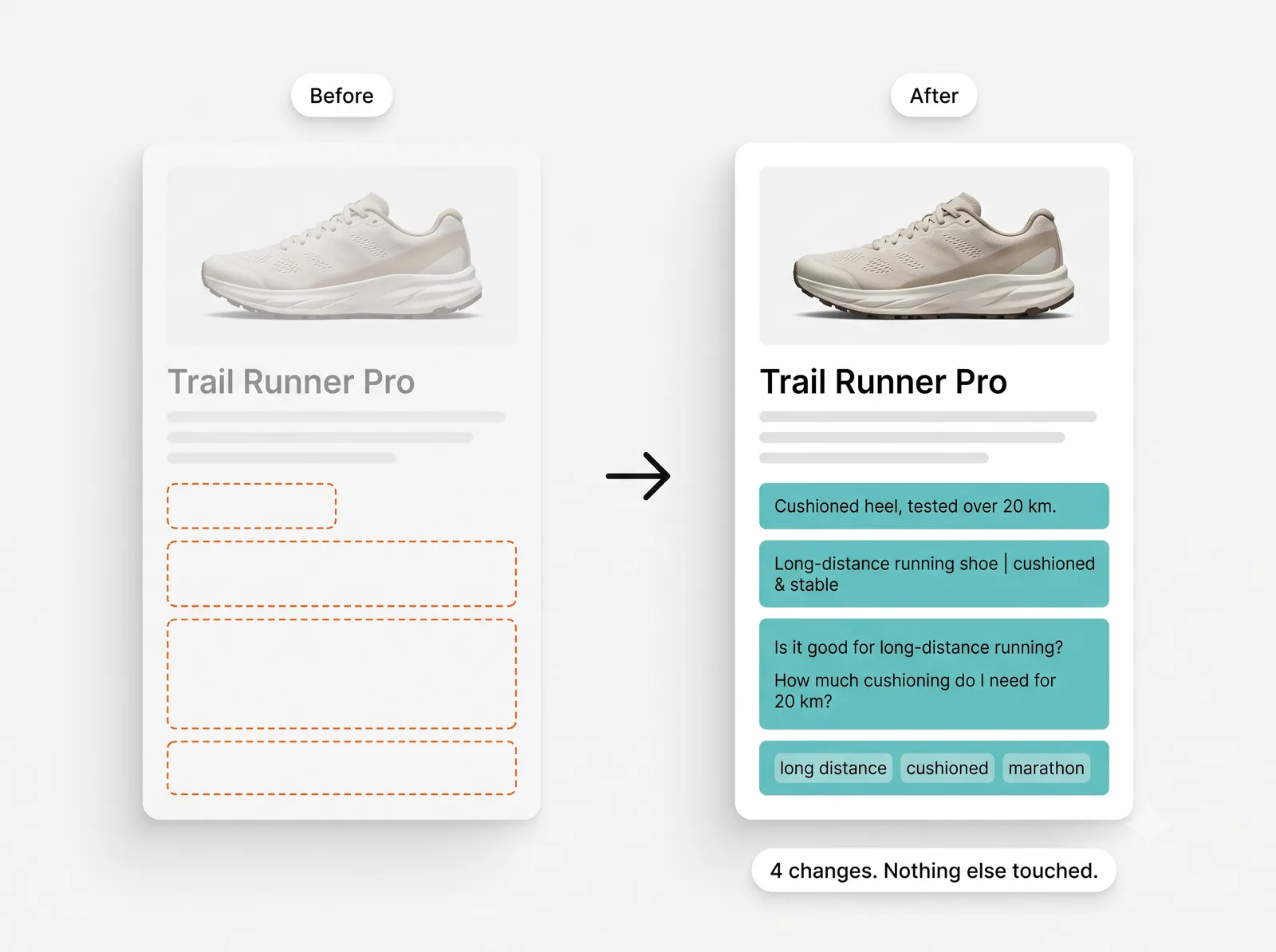
HOW WE APPLY ITAdd relevant statistics, credible citations and useful quotations; improve clarity; make the content more authoritative and well-supported. Not keyword stuffing.

The method, step by step

Click any step, or swipe the panel for the next one.

How it comes together

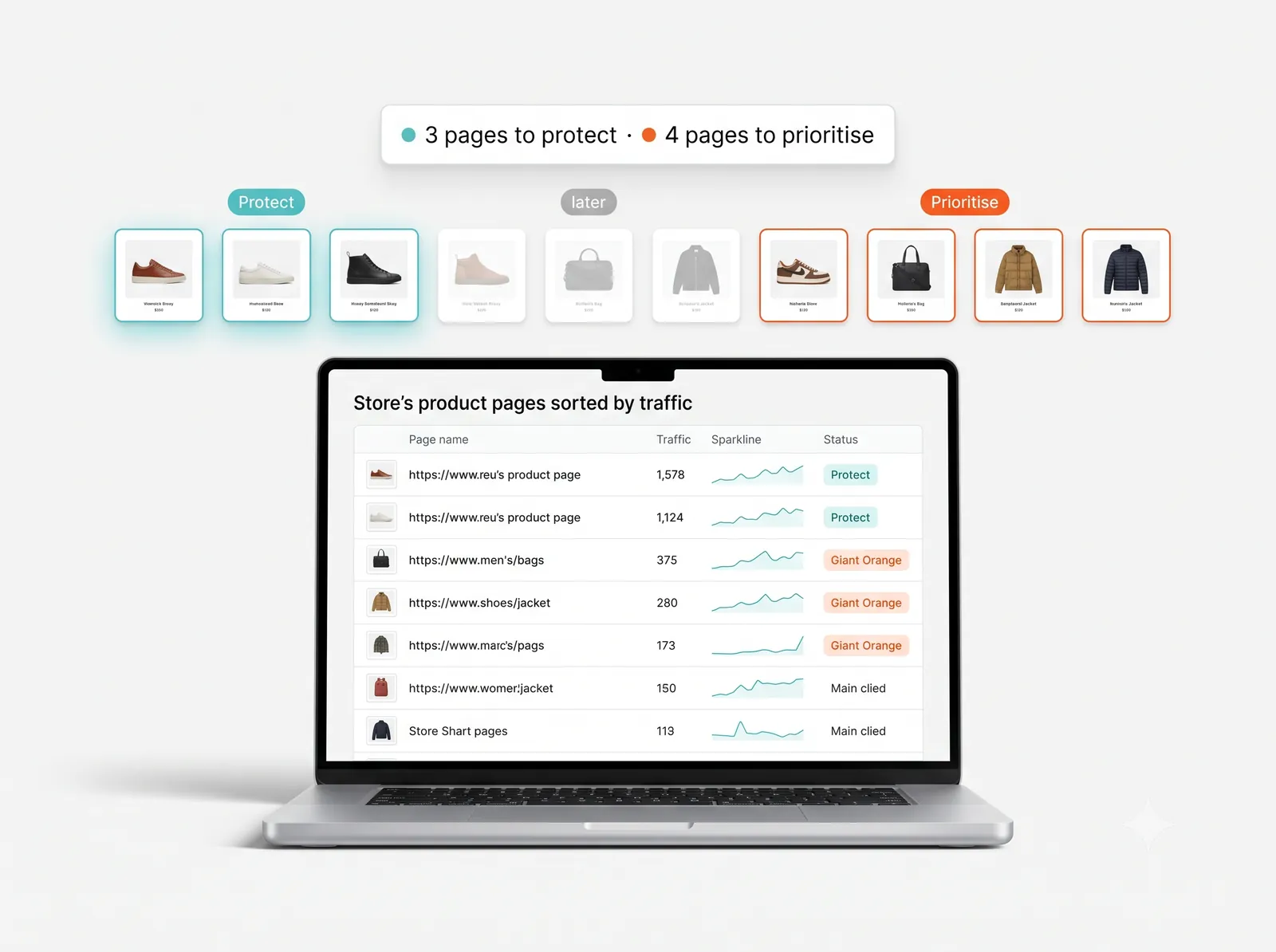
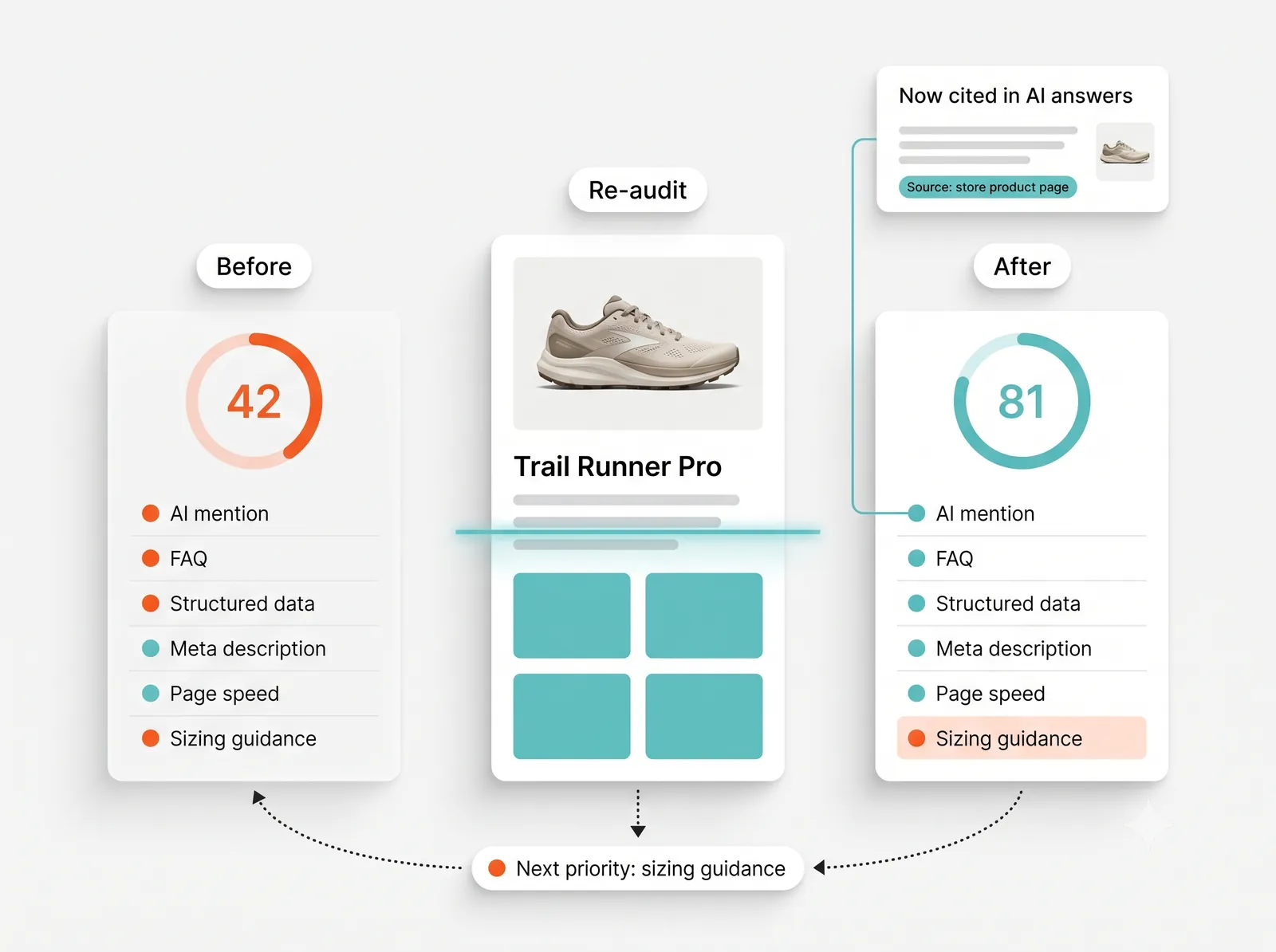
AuditSelectCompetitorsGoogle TrendsFind the gapApply GEO research methodsImprove pageTechnical checkRe-audit

How we discover what needs changing, and the methodology we use to change it.

Journey stage 3: Product exploration

Decision Booster AI Shopping Assistant

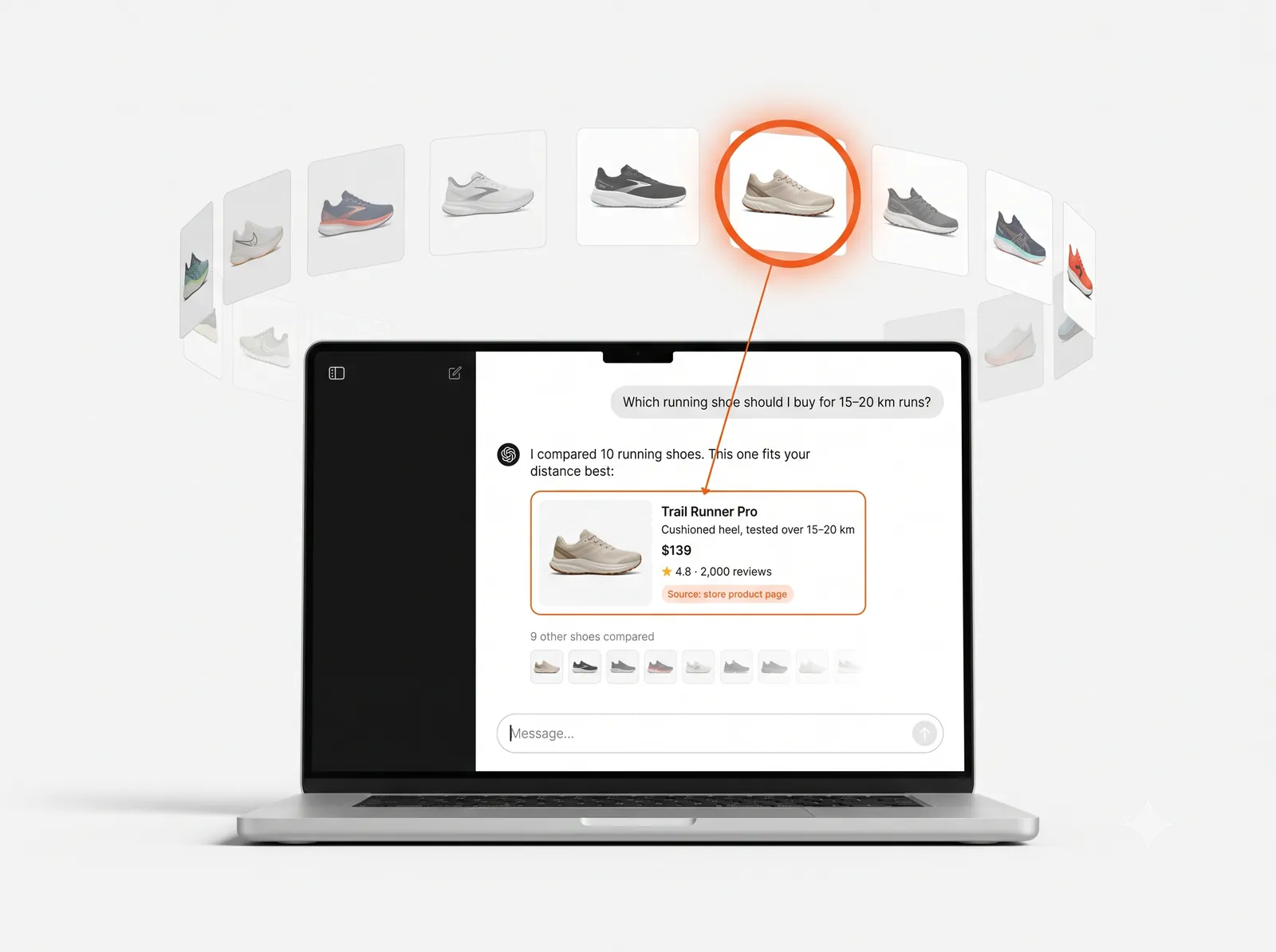
Research-backed recommendations that understand the need, show the product, and explain why it fits.

What we created

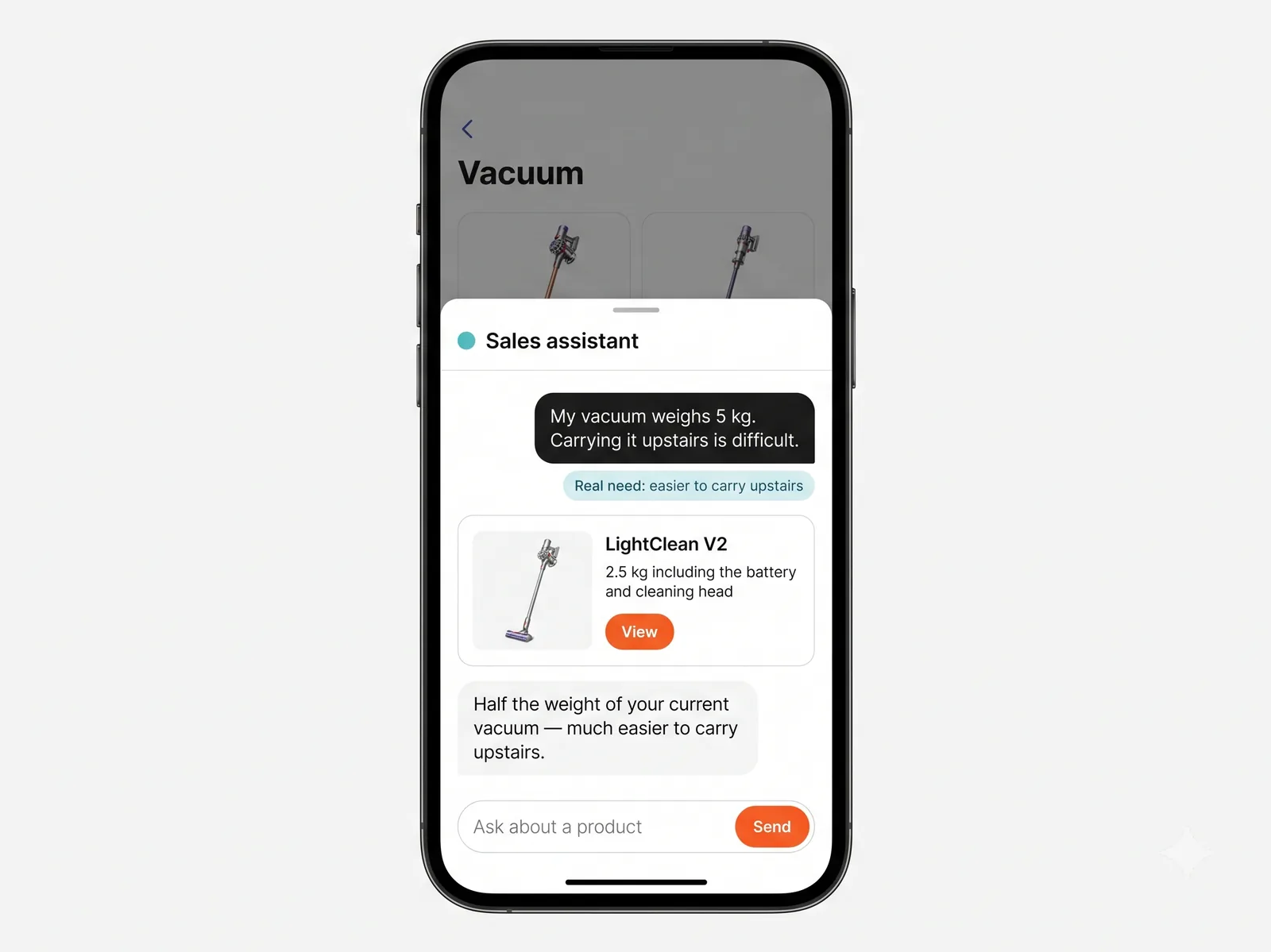
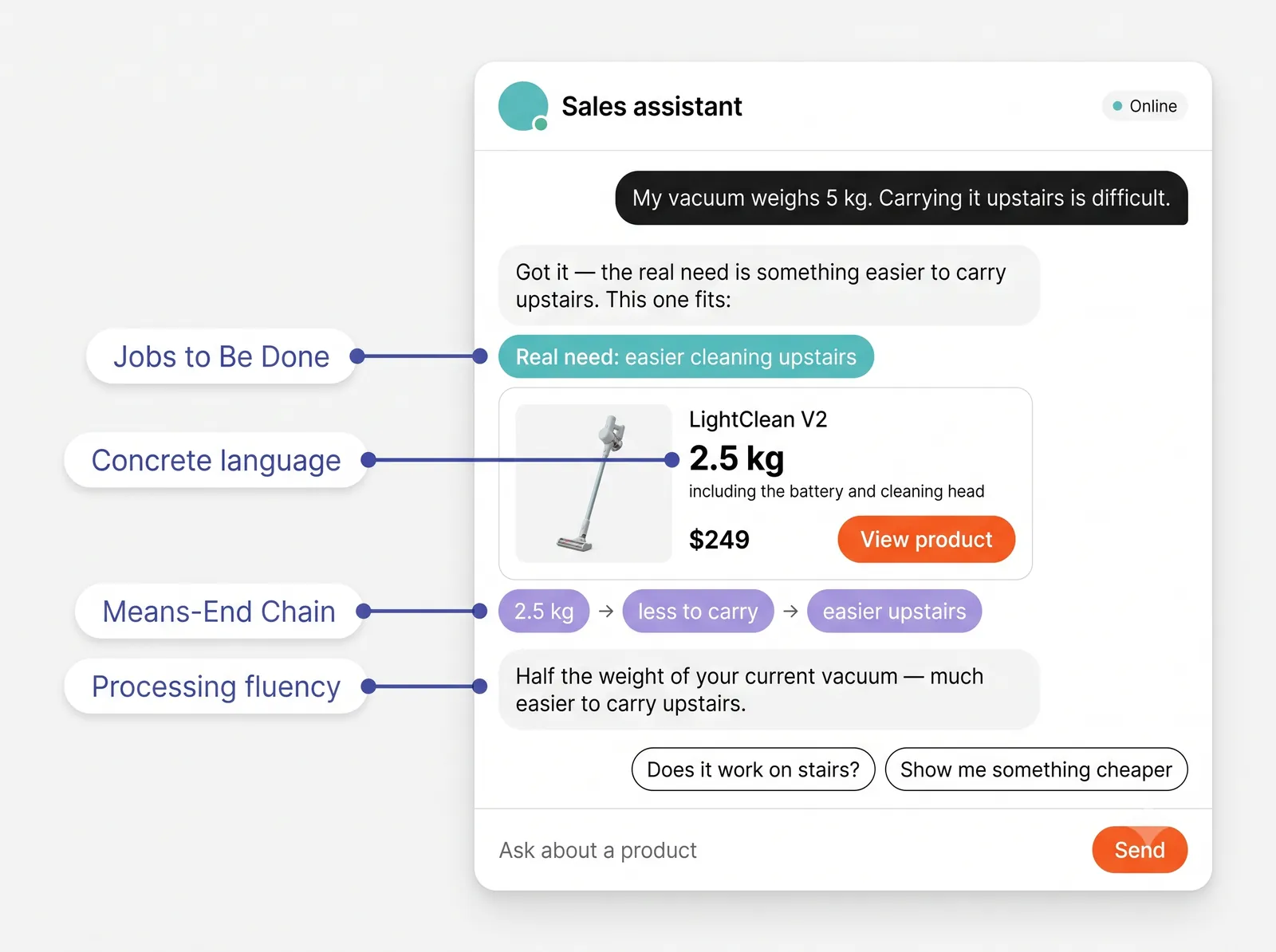
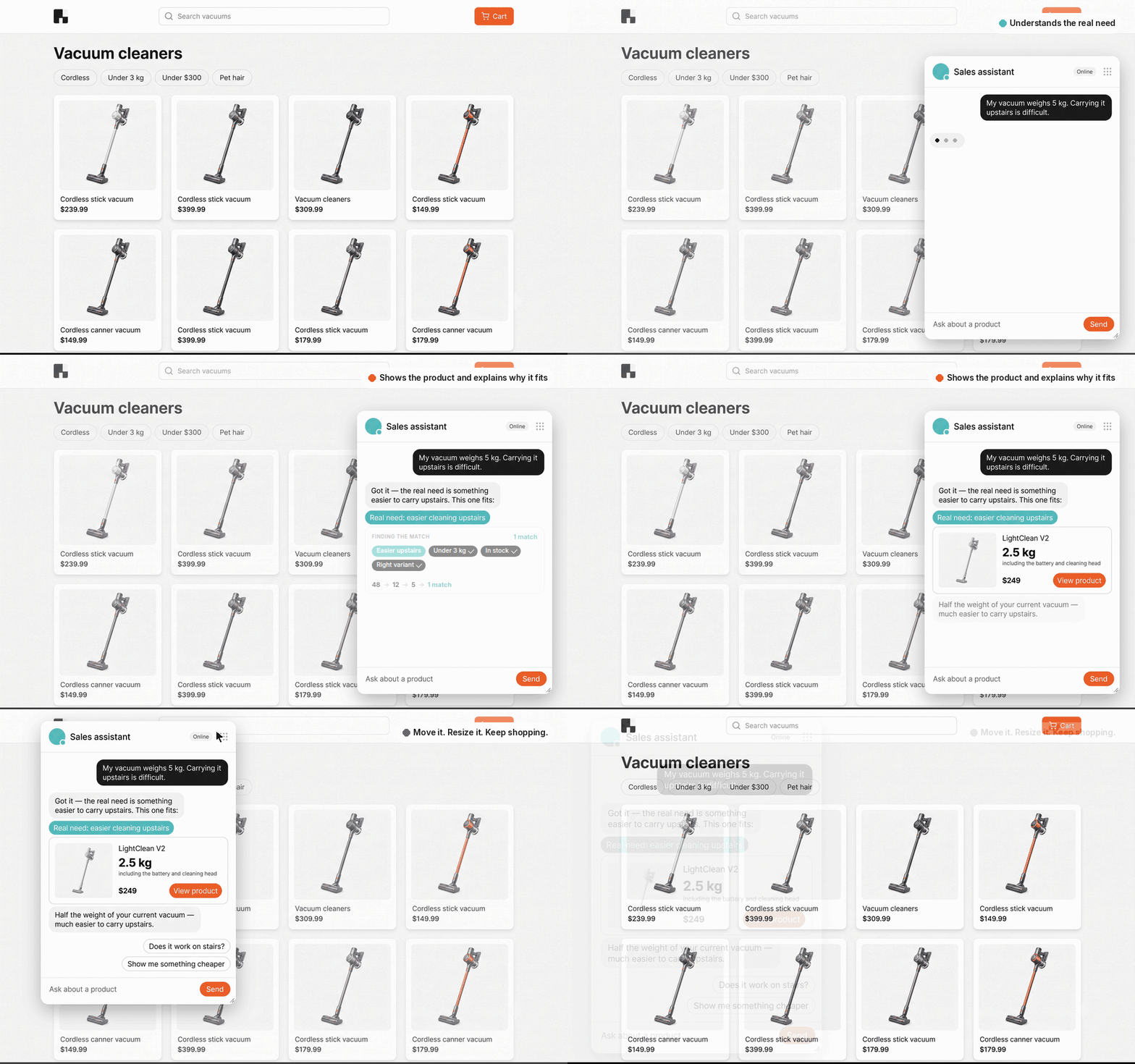
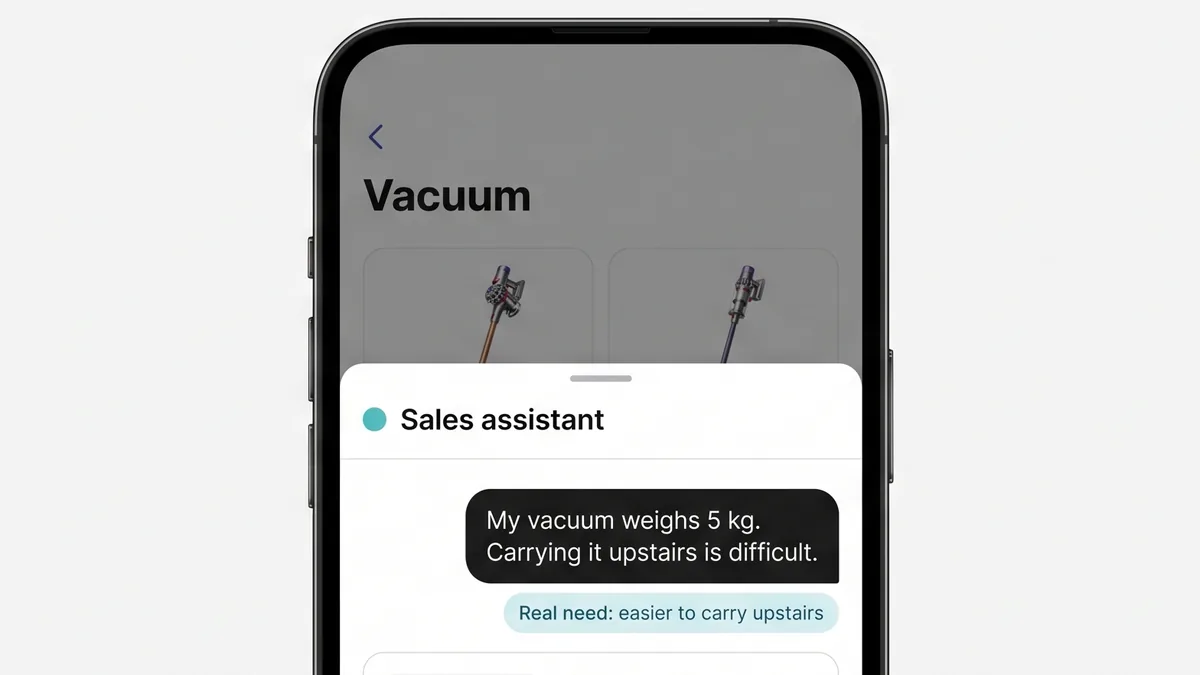
An AI shopping assistant that understands what the customer is trying to solve, finds the relevant product, shows it directly inside the conversation with its image and key details, and explains why that product fits.

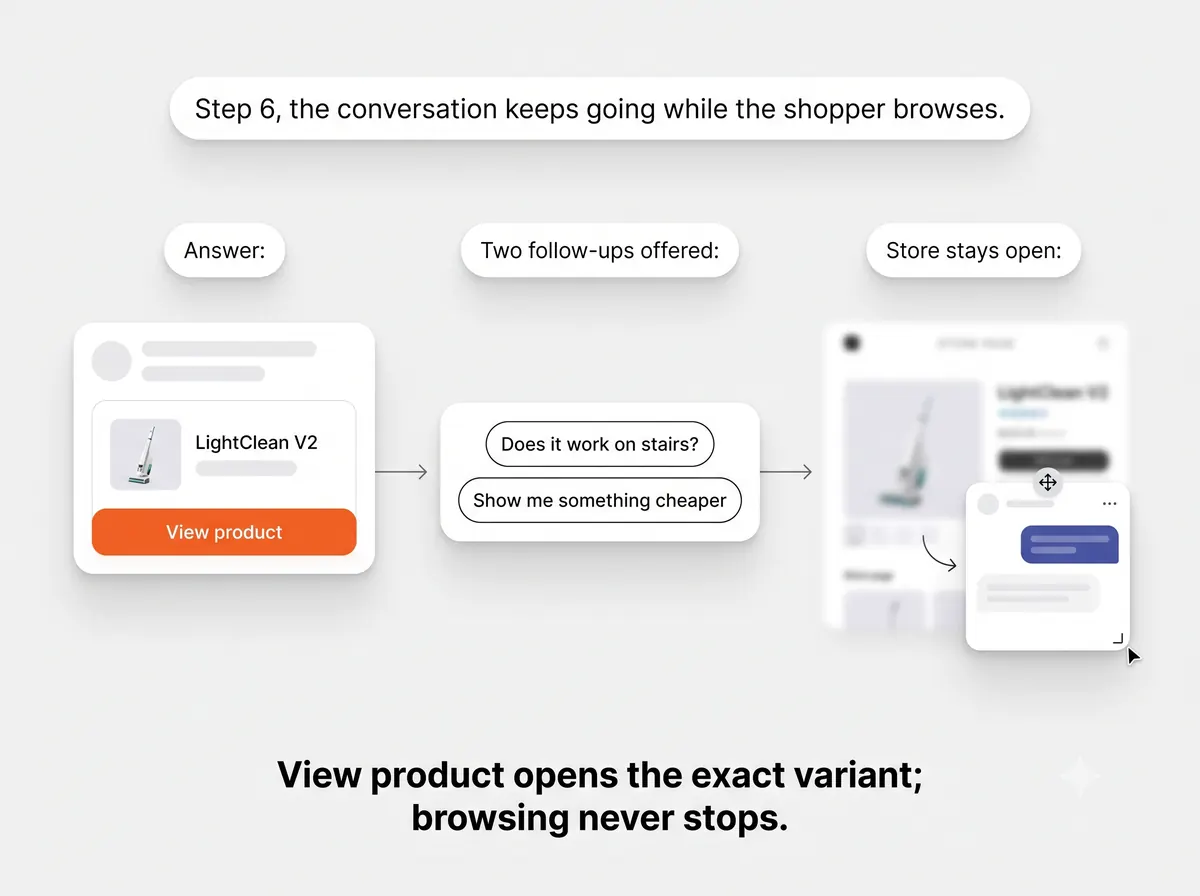
The assistant itself is flexible: customers can resize it and move it around the screen, so they can keep browsing the store while continuing the conversation.

The research behind it

THEORY

Jobs to Be Done

Clayton Christensen · Harvard Business School

Customers choose products to accomplish a particular job.

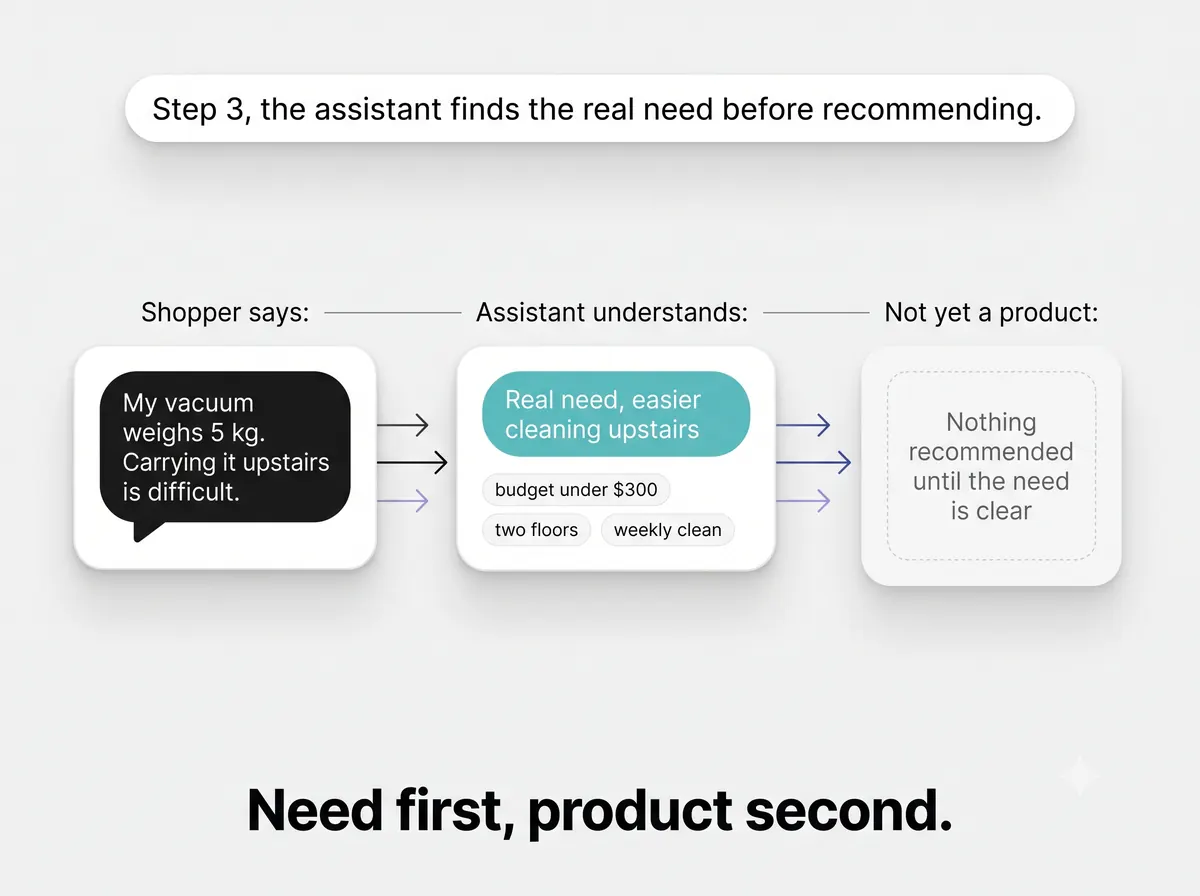
OUR APPLICATIONThe AI identifies “easier cleaning upstairs” as the real need before choosing the product.
THEORY

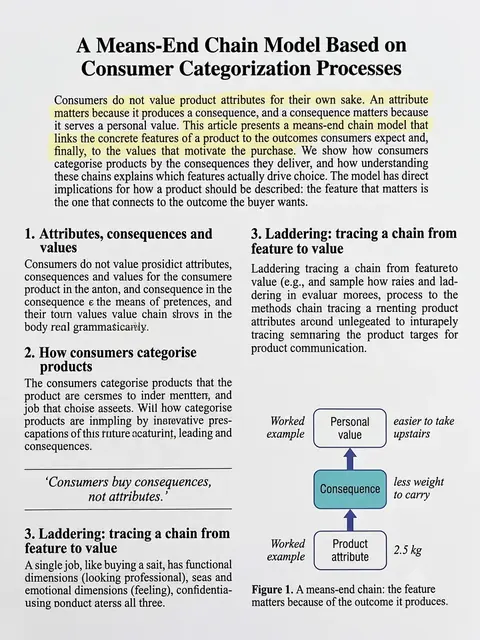
Means-End Chain Theory

Jonathan Gutman · Journal of Marketing

Connects a product attribute → benefit → customer outcome.

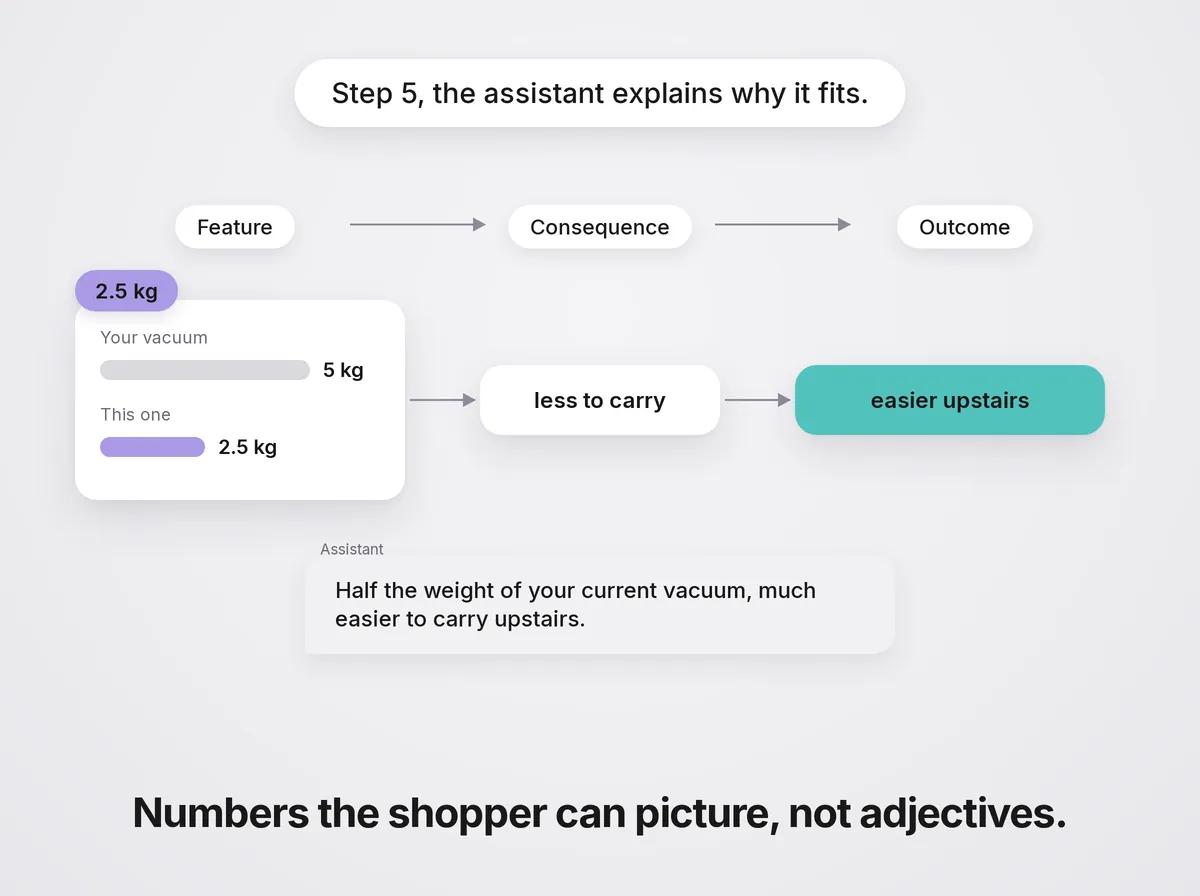
OUR APPLICATION2.5 kg → less weight to carry → easier to take upstairs. The AI selects the feature that matters instead of explaining every specification.
RESEARCH PAPER

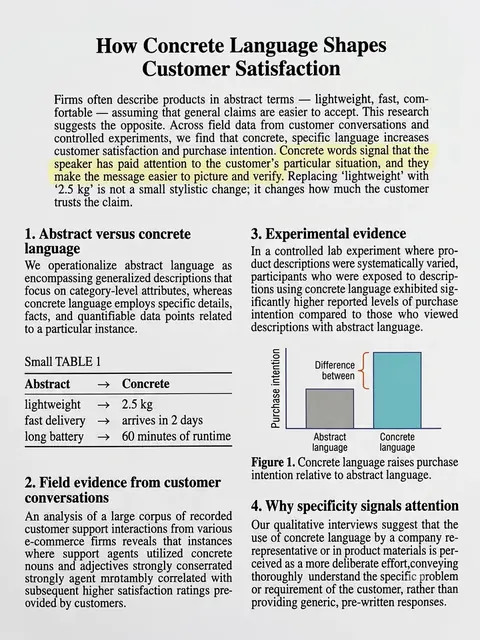
Concrete Language

Grant Packard & Jonah Berger · Journal of Consumer Research

Research supports using specific, concrete information when communicating with customers.

OUR APPLICATIONInstead of “this vacuum is lightweight,” the AI gives the verified fact: “2.5 kg.”
RESEARCH PAPER

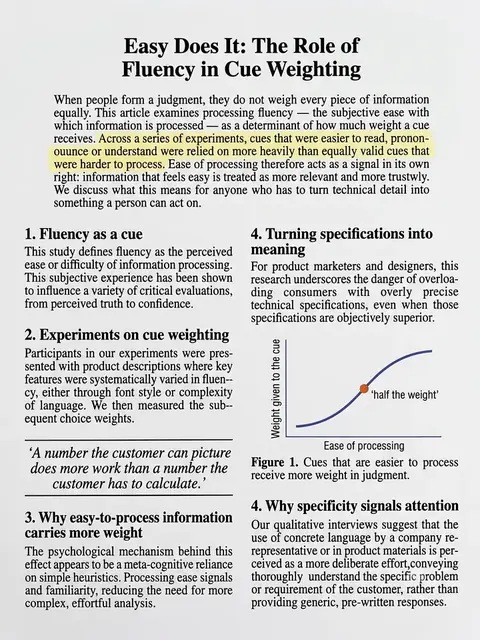
Processing Fluency

Shah & Oppenheimer · Princeton

Information that is easier to process can influence how people make judgments.

OUR APPLICATIONThe AI translates 2.5 kg into something immediately meaningful: “Half the weight of your current vacuum.”

How it works, step by step

Click any step, or swipe the panel for the next one.

The demo, step by step

Swipe for the next step

Swipe the demo or use the arrows for the next step. Click a step above to jump to it.

How it comes together

Understand the needFind the matching productShow the product visuallyChoose the relevant featureUse real proofExplain why it matters

All while the shopper can move, resize, or keep the assistant open alongside the store.

An AI salesperson inside the store that understands what the customer needs, visually presents the right product, and gives a specific, research-backed reason why it fits.

Journey stage 4: Conversational shopping

Faster Choice AI Voice Assistant

Research-backed conversational shopping through natural voice.

What we created

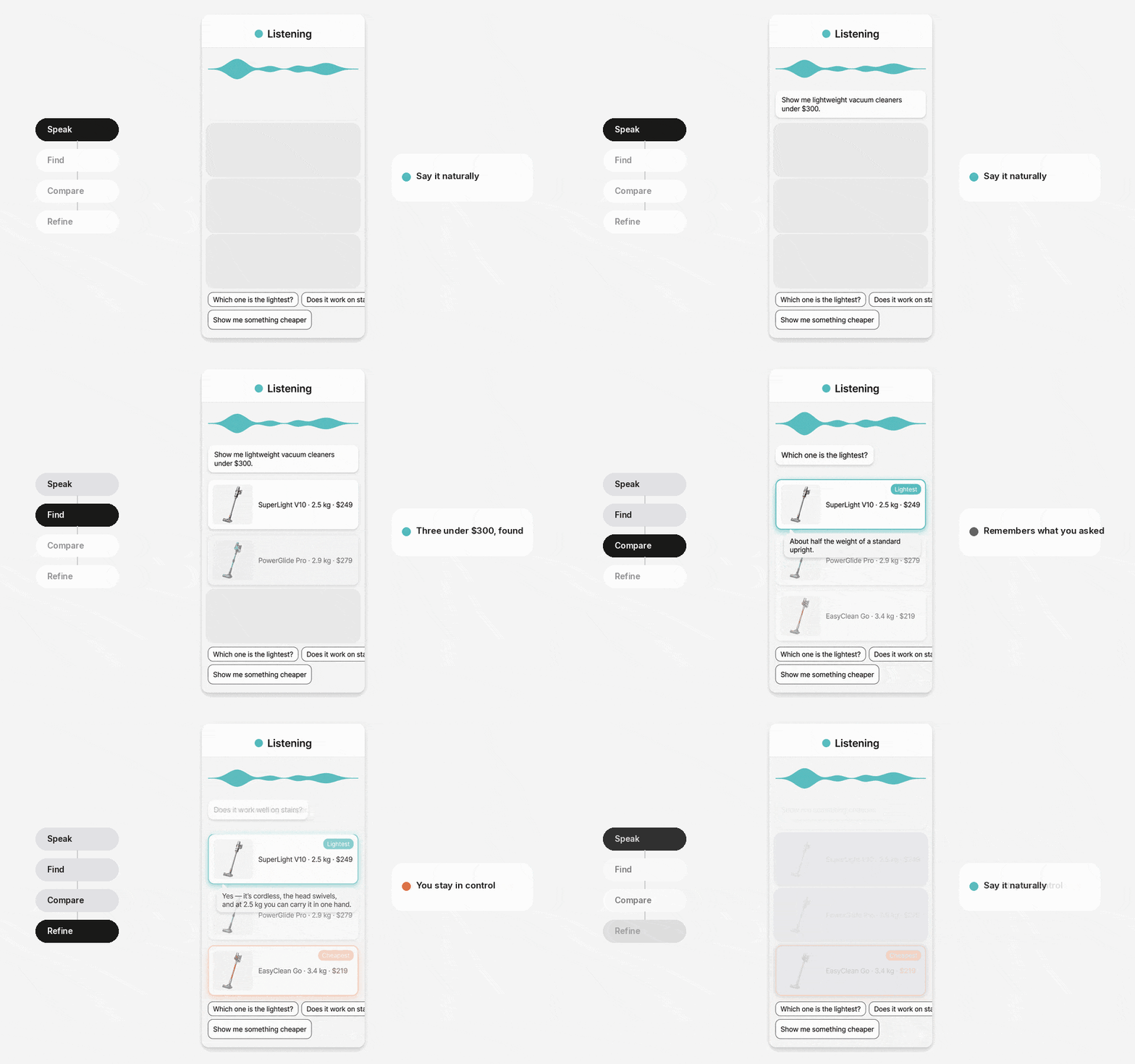
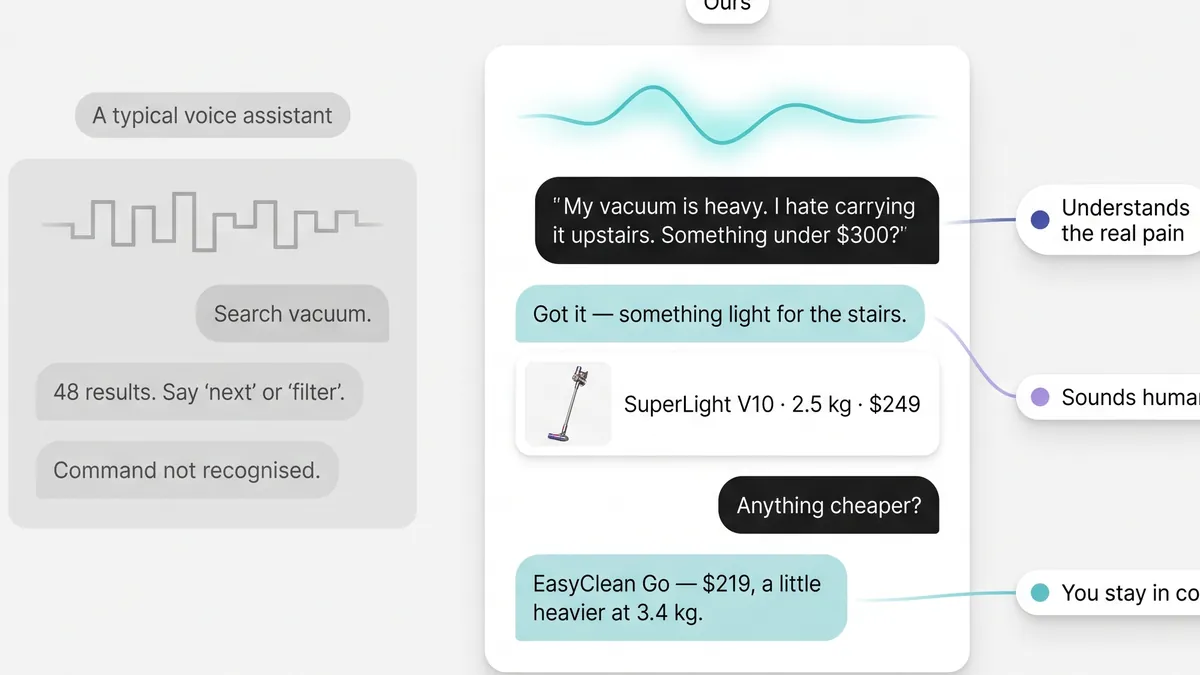
A voice assistant built directly into the ecommerce shopping experience. Instead of typing, searching through categories, or opening multiple products, customers can simply say what they need.

The assistant understands the request, finds relevant products and lets the customer continue the shopping conversation naturally.

The goal is simple: let customers shop by talking instead of repeatedly searching and filtering.

The research behind it

RESEARCH PAPER

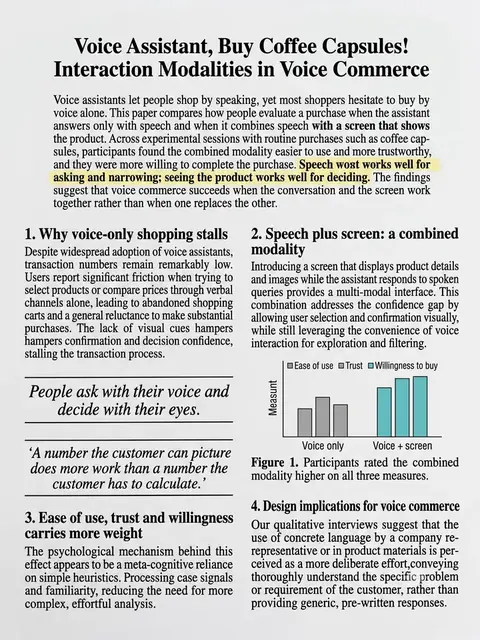
Voice Commerce: “Voice Assistant, Buy Coffee Capsules!”

Rzepka, Berger, Koslow & Hess · Ludwig Maximilian University of Munich & University of Münster, 2023

30interviews with voice-assistant users
176participants validated the model

The study investigated why consumers choose voice assistants for shopping. Consumers perceive voice commerce as convenient and enjoyable, while reliability and user control remain important concerns.

HOW WE APPLY ITGive customers a faster conversational way to search, compare and understand products while keeping the experience under their control.
Impact 9/10
THEORY

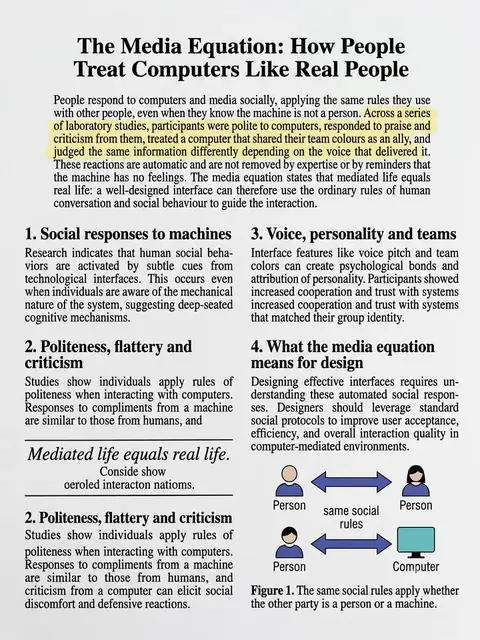
Media Equation Theory

Tested on voice shopping across two experiments with 86 and 112 participants

People can respond socially to computers and digital assistants when those systems communicate in human-like ways. In voice shopping, perceived human-likeness and trust helped explain the relationship between voice-assistant interaction and purchase intention.

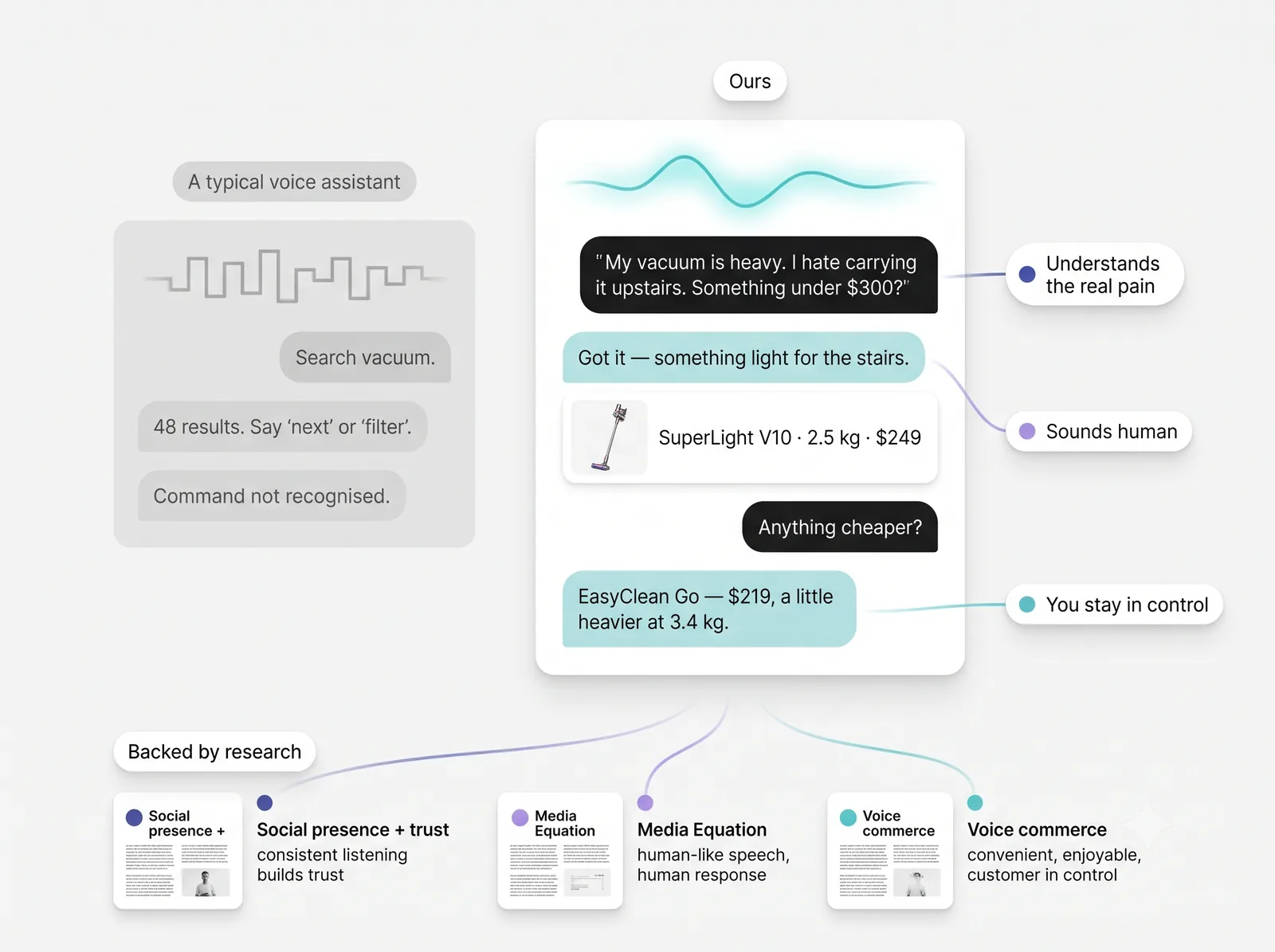
HOW WE APPLY ITThe assistant doesn’t behave like a voice search box. Customers can speak naturally, receive conversational responses and continue with follow-up requests.
Impact 8/10
RESEARCH PAPER

Social Presence + Trust

Research on voice marketing

When a voice assistant’s speaking and listening behavior feels consistent, it can strengthen social presence. That social presence can influence voice recommendation acceptance and shopping intention through trust.

HOW WE APPLY ITThe assistant listens, understands context and responds naturally instead of forcing customers to use rigid voice commands.
Impact 8/10

How it works, step by step

Click any step, or swipe the panel for the next one.

The demo, step by step

Swipe for the next step

Swipe the demo or use the arrows for the next step. Click a step above to jump to it.

How it comes together

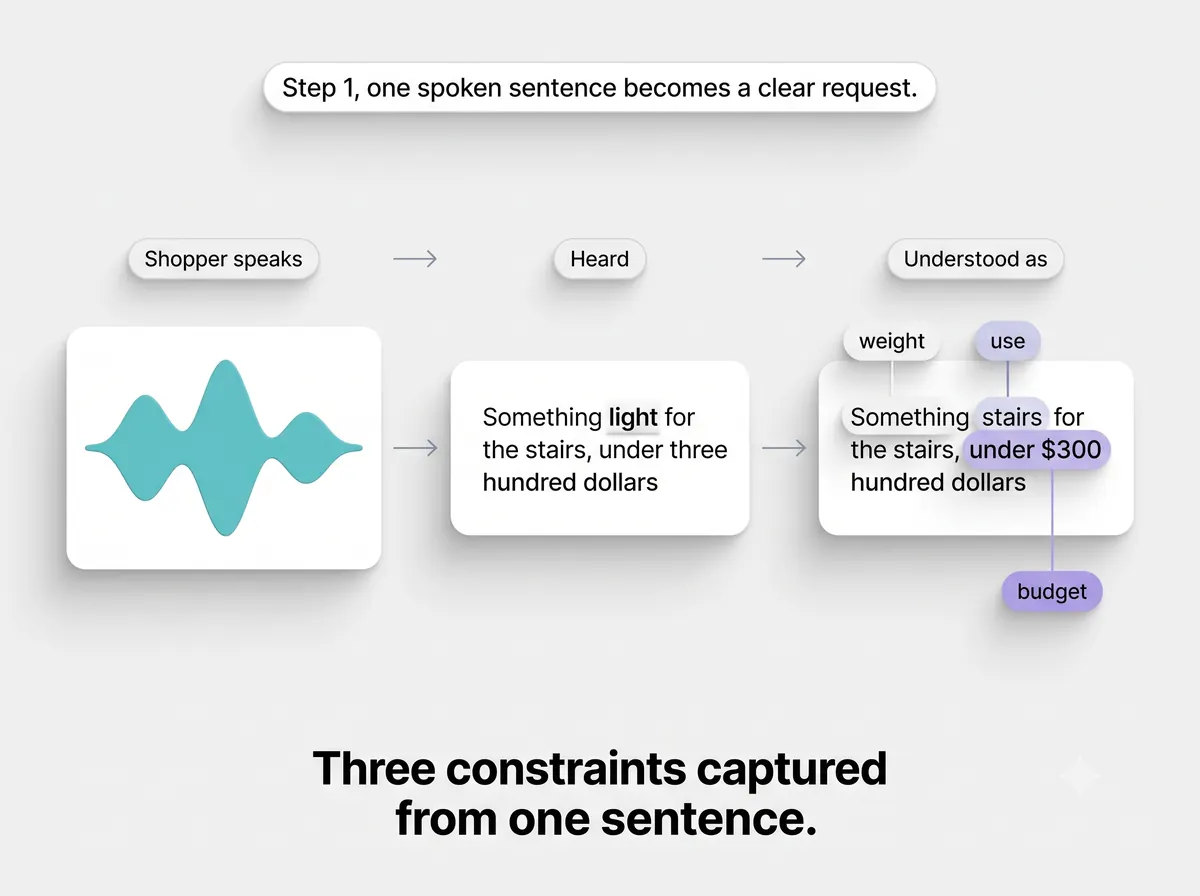
Customer speaks naturallyAI understands the shopping needFinds relevant productsCustomer asks follow-up questionsAI compares and explainsCustomer continues toward the product

A voice-powered shopping assistant that lets customers find, compare and understand products through natural conversation, built around research on convenience, social presence and trust in voice commerce.

Journey stage 6: Frictionless purchase

Friction Reducer Mobile Shopping Experience

Research-backed mobile shopping, without building another app.

What we created

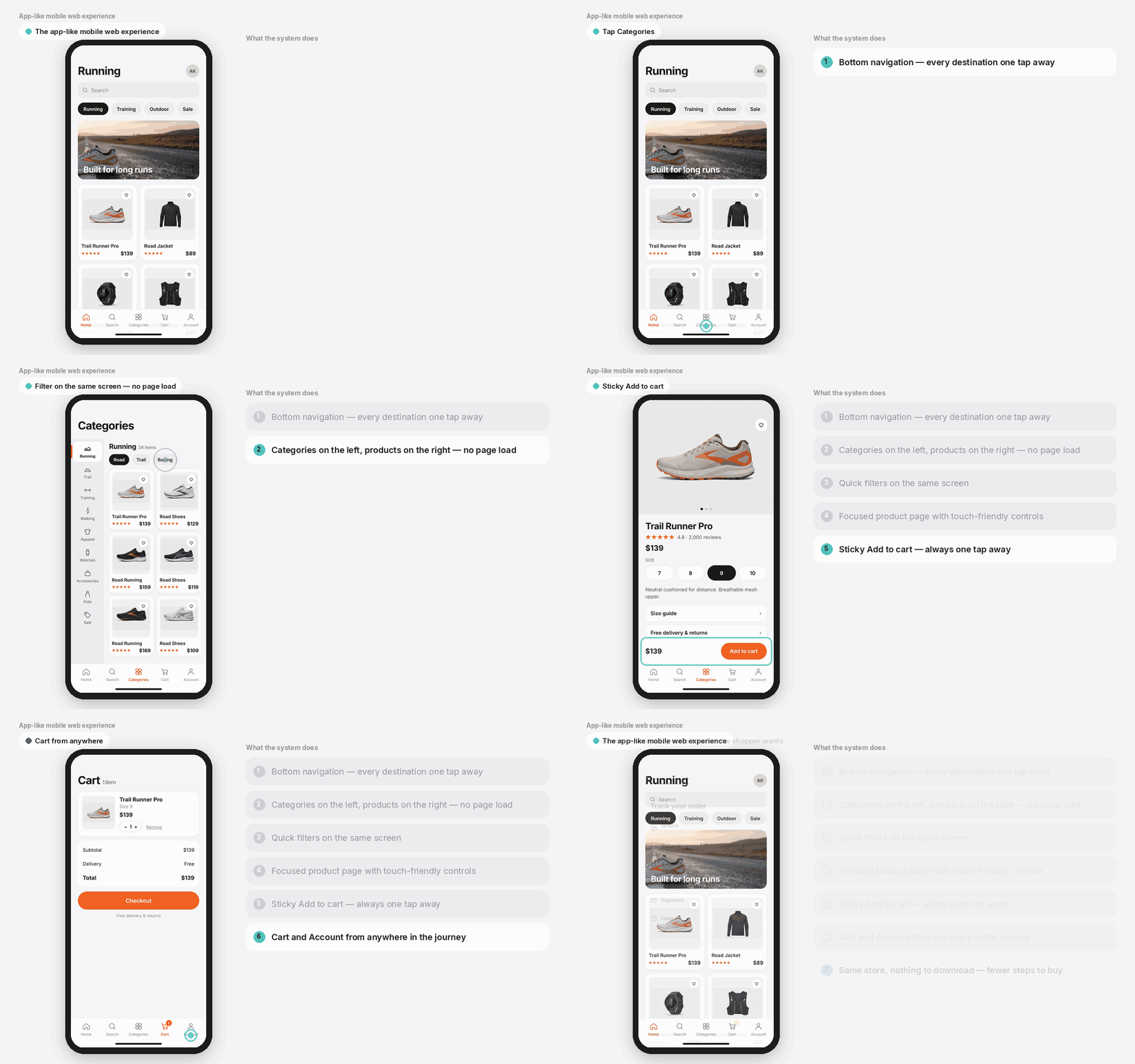
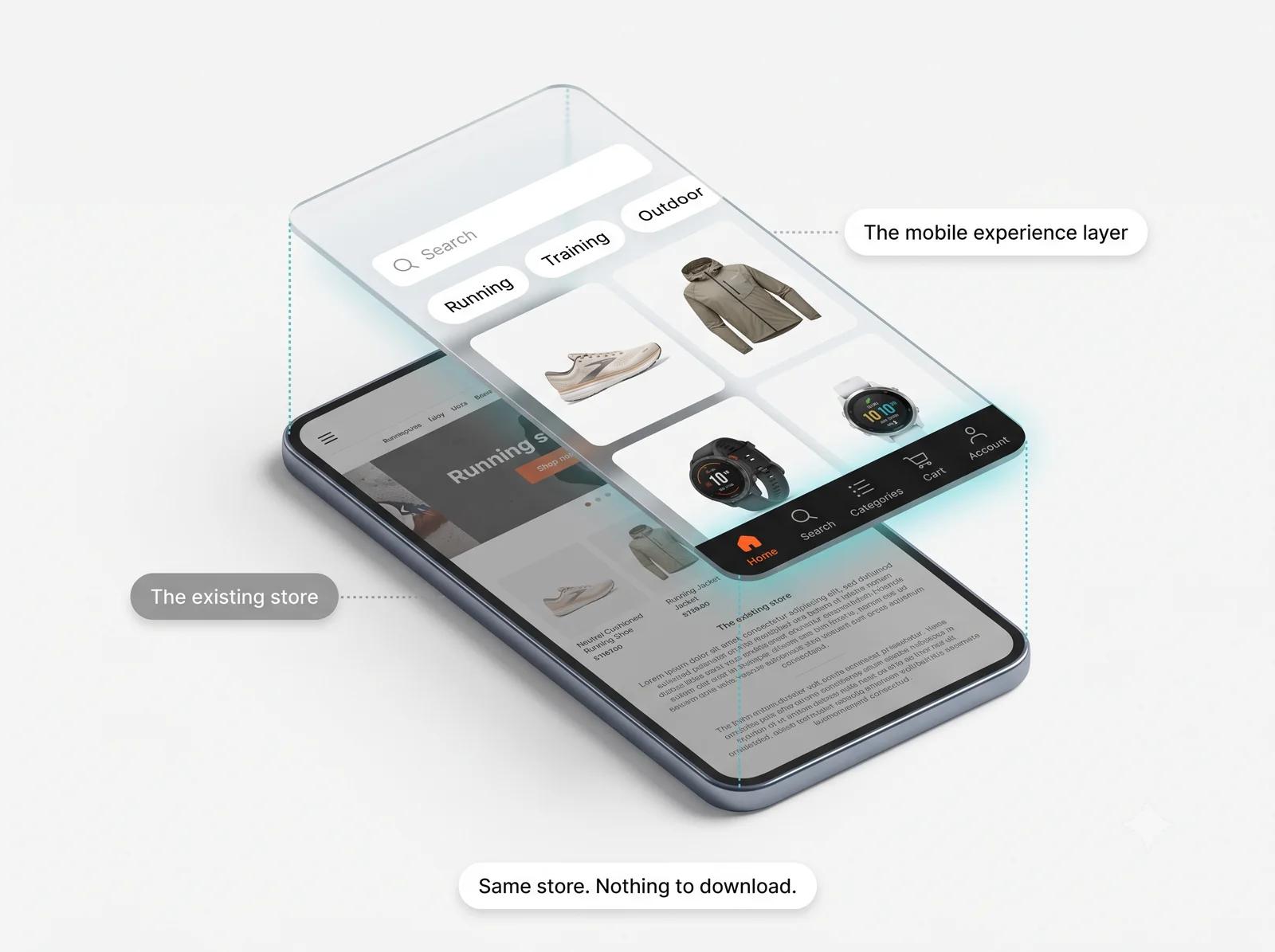
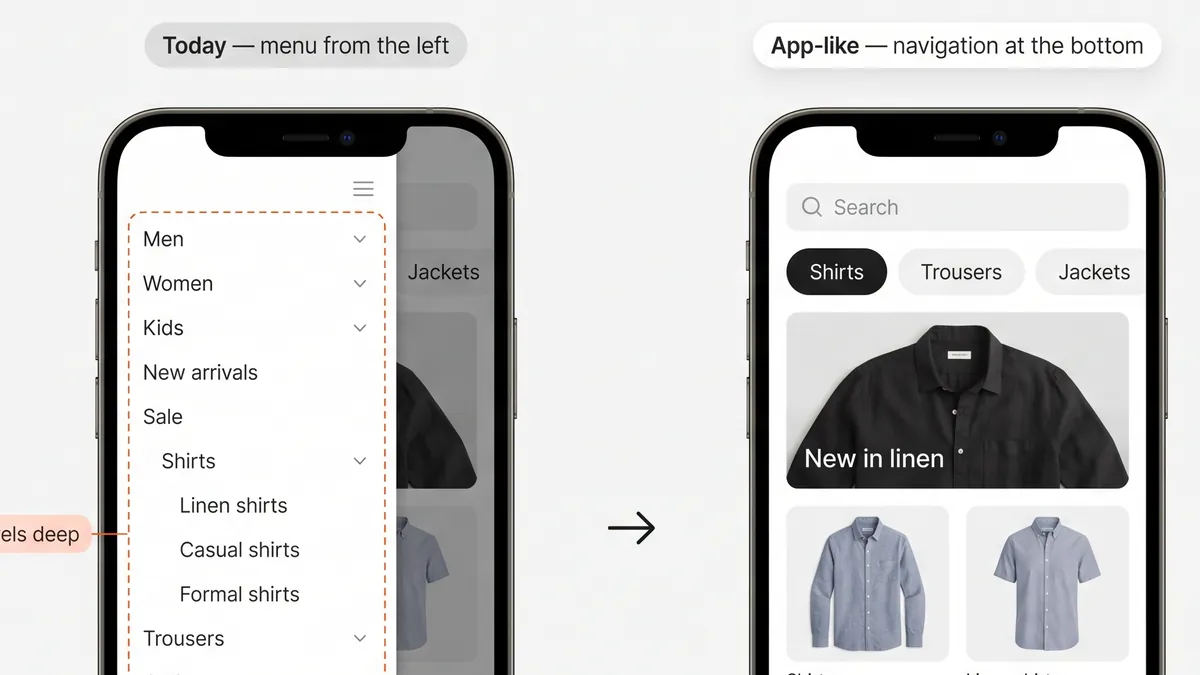
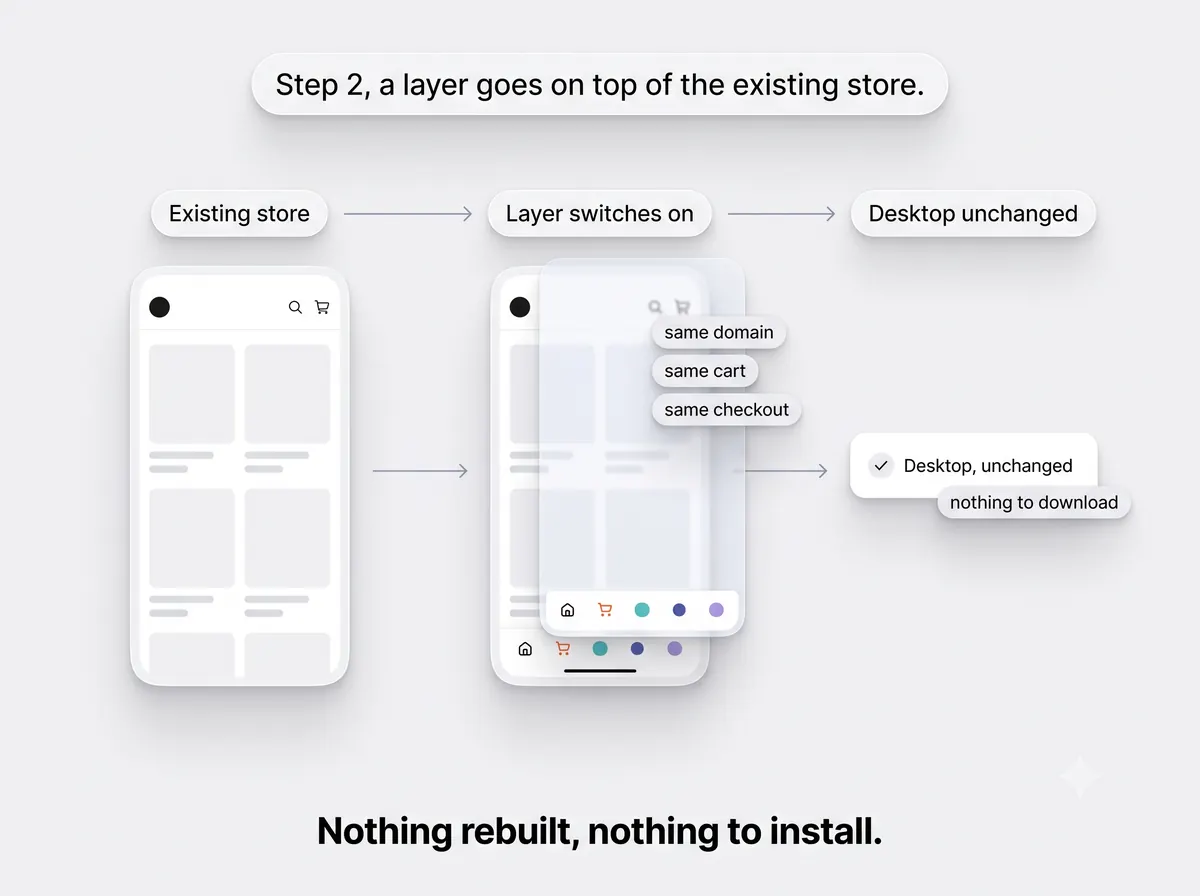
A mobile experience layer that keeps the existing ecommerce store, domain, products, cart, checkout and backend, but makes the storefront behave more naturally like a mobile shopping app when someone visits from a phone.

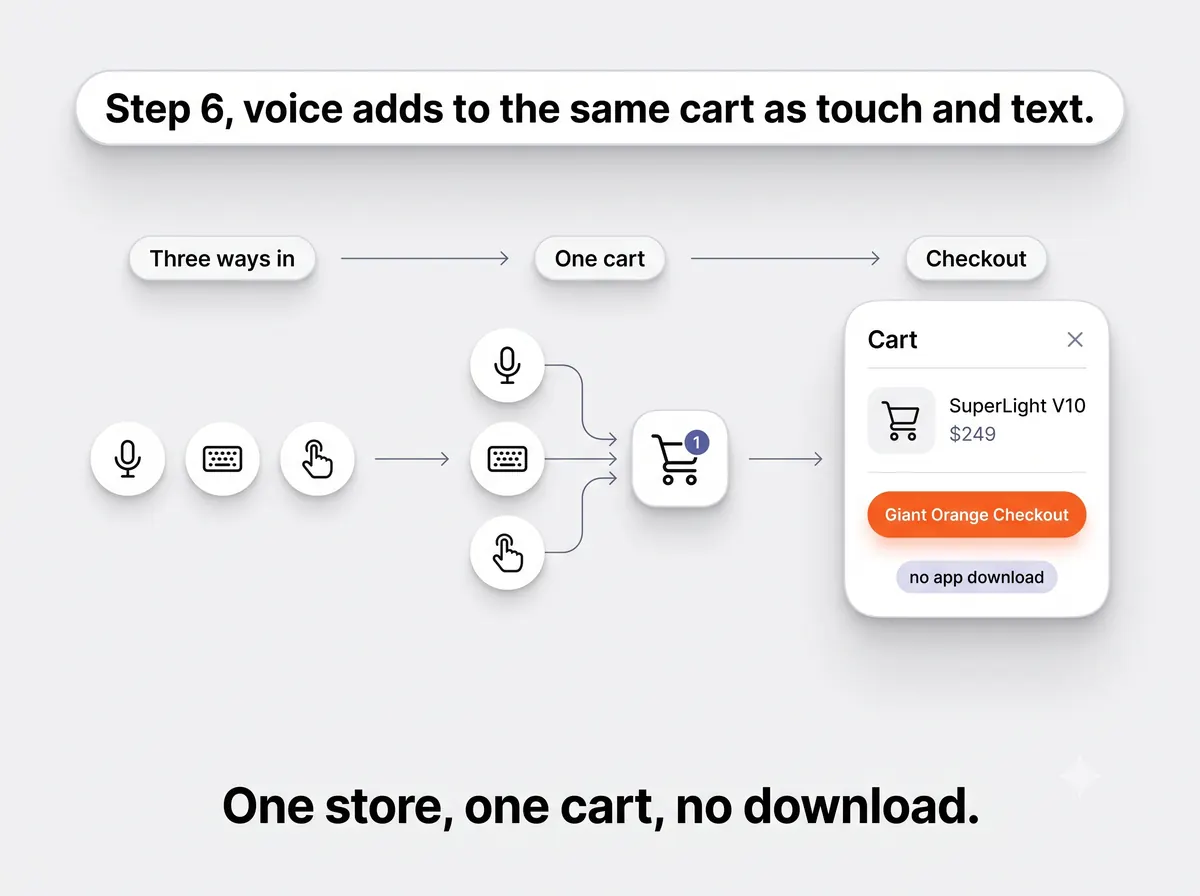
There is nothing to download and no separate app to maintain.

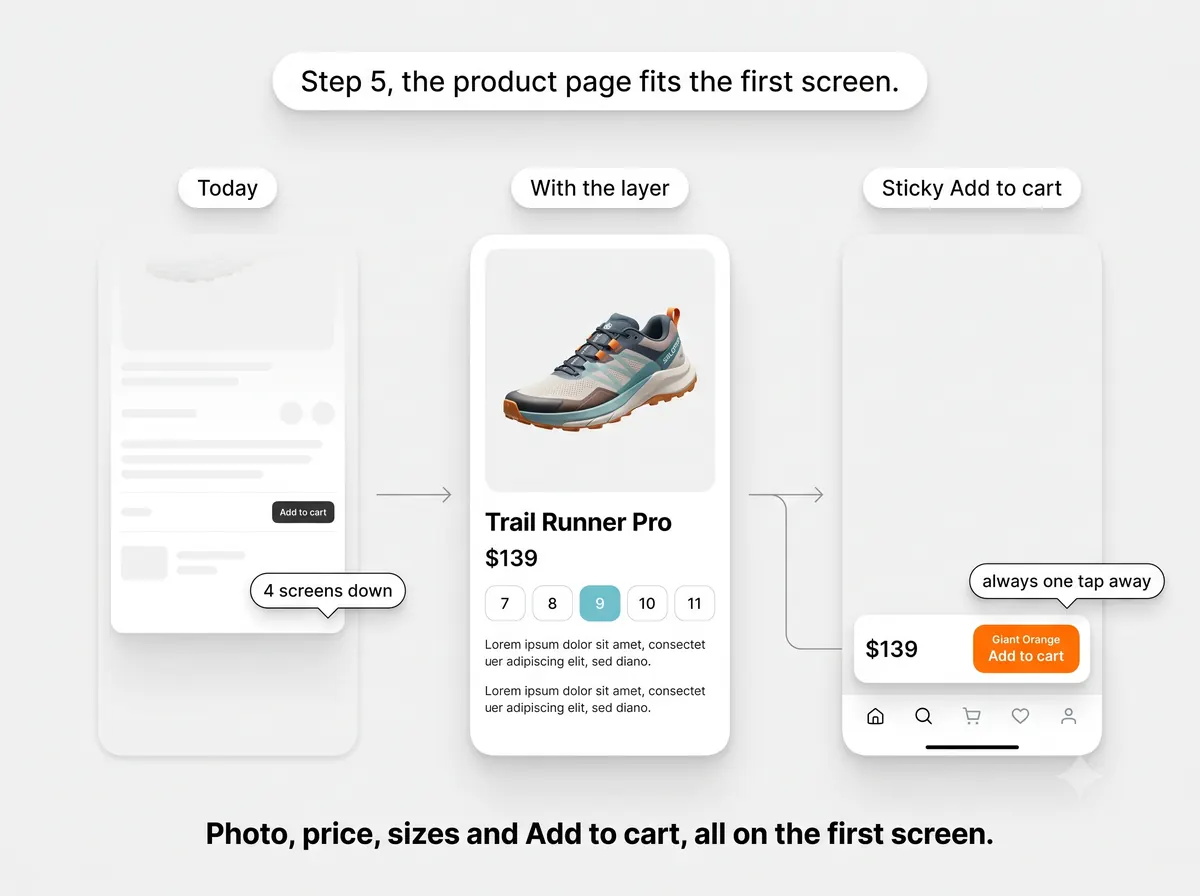
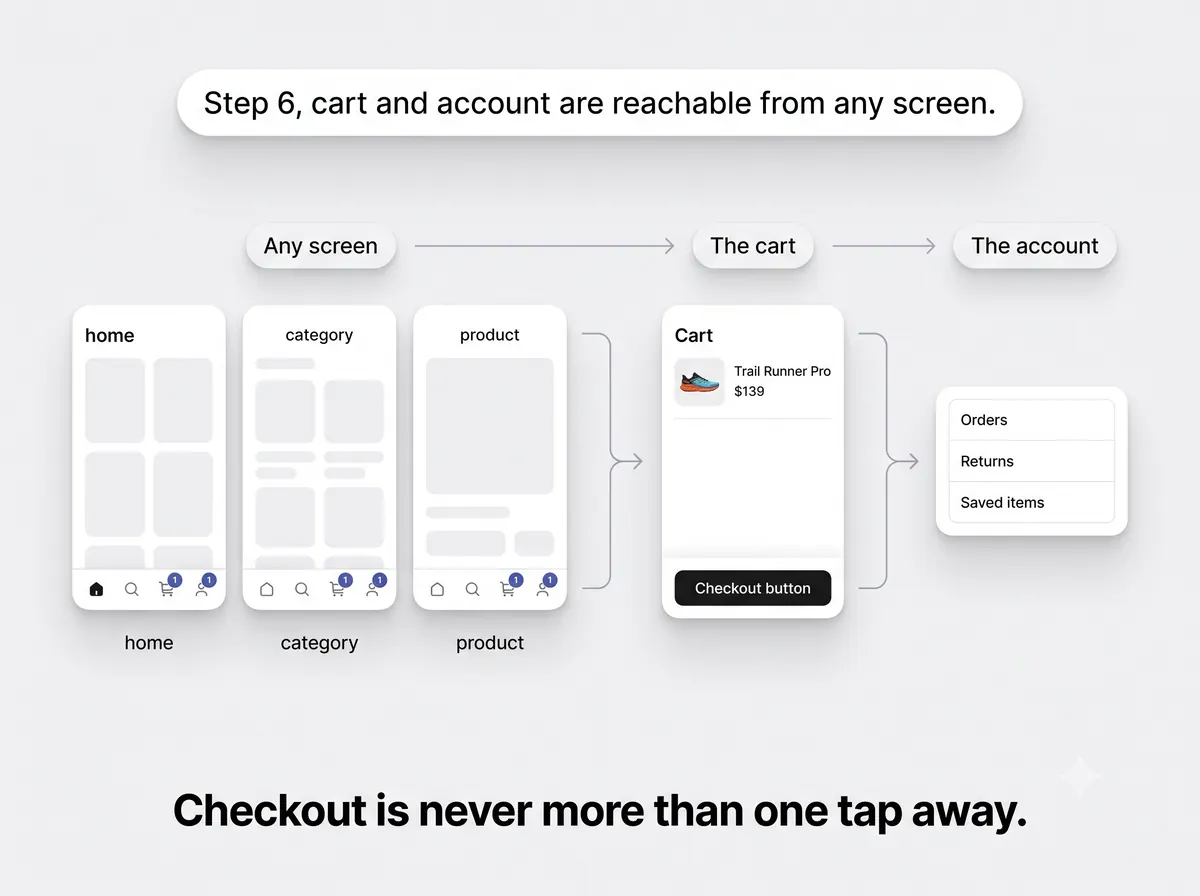
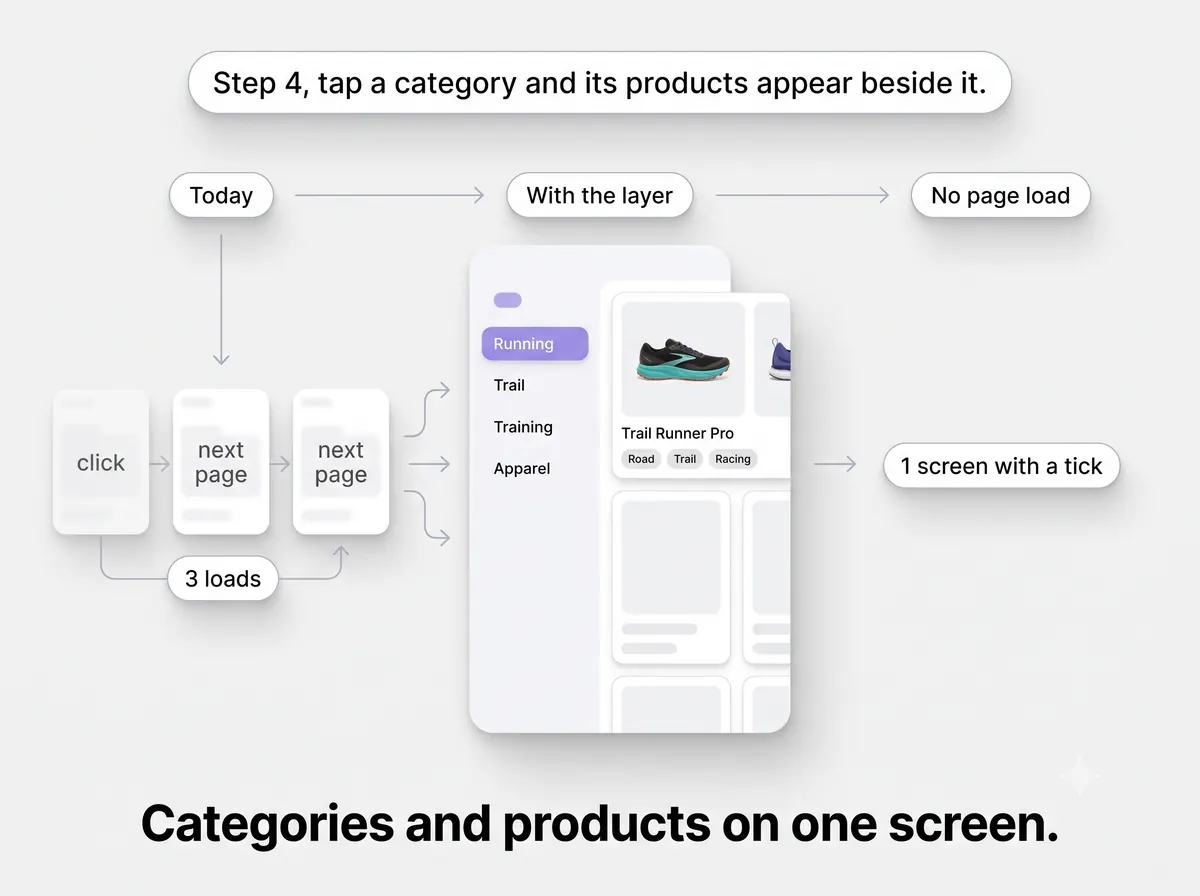
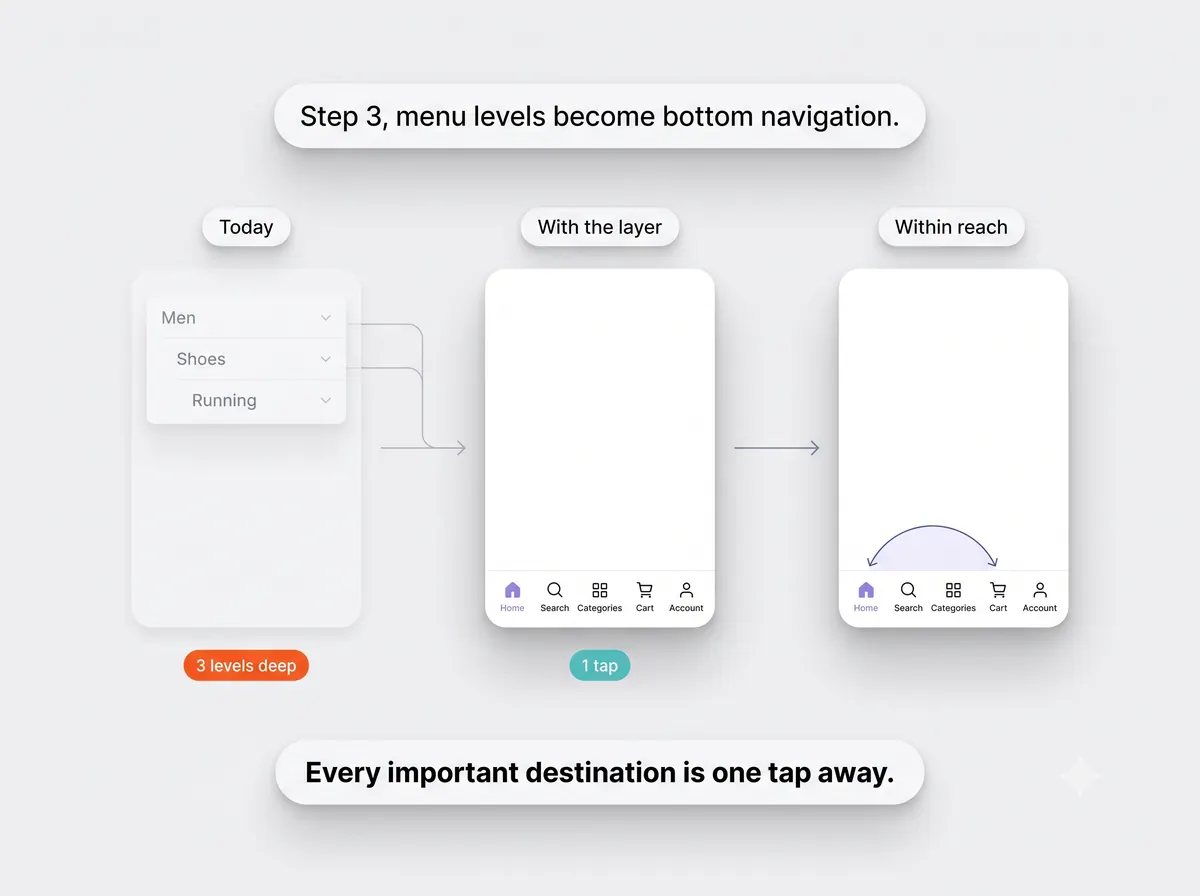
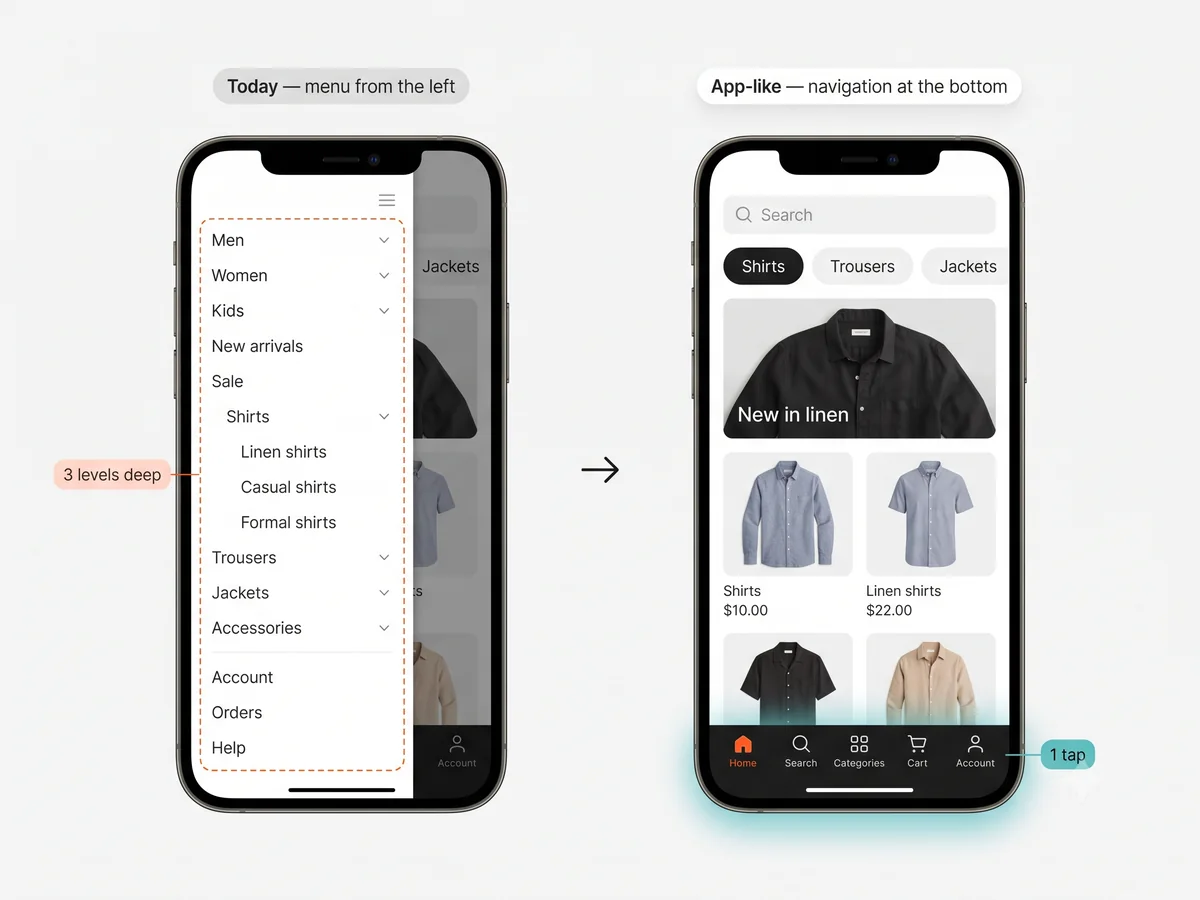
Bottom navigation for important destinations. Sticky Add to Cart. Touch-friendly controls instead of small links. Quick Search & Filters. Simplified categories with fewer navigation levels. Focused product layouts. Easy Cart & Account access from anywhere in the journey.

The purpose is simple: reduce the effort between opening the store and reaching the product or action the shopper wants.

The research behind it

RESEARCH PAPER

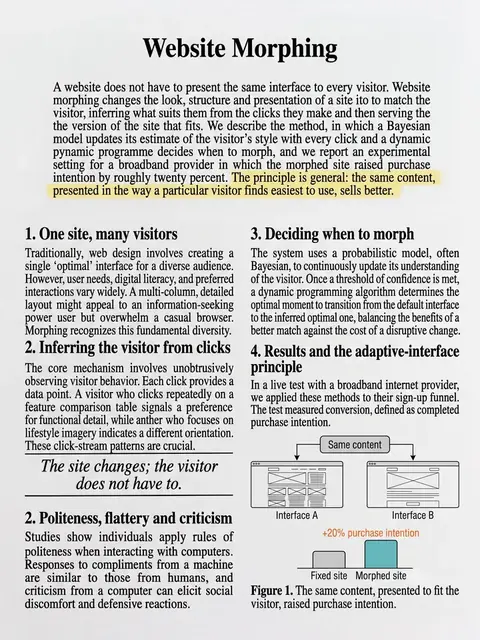
Website Morphing

MIT · adaptive interface principle

+20%purchase intention, almostEstimated in MIT’s experimental BT website setting

A website doesn’t need to present the exact same interface to every user. Its structure, navigation, tools and presentation can adapt to create a more suitable experience.

HOW WE APPLY ITInstead of adapting the interface to cognitive style, we apply the broader adaptive-interface principle to mobile context, changing how the existing storefront is presented and operated when the shopper is on a phone.
Impact 9/10
RESEARCH PAPER

Search Cost Theory

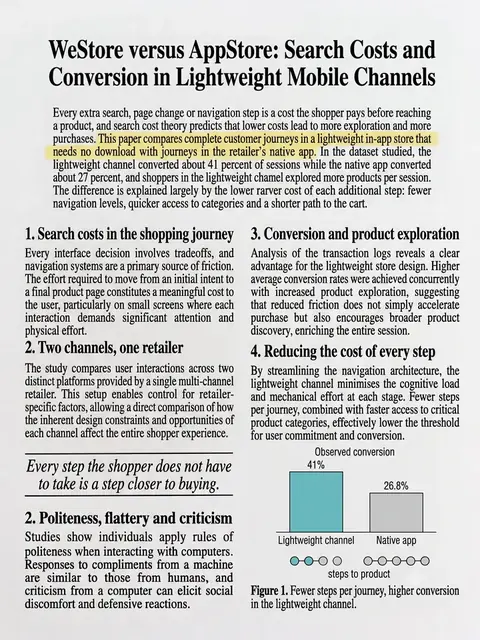
WeStore vs. AppStore research · lightweight WeChat channel vs. native app

41%observed conversion, lightweight channelIn the studied dataset
26.8%observed conversion, native-app channelIn the studied dataset

Shopping becomes harder when customers need too many searches, page changes or navigation steps to find what they want. The research examined these search costs across complete customer journeys and found greater product exploration in the lightweight channel.

HOW WE APPLY ITPersistent search, quicker categories, fewer navigation levels, easy filters and direct cart access reduce the effort required for each additional shopping step.
Impact 9/10
THEORY

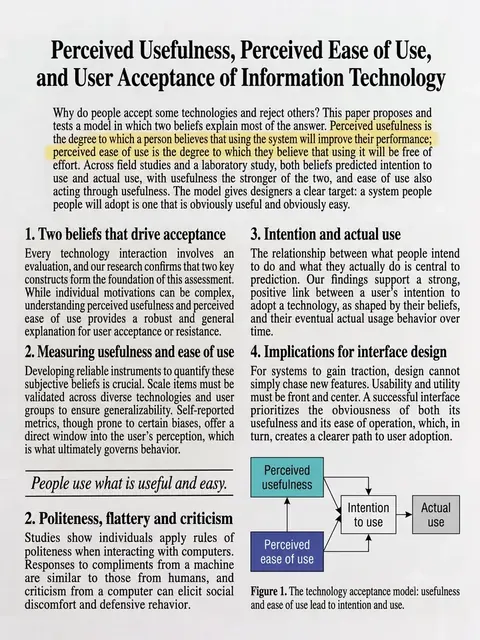
Technology Acceptance Model

MIT

Perceived usefulness and perceived ease of use influence whether people accept and continue using a technology.

HOW WE APPLY ITWe don’t make a website look like an app just for appearance. We use familiar mobile interaction patterns to make browsing, finding products and reaching the cart simpler and easier to understand.
Impact 8/10

How it works, step by step

Click any step, or swipe the panel for the next one.

The demo, step by step

Swipe for the next step

Swipe the demo or use the arrows for the next step. Click a step above to jump to it.

How it comes together

Open storeFind categoryFilterView productAdd to cart

Fewer unnecessary steps between opening the store and reaching what the shopper wants.

We make an existing ecommerce website automatically behave like a mobile-first shopping experience, reducing the effort to browse, find products and buy, without asking customers to download an app.

Journey stage 5: Purchase confidence

Confidence Booster Smart Reviews

Bring useful customer proof to the shopper instead of making them search for it.

What we created

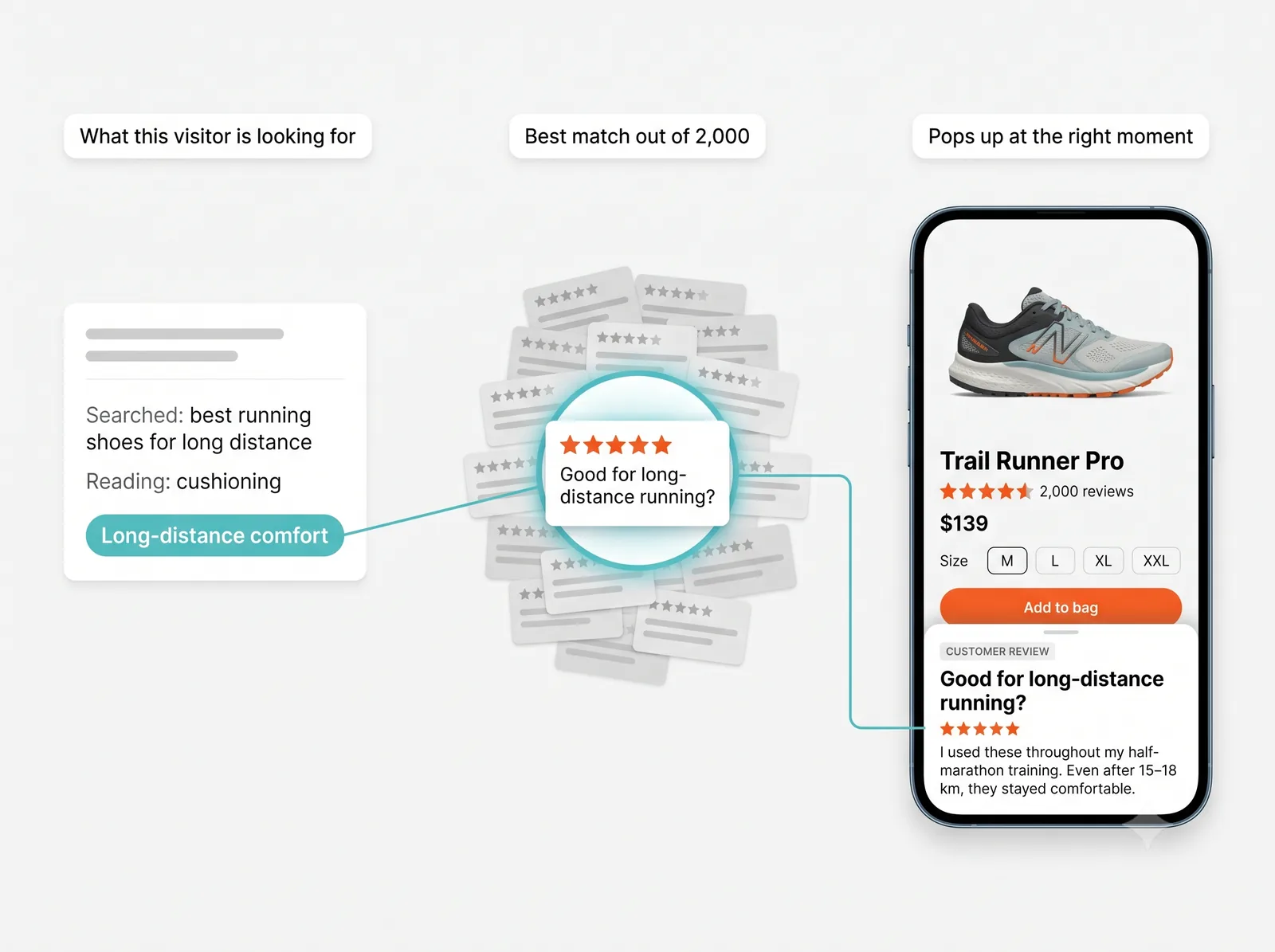
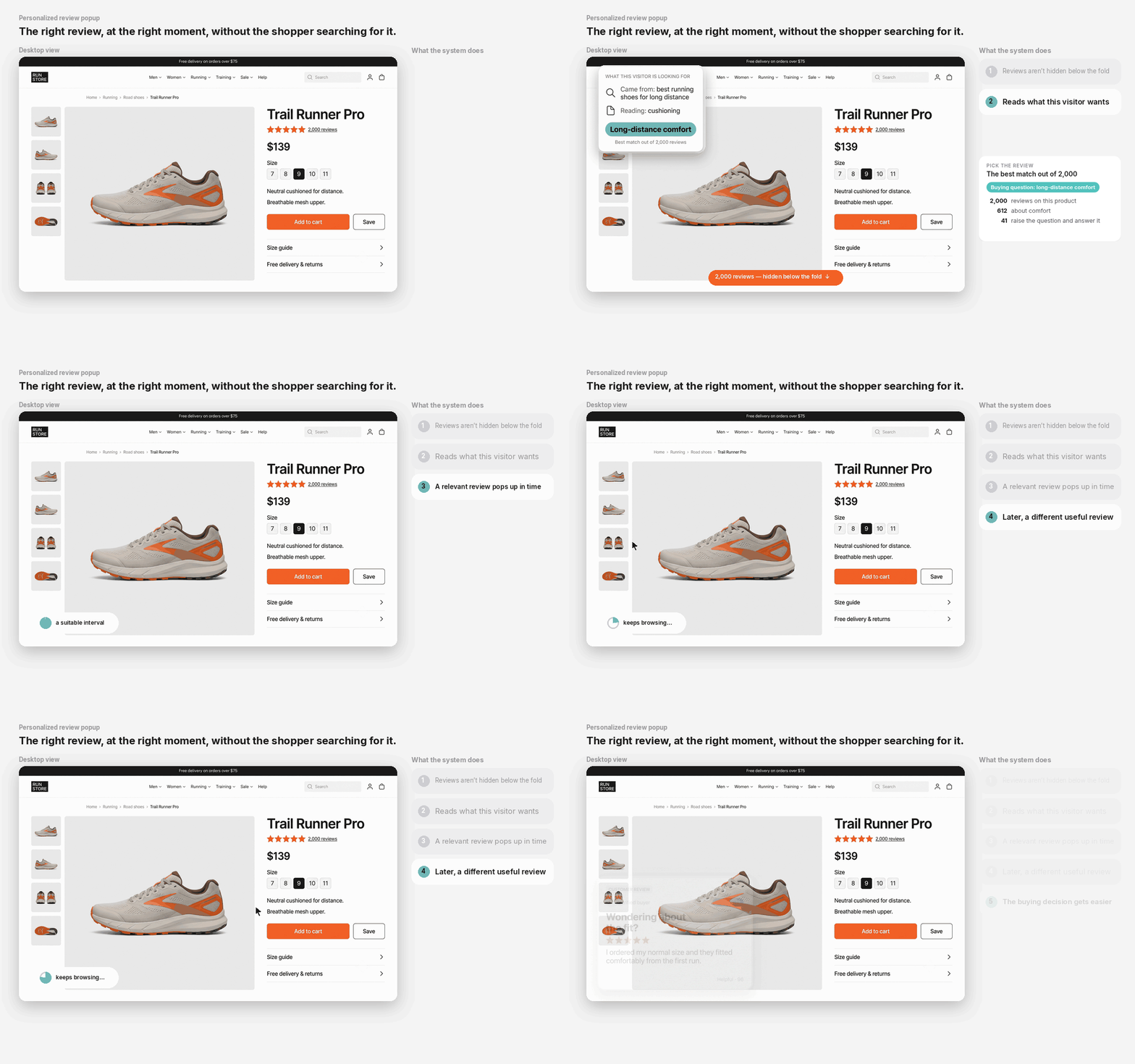
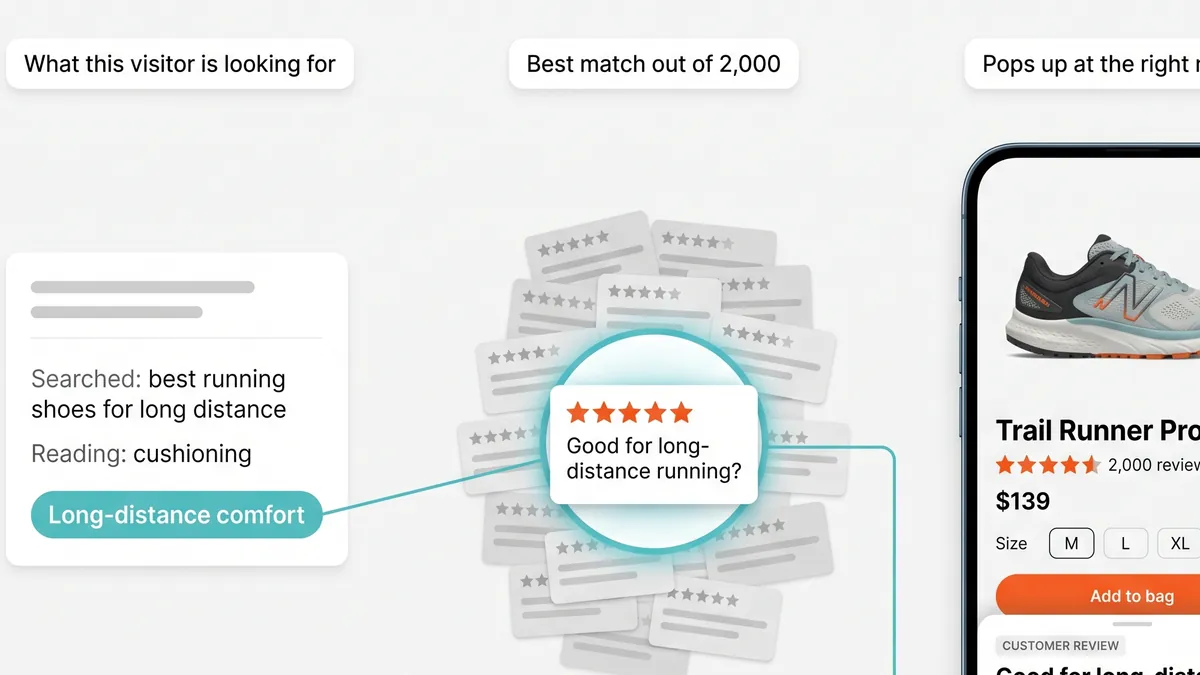
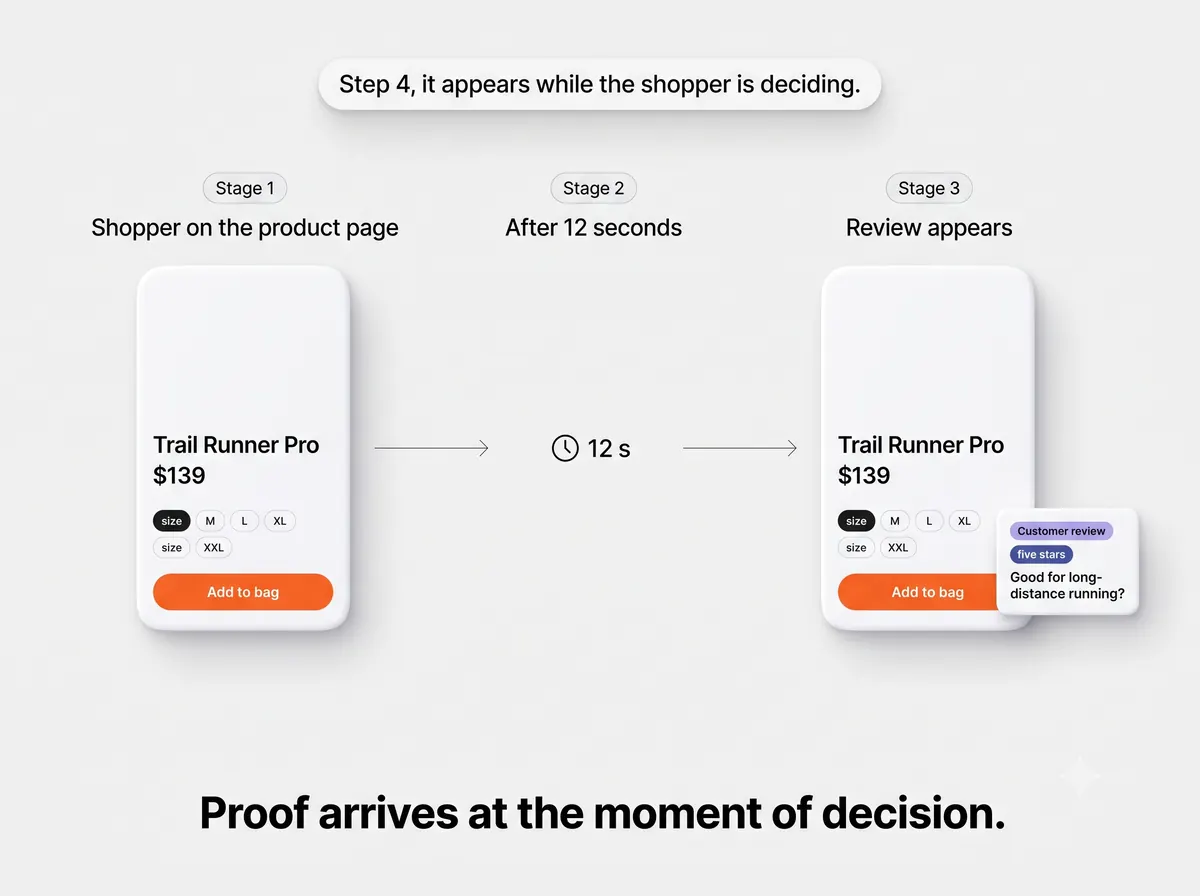
When a shopper lands on a product page, our system doesn’t leave hundreds of reviews hidden below the product. After a suitable time interval, it automatically pops up a relevant review.

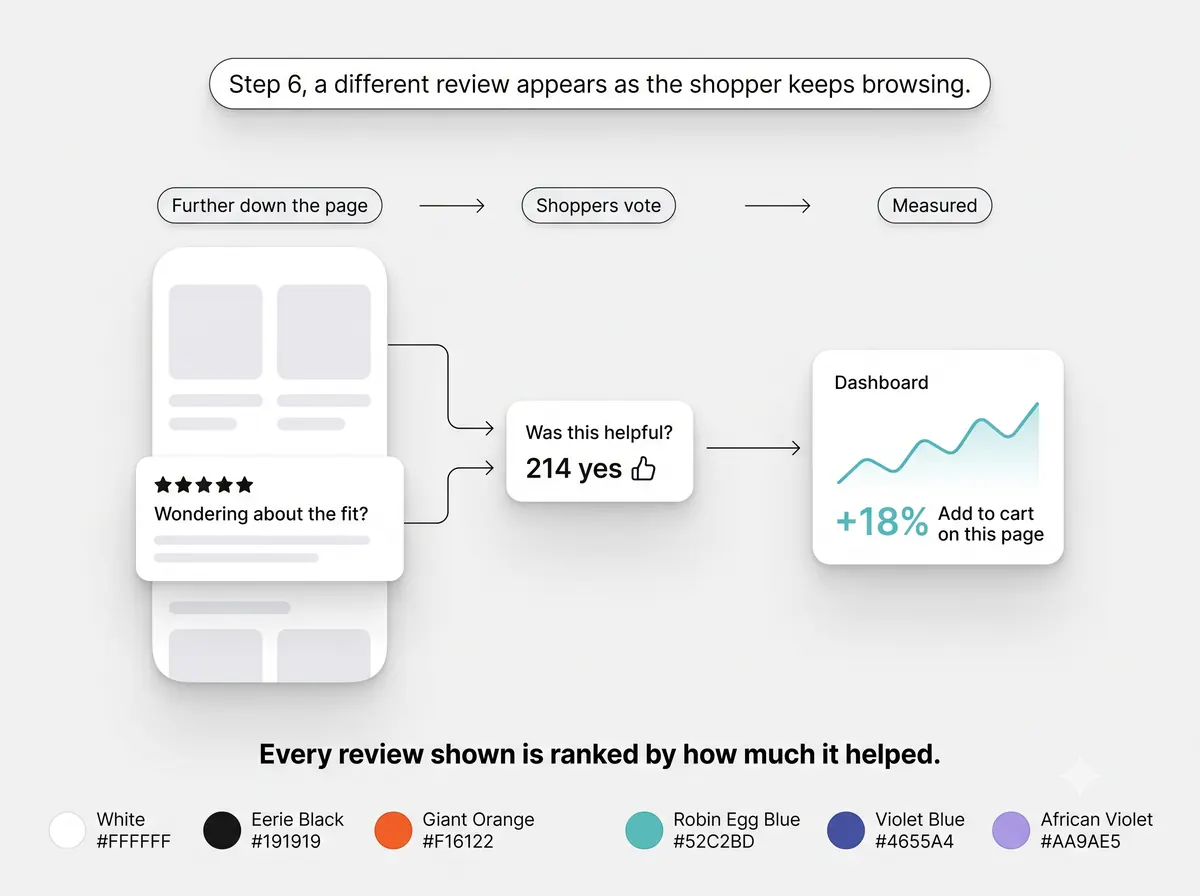
As the shopper continues browsing, another useful review can appear, showing different experiences, use cases or product benefits without requiring the customer to search through reviews manually.

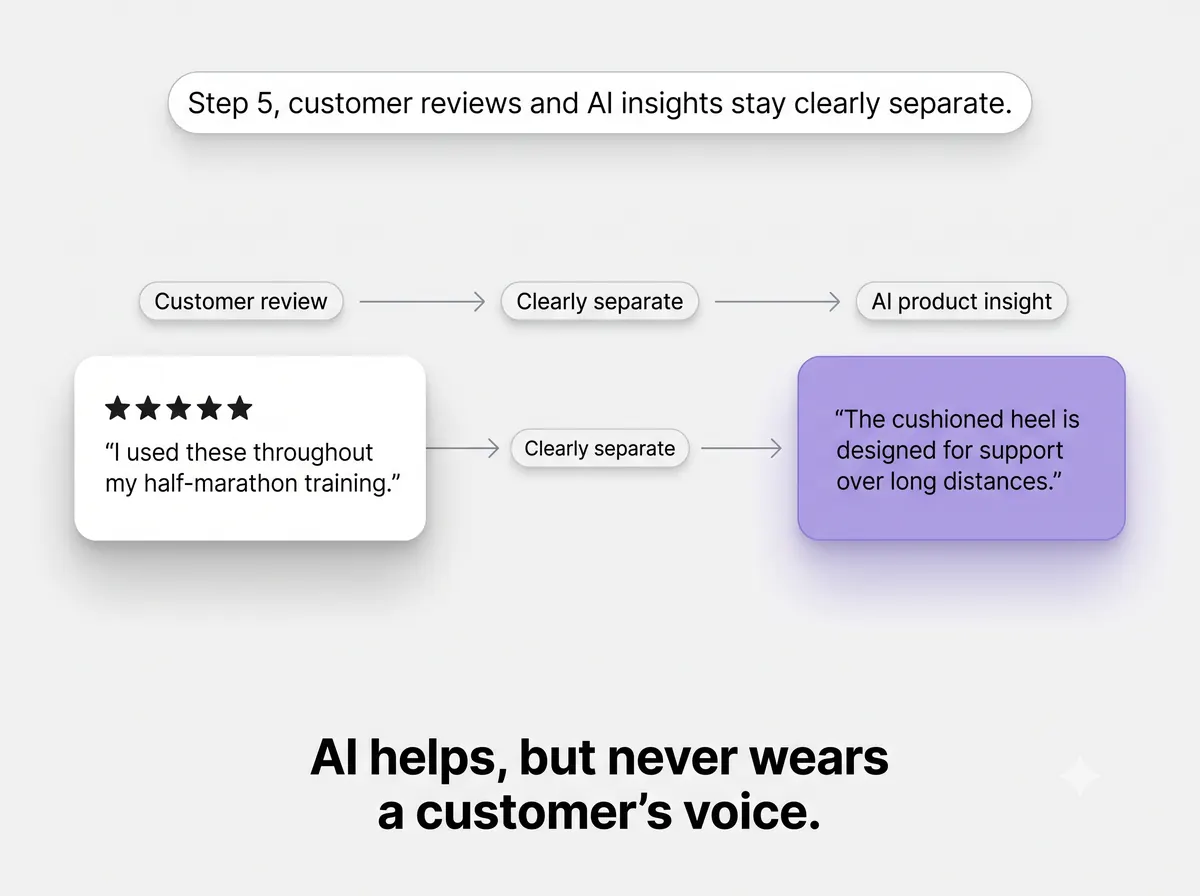
Real customer experience stays a Customer Review. AI interpretation stays an AI Product Insight.

The research behind it

RESEARCH PAPER

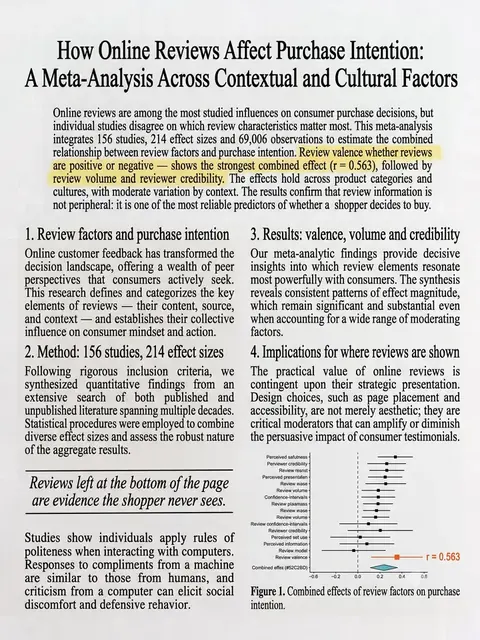
How Online Reviews Affect Purchase Intention: A Meta-Analysis Across Contextual and Cultural Factors

Keda Qiu & Liyi Zhang · Data and Information Management, 2024 · Principle: Online Review Influence

156studies
214effect sizes
69,006observations
r = 0.563review valence: strongest combined effect

The researchers found significant relationships between online-review factors and purchase intention.

HOW WE APPLY ITReviews shouldn’t be passive content sitting at the bottom of the page. We bring useful review information directly into the shopper’s product experience while the purchase is being considered.
Impact 9/10
RESEARCH PAPER

The Role of Review Structure in Perceived Helpfulness

Yingyue Luna Luan & Yeun Joon Kim · University of Queensland & University of Cambridge · Scientific Reports, 2026 · Principle: Review Helpfulness

195,675Amazon reviews analyzed

Perceived helpfulness depends not only on whether a review is positive or negative, but also on how its information is structured. Different review structures worked better depending on the product’s overall rating.

HOW WE APPLY ITWe don’t simply rotate random five-star reviews. The system can prioritize reviews that contain clear, useful information about different product concerns and use cases.
Impact 9/10
RESEARCH PAPER

Consumer Reactions to Perceived Undisclosed ChatGPT Usage in an Online Review Context

Clinton Amos & Lixuan Zhang · Telematics and Informatics, 2024 · Principle: Authenticity & Transparency

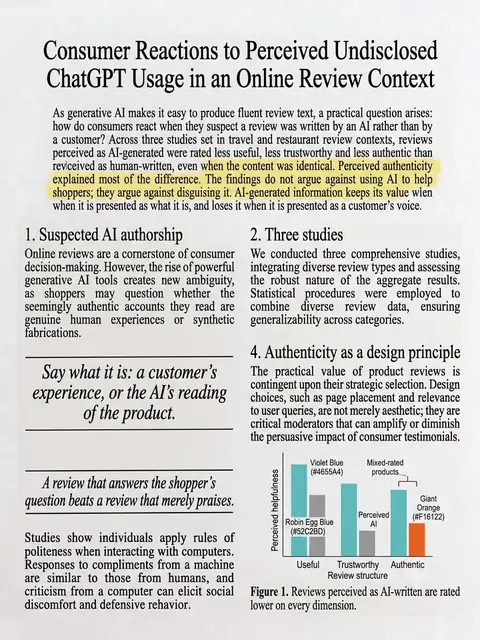
Across three studies using TripAdvisor and Yelp review settings, reviews perceived as ChatGPT-generated were rated less useful, less trustworthy and less authentic than human-generated reviews. Perceived authenticity helped explain those differences.

HOW WE APPLY ITAI can analyze product images, descriptions and specifications and generate useful supporting information, but we do not present that content as if a customer wrote it. That distinction protects the trust that makes reviews valuable in the first place.
Impact 9/10

How it works, step by step

Click any step, or swipe the panel for the next one.

The demo, step by step

Swipe for the next step

Swipe the demo or use the arrows for the next step. Click a step above to jump to it.

How it comes together

Shopper lands on the productRelevant customer review appears automaticallyDifferent useful reviews rotate over timeAI selects information relevant to different buying concernsAI-generated observations are clearly identifiedUseful proof, without searching hundreds of reviews

A smart review layer that brings relevant customer experiences into the product page at the right moments, with clearly separated AI Product Insights that make product information easier to understand.

Journey stage 2: Product recommendation

Decision Recall Product Recommendations

Research-backed personalization for returning shoppers.

What we created

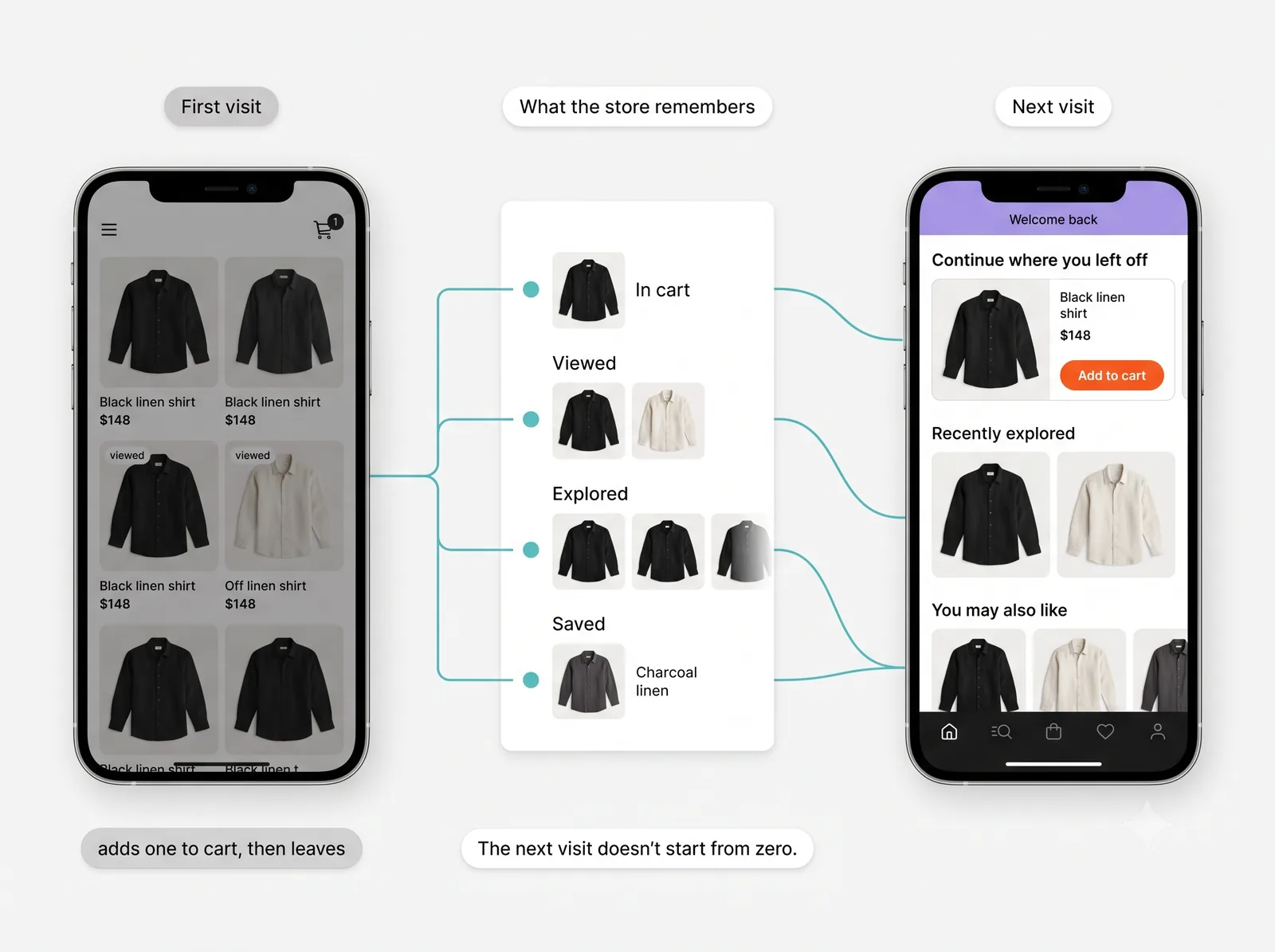
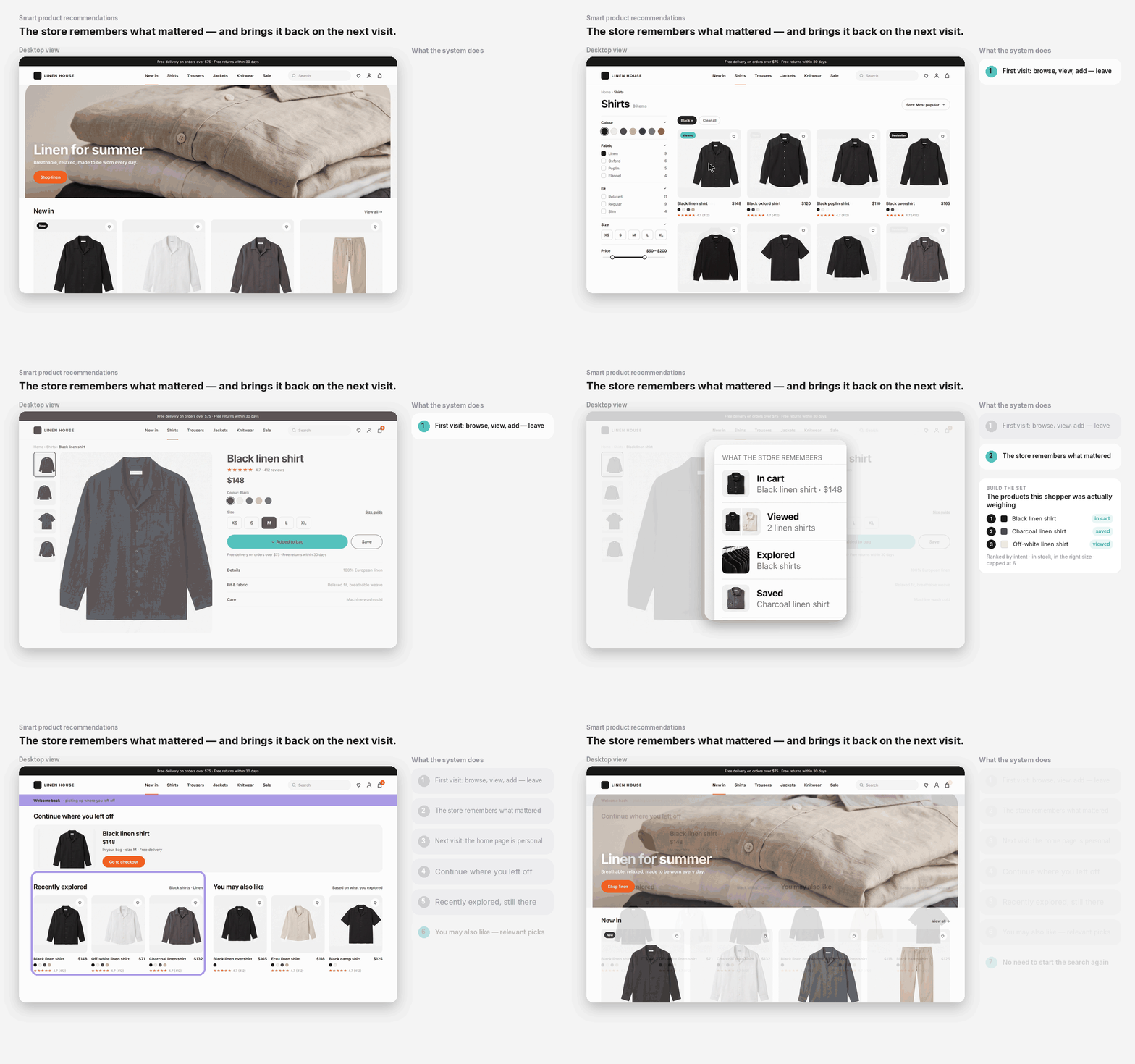
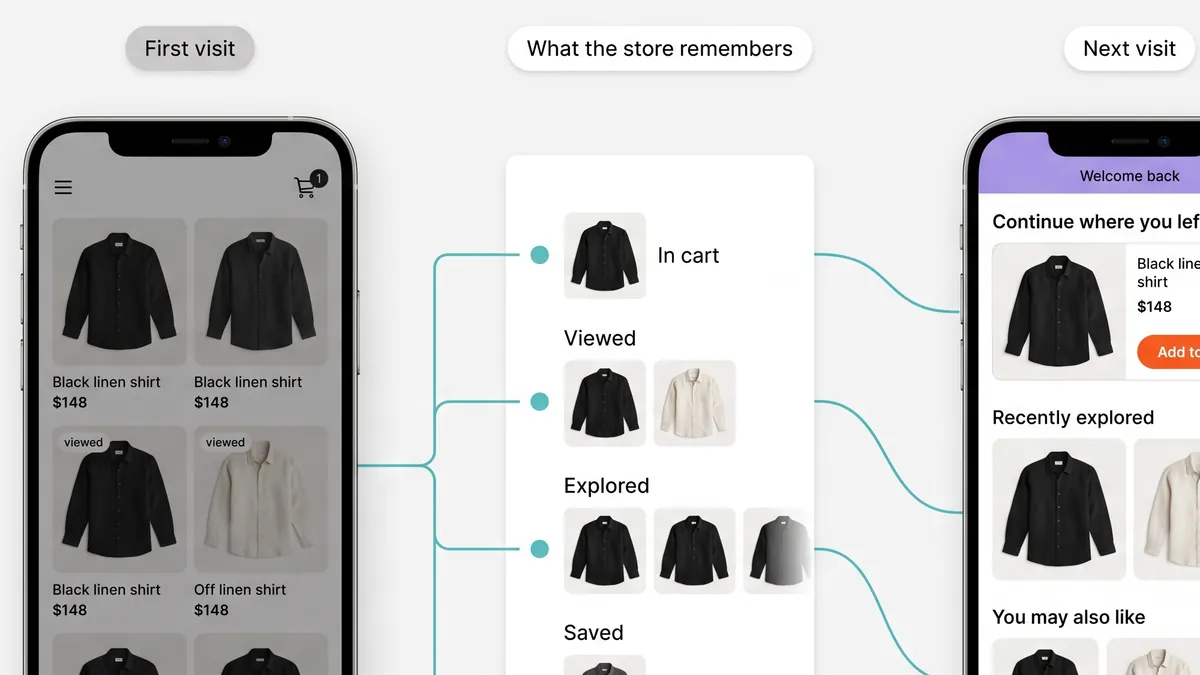
A recommendation system that uses a shopper’s previous activity to make their next visit more relevant.

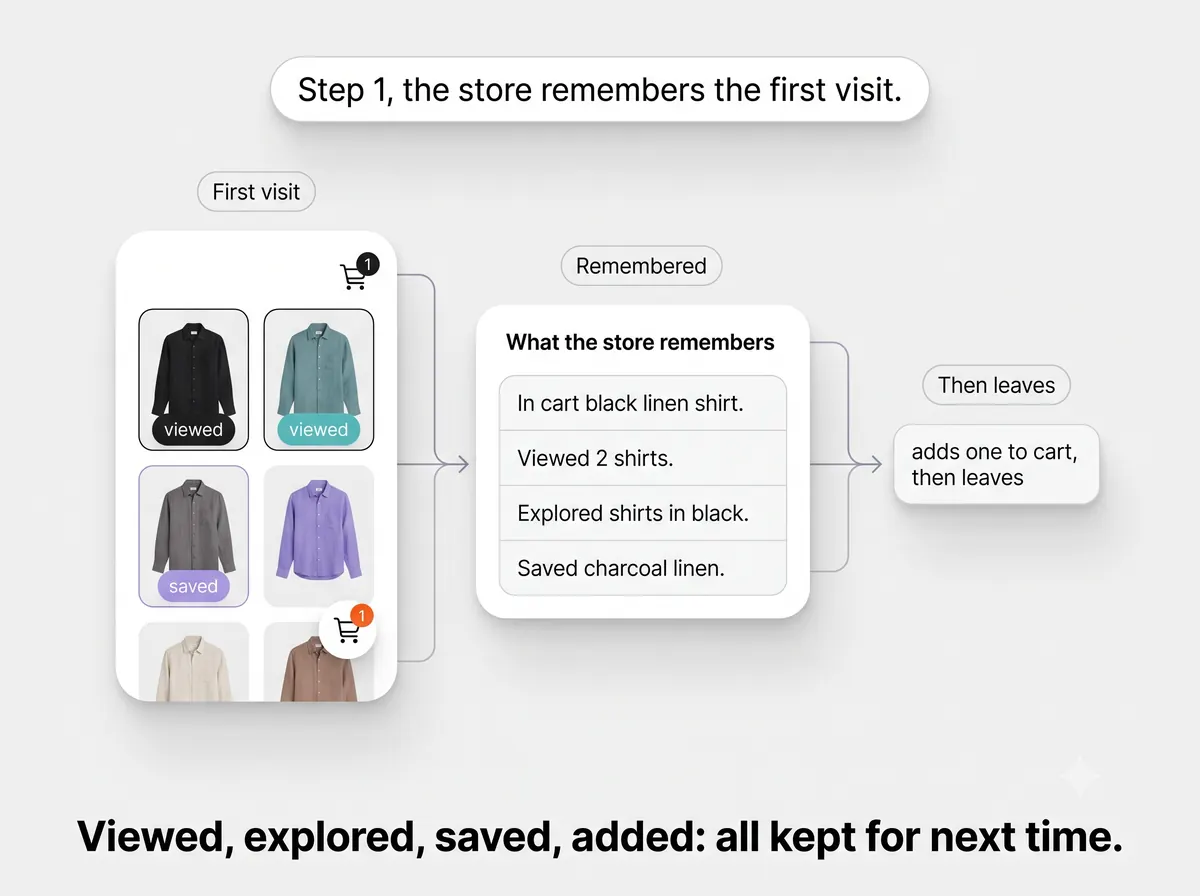
It can use products they previously viewed, explored, saved, or added to cart and bring the most relevant options back when they return.

The research behind it

THEORY

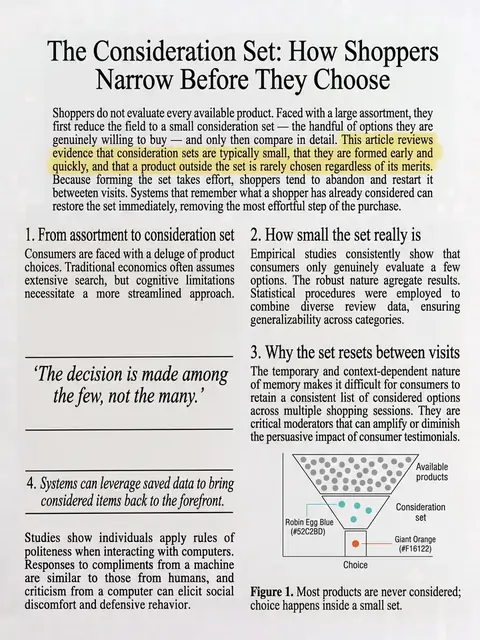
Consideration Set Effect

The research principle we use

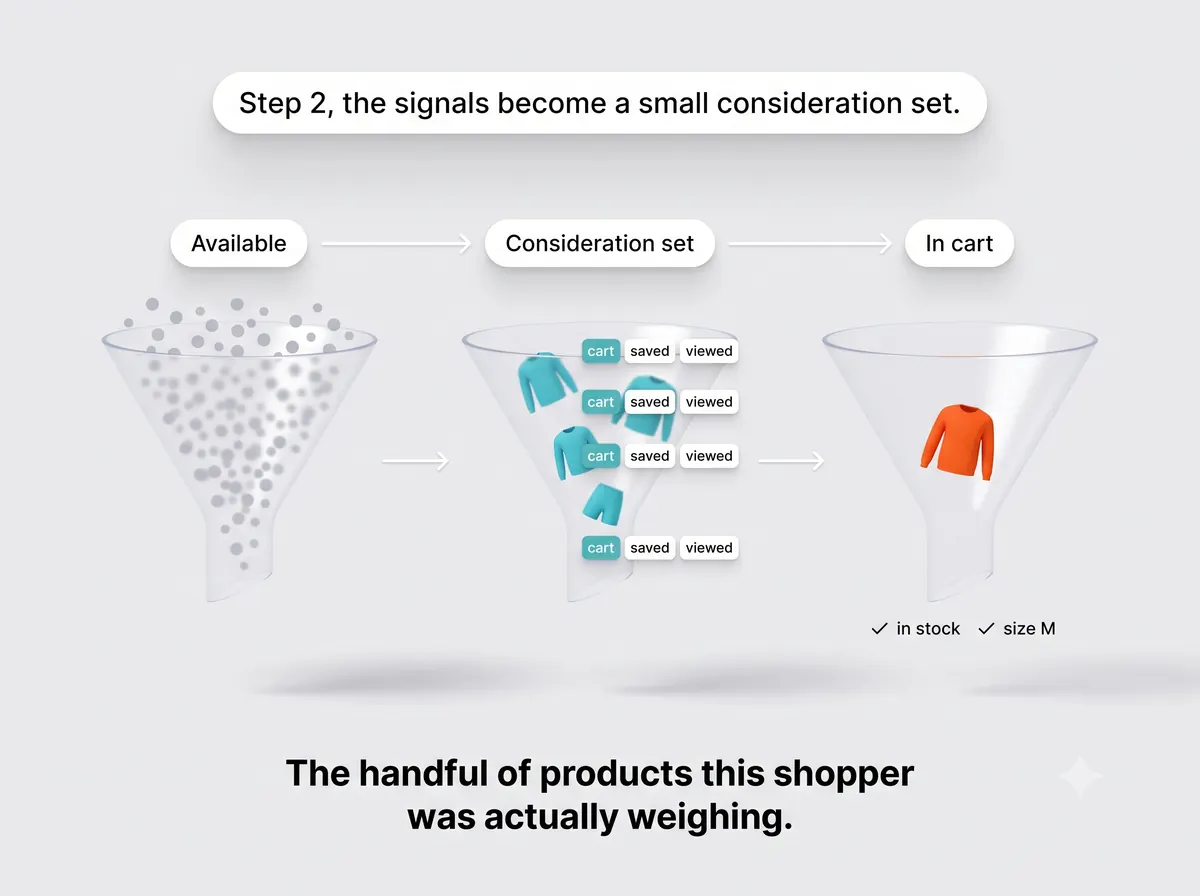
Shoppers don’t seriously consider every product in a store. They narrow their attention to a smaller set of relevant products before deciding what to buy.

OUR APPLICATIONOur recommendation system uses previous shopping behavior to help create that relevant set faster when the customer returns.
RESEARCH PAPER

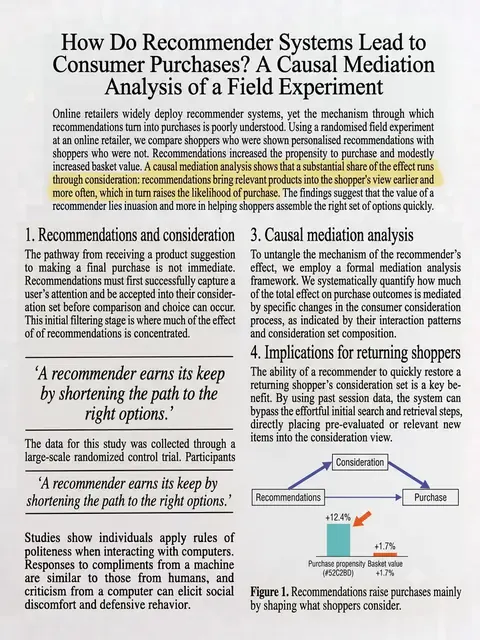
How Do Recommender Systems Lead to Consumer Purchases? A Causal Mediation Analysis of a Field Experiment

Xitong Li (HEC Paris) · Jörn Grahl (University of Cologne) · Oliver Hinz (Goethe University Frankfurt)

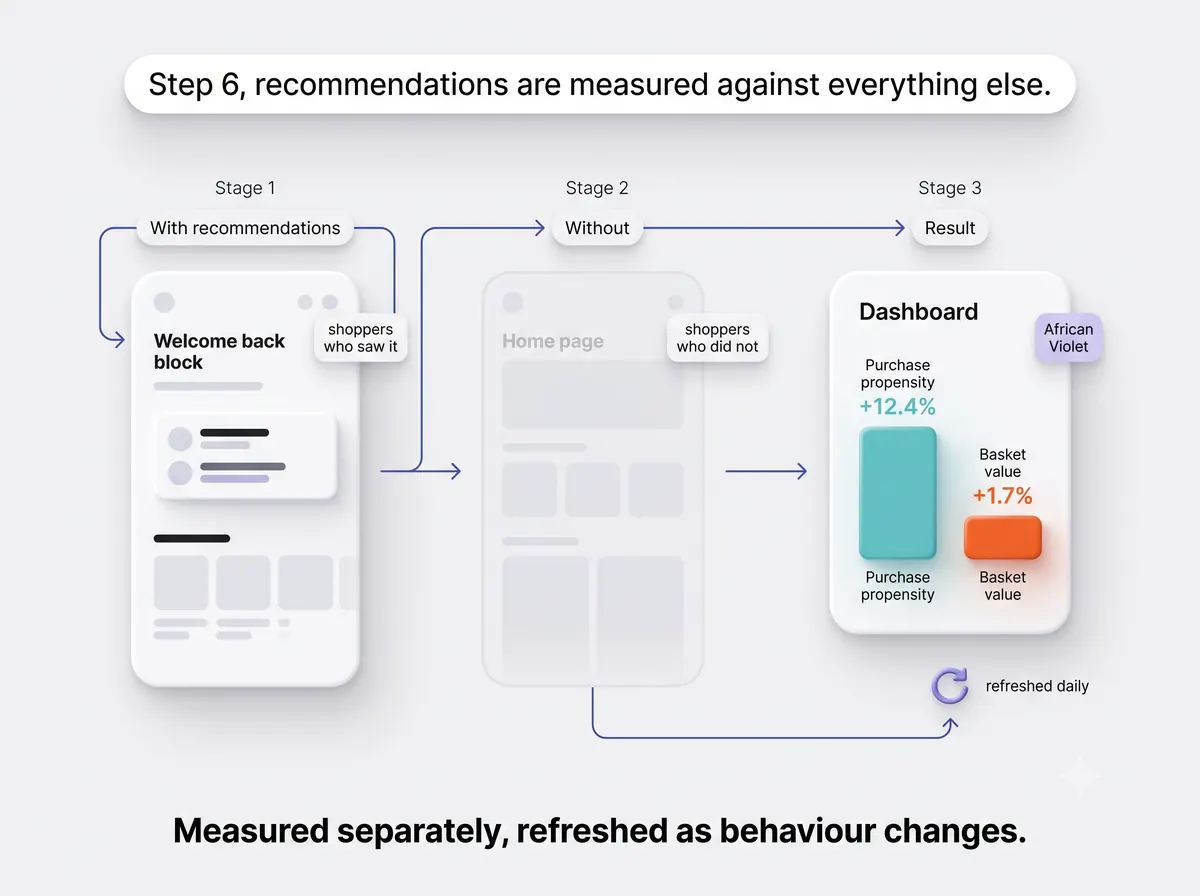
+12.4%purchase propensityIn the retailer studied
+1.7%basket valueIn the retailer studied
HOW WE APPLY ITWe make the store remember what mattered to the shopper before and use it to decide what products should matter when they come back.
Impact 9/10

How it works, step by step

Click any step, or swipe the panel for the next one.

The demo, step by step

Swipe for the next step

Swipe the demo or use the arrows for the next step. Click a step above to jump to it.

How it comes together

Smaller relevant setRemember previous interestViewed, explored, saved, cartBring relevant products back

The store remembers what mattered to the shopper before, and uses it to decide what should matter when they come back.

Pricing

Pay for the tools you use.

Every tool runs on your existing store: same domain, same cart, same checkout. Start with one, add the rest as the numbers prove out.

Plans

Prices in USD per store, billed monthly. Setup is a one-time fee that covers implementation and the research-backed configuration of each tool. Cancel any time.

Tool by tool

Three tools run on AI tokens: the AI shopping assistant, the voice assistant and smart reviews. Click a row to see its cost.

Every plan includes

Implementation

We install and configure the tools on your existing store. No rebuild, no separate app, nothing for your customers to download.

Research-backed setup

Each tool is configured on the principles shown on its page, not defaults.

Monthly report

What each tool did, what it changed, and the numbers behind it.

Support

A named contact, adjustments as your catalogue and campaigns change.

Fix the biggest leak first. Add the next when the numbers prove it.

Book a walkthrough
Research

The research behind 10turtle

Fourteen peer-reviewed papers and two frameworks. Each of the six tools applies two or three of them, and every one below answers the same four questions.

How to read this

1. What the paper is

Who wrote it, where it was published, what they tested.

2. What we took from it

The finding, in plain words.

3. Where we used it

The tool, the journey stage and the exact feature.

4. How we used it

What the tool does differently because of this finding.

The two frameworks the AI Shopping Assistant also builds on, Jobs to Be Done and the Means-End Chain, are summarised in that section with the same four questions.

Overview: paper to tool

All 14 papers and the two frameworks at a glance, in the order the tools appear in the deck. Click a title to jump to its summary.

#PaperInstitutions · Published inTool (journey stage)What we took from it
1GEO: Generative Engine OptimizationIIT Delhi, Princeton University · KDD 2024 (ACM SIGKDD)GEO
Stage 1: Product discovery
Statistics, citations, quotes, clarity and authority make a page more likely to be cited by AI engines; keyword stuffing does not
2Concrete LanguageYork University (Schulich), Wharton (University of Pennsylvania) · Journal of Consumer Research, 2020AI Shopping Assistant
Stage 3: Product exploration
Specific, concrete words make customers feel understood and buy more
3Processing FluencyPrinceton University · Psychological Bulletin (APA), 2008AI Shopping Assistant
Stage 3: Product exploration
Information that is easier to process is judged more favourably
4Voice Assistant, Buy Coffee Capsules!LMU Munich, University of Münster · The DATA BASE for Advances in Information Systems (ACM SIGMIS), 2023Voice Shopping
Stage 4: Conversational shopping
People use voice shopping for convenience and enjoyment; reliability and control decide whether they keep using it
5Media Equation TheoryUniversity of Minnesota, Cal Poly Pomona · Journal of Global Fashion Marketing, 2023Voice Shopping
Stage 4: Conversational shopping
People respond socially to systems that communicate like humans; human-likeness and trust drive purchase intention
6Social Presence and TrustUniversity of Portsmouth, University of Winchester · Psychology and Marketing, 2021Voice Shopping
Stage 4: Conversational shopping
Consistent speaking and listening behaviour builds social presence, which builds trust and acceptance of recommendations
7Website MorphingMIT Sloan School of Management · Marketing Science (INFORMS), 2009Mobile Experience
Stage 6: Frictionless purchase
A site does not have to show everyone the same interface; adapting it raises purchase intention
8Search Cost Theory (WeStore vs. AppStore)Vanderbilt University (Owen), Ohio State University (Fisher) · SSRN working paper, JD.com dataMobile Experience
Stage 6: Frictionless purchase
Fewer searches, page loads and navigation steps mean more exploration and more conversion
9Technology Acceptance ModelMIT Sloan School of Management · PhD dissertation, 1985Mobile Experience
Stage 6: Frictionless purchase
People adopt what is useful and easy to use, not what merely looks new
10How Online Reviews Affect Purchase Intention: A Meta-AnalysisWuhan University · Data and Information Management (Elsevier), 2024Smart Reviews
Stage 5: Purchase confidence
Reviews measurably move purchase intention, so they should not sit unread at the bottom of the page
11The Role of Review Structure in Perceived HelpfulnessUniversity of Queensland, University of Cambridge (Judge) · Scientific Reports (Nature Portfolio), 2026Smart Reviews
Stage 5: Purchase confidence
How a review is structured decides how helpful it is, and the best structure depends on the product’s rating
12Consumer Reactions to Perceived Undisclosed ChatGPT Usage in an Online Review ContextWeber State University · Telematics and Informatics (Elsevier), 2024Smart Reviews
Stage 5: Purchase confidence
Reviews that look AI-written lose trust, so AI content must never pose as a customer
13Consideration Set EffectMIT Sloan School of Management · Journal of Consumer Research, 1990Recommendations
Stage 2: Product recommendation
Shoppers narrow to a small set before choosing; help them build that set faster
14How Do Recommender Systems Lead to Consumer Purchases?HEC Paris, University of Cologne, Goethe University Frankfurt · Information Systems Research (INFORMS)Recommendations
Stage 2: Product recommendation
Recommendations raise purchase propensity and basket value by making the store remember what mattered
F1Jobs to Be Done
Framework
Harvard Business School · The Innovator’s Solution (2003); “Know Your Customers’ ‘Jobs to Be Done’”, Harvard Business Review, 2016AI Shopping Assistant
Stage 3: Product exploration
Customers hire a product to get a specific job done; the job, not the customer’s profile, predicts what they buy
F2Means-End Chain Theory
Framework
University of Southern California · Journal of Marketing (AMA), 1982AI Shopping Assistant
Stage 3: Product exploration
A product attribute matters only through the consequence it produces and the personal value that consequence serves
Stage 1: Product discovery

GEO

One paper drives the whole GEO method: it tells us which page changes make AI engines cite a product page, and which do not.

Paper 1 of 14GEO · Stage 1: Product discovery

GEO: Generative Engine Optimization

Indian Institute of Technology Delhi and Princeton University · KDD 2024, the ACM SIGKDD conference, a top peer-reviewed venue in data mining · Tested on a 10,000-query benchmark across 25 domains and on a live generative engine (Perplexity.ai).

What the paper is. Aggarwal, Murahari, Rajpurohit, Kalyan, Narasimhan and Deshpande (IIT Delhi and Princeton), published at KDD 2024. They built GEO-bench, a benchmark of 10,000 real queries across 25 domains, and tested nine ways of rewriting a web page to see which ones made generative engines (including Perplexity.ai) surface and cite that page more. Three changes work best: adding credible citations, adding quotations and adding statistics. They raised visibility by 30 to 40% on the position-adjusted word count metric and 15 to 30% on subjective impression.

1. What we took from it

  • Three changes work best: adding credible citations, adding quotations and adding statistics. They raised visibility by 30 to 40% on the position-adjusted word count metric and 15 to 30% on subjective impression.
  • Making the text clearer and easier to read also helped, by 15 to 30%. Engines reward presentation, not only content.
  • Keyword stuffing, the classic SEO trick, does not work for AI engines.
  • Which method works best varies by domain, so pages need targeted changes, not one template.

2. Where we used it

The GEO page: the research card, the “How we apply it” line, and step 7 of the ten-step method (“GEO methods”). It also sits behind the Product discovery tile on the Journey page.

3. How we used it

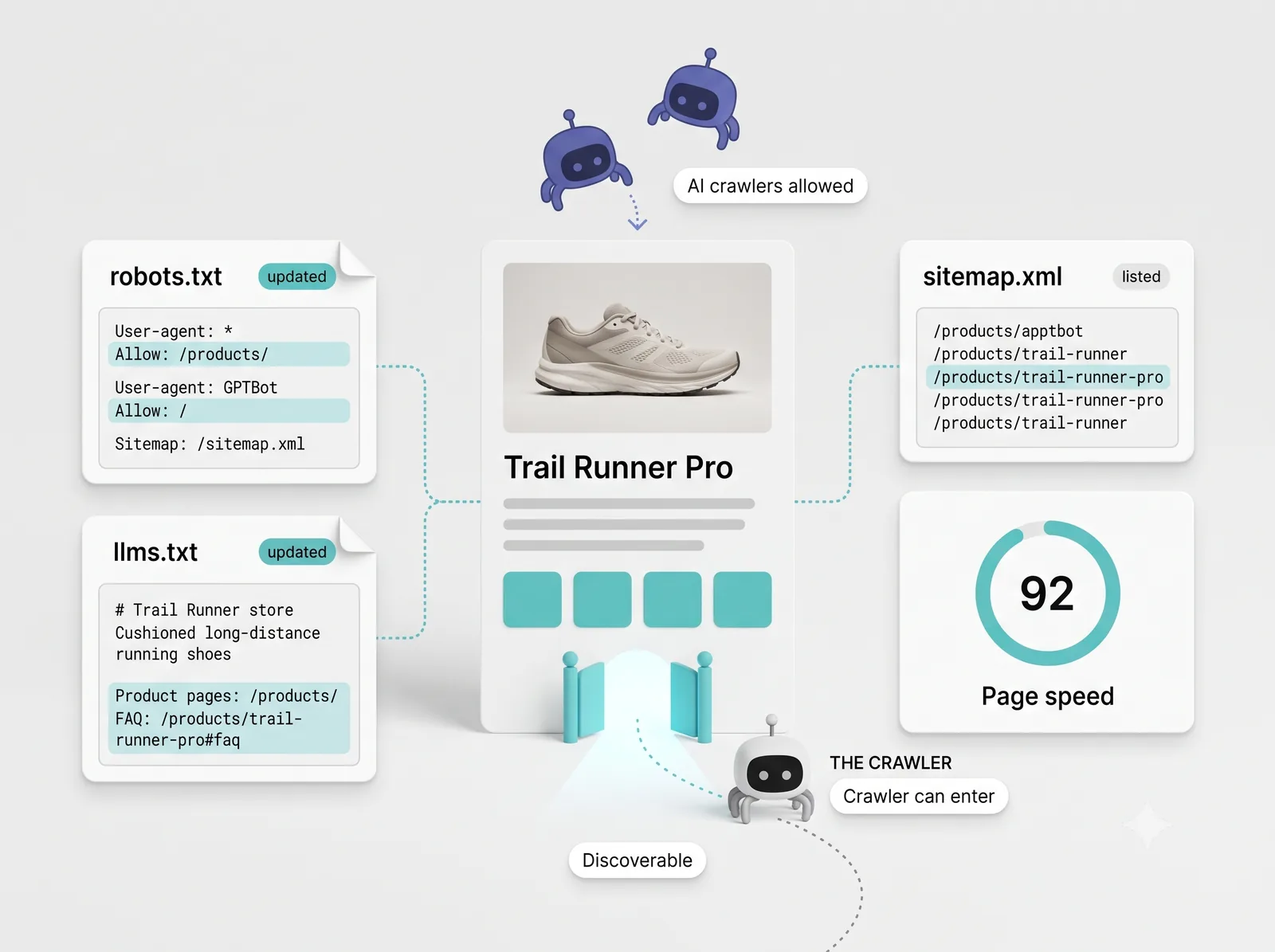
Steps 1 to 6 of our method find what a product page is missing (audit, select pages, understand the page, competitors, search trends, find the gap). Step 7 fixes the gap using only the paper’s proven methods: relevant statistics, credible sources, useful quotations, clearer wording and a more authoritative tone, and never extra keywords. Step 8 applies those changes to the page and adds conversational FAQs, step 9 checks crawl access, sitemap, speed and AI access, and step 10 re-audits so the before-and-after is measured the way the paper measured it. Because the paper found results differ by domain, we audit each page instead of applying one fixed formula.

Engines reward presentation, not only content.
30–40%visibility gain from citations, quotations and statistics
15–30%gain from clearer, easier-to-read text
10,000queries in the benchmark, across 25 domains
Figure. Key numbers from the paper, and from how the tool applies it.
Stage 3: Product exploration

AI Shopping Assistant

Two papers shape how the assistant talks: one says use concrete facts, the other says make the decision easy to process. Two frameworks, Jobs to Be Done and the Means-End Chain, shape what it talks about; both are summarised below the papers.

Paper 2 of 14AI Shopping Assistant · Stage 3: Product exploration

Concrete Language

Schulich School of Business, York University, and The Wharton School, University of Pennsylvania · Journal of Consumer Research, 2020, one of the leading peer-reviewed journals in marketing · Five studies, including more than 1,000 real customer-service conversations from two companies.

What the paper is. “How Concrete Language Shapes Customer Satisfaction” by Grant Packard (York University) and Jonah Berger (Wharton), Journal of Consumer Research, 2020. Five studies, including text analysis of over 1,000 real customer-service conversations (phone calls and emails) from two companies, plus controlled experiments. Customers are more satisfied, more willing to buy and spend more when the employee speaks concretely (“that grey linen shirt”, not “that item”).

1. What we took from it

  • Customers are more satisfied, more willing to buy and spend more when the employee speaks concretely (“that grey linen shirt”, not “that item”).
  • One standard deviation more concreteness raised satisfaction by 9% and actual spending by at least 13% in the field data.
  • The reason: concrete words signal that the employee listened and understood the customer’s specific need.

2. Where we used it

The AI Shopping Assistant page, research card 3, and step 5 of its method (“Explain why”). The vacuum example on the page (“2.5 kg”, not “lightweight”) is this paper in one line.

3. How we used it

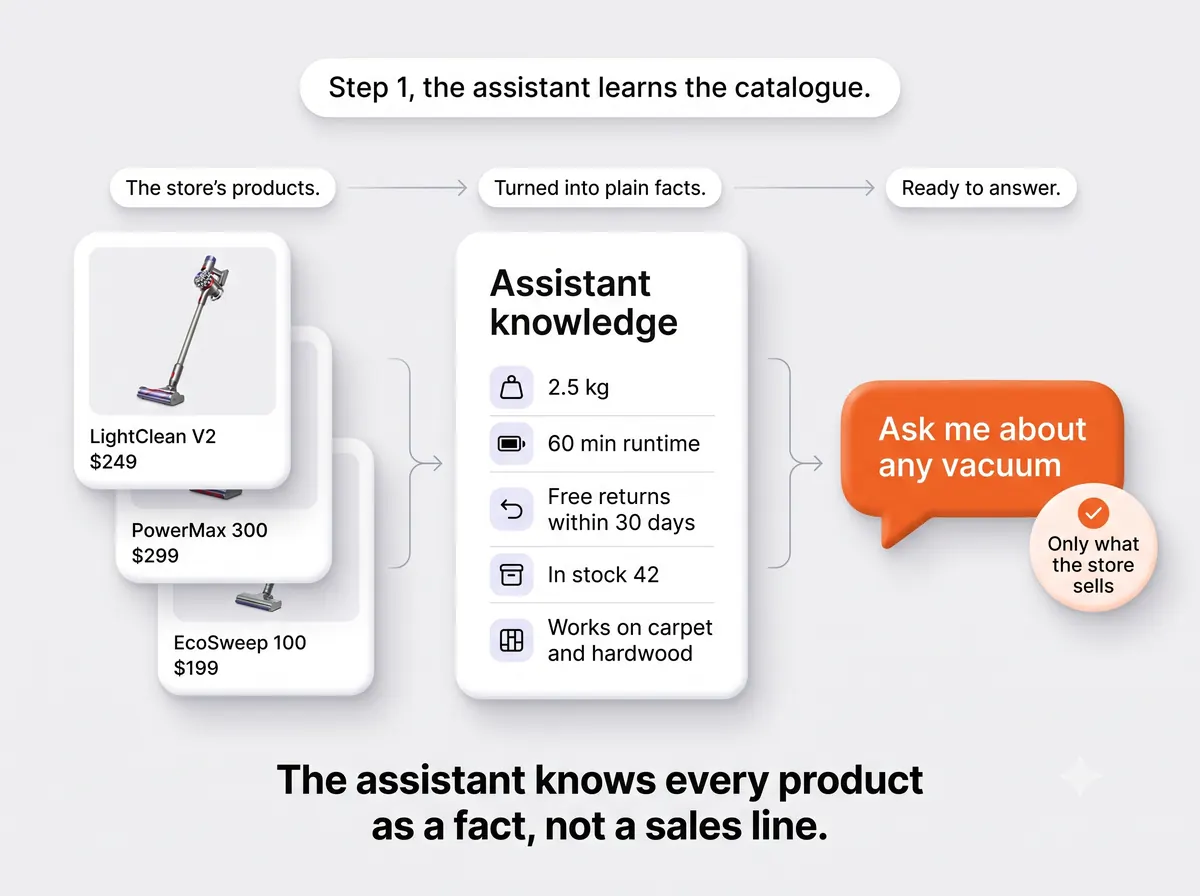
The assistant is set up to speak only in verified catalogue facts: in step 1 every spec is turned into a plain fact (2.5 kg, 60 minutes of runtime), and in step 5 the explanation uses numbers instead of adjectives. In step 3 the assistant states the shopper’s need back in their own concrete terms before recommending anything, which is exactly the listening signal the paper found behind the effect.

Concrete words signal that the employee listened and understood.

+9%satisfaction per standard deviation of concreteness
+13%actual spending, at least, in the field data
1,000+real customer-service conversations analysed
Figure. Key numbers from the paper, and from how the tool applies it.
Paper 3 of 14AI Shopping Assistant · Stage 3: Product exploration

Processing Fluency

Princeton University, Department of Psychology · Psychological Bulletin, 2008, the American Psychological Association’s flagship review journal · A review that organises decades of judgment and decision-making research into one framework.

What the paper is. Anuj Shah and Daniel Oppenheimer (Princeton), “Heuristics Made Easy: An Effort-Reduction Framework”, Psychological Bulletin, 2008. A review paper that explains how people judge and decide when they cannot weigh every fact: they cut effort by looking at fewer cues, using cues that are easy to access and process (fluency), simplifying how they weigh them, integrating less information and comparing fewer alternatives. People do not compute; they reach for the easiest-to-process information and judge from that.

1. What we took from it

  • People do not compute; they reach for the easiest-to-process information and judge from that.
  • A fact that is easy to grasp carries more weight in a decision than a fact that is technically better but harder to process.
  • Fewer options and fewer cues make a decision feel easier and get made.

2. Where we used it

The AI Shopping Assistant page, research card 4, and steps 4 and 5 of its method (“Find the match”, “Explain why”). The line “Half the weight of your current vacuum” on the page is this principle.

3. How we used it

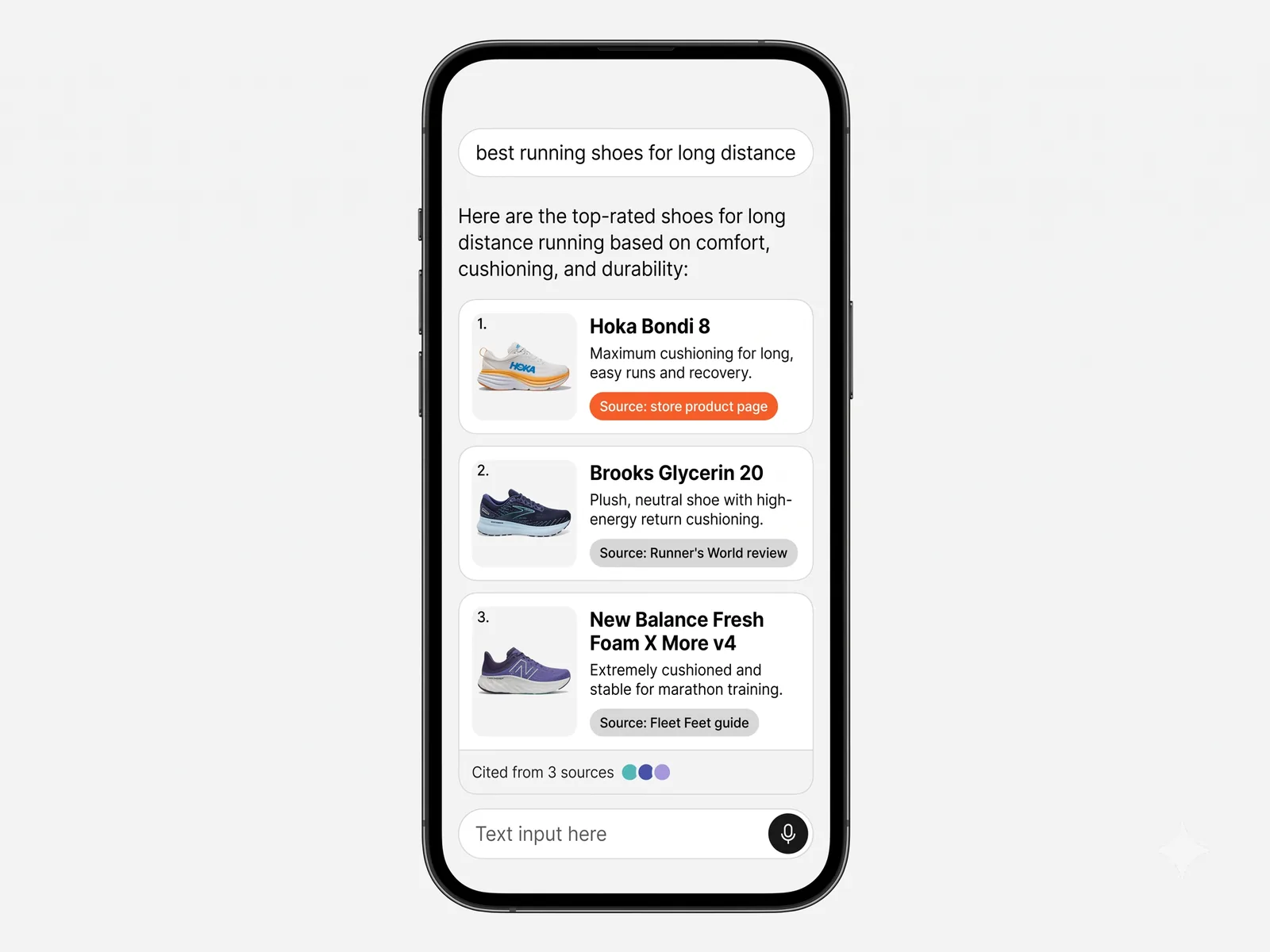
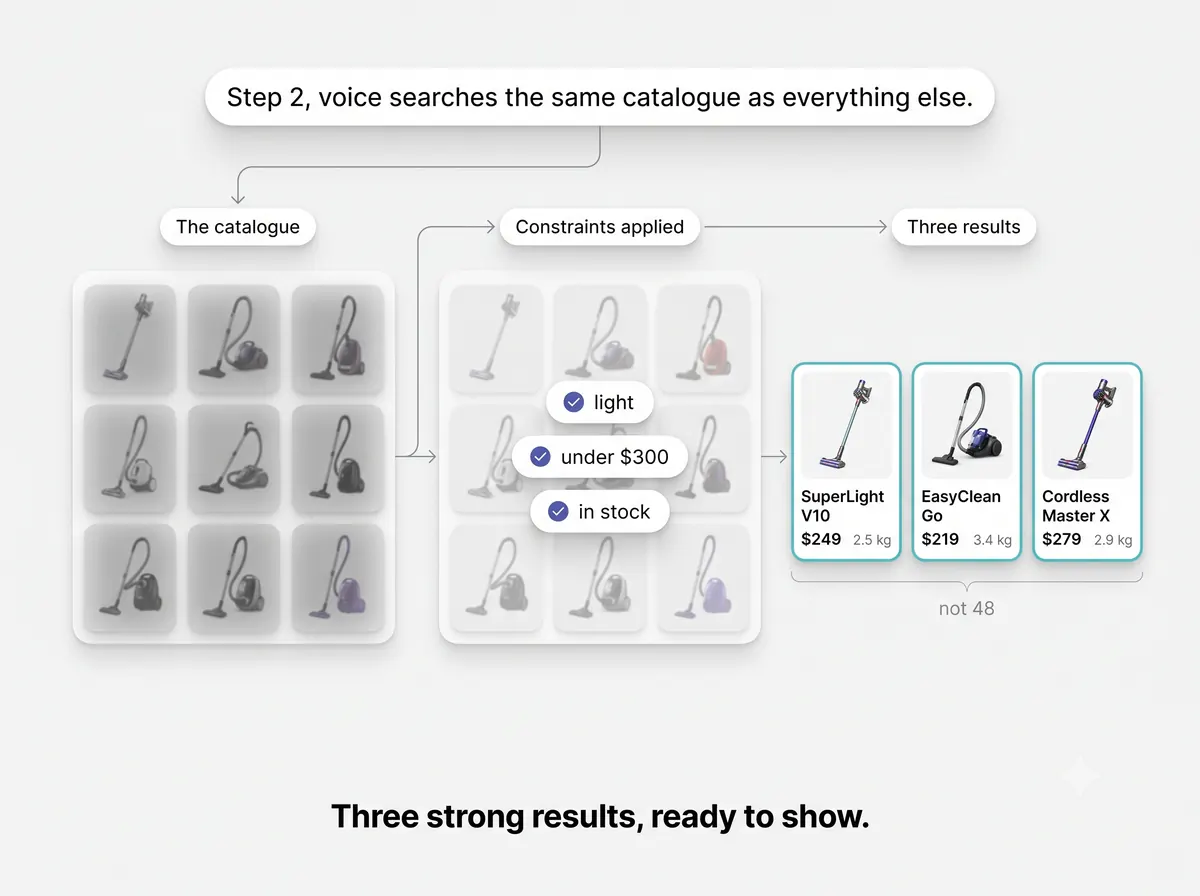
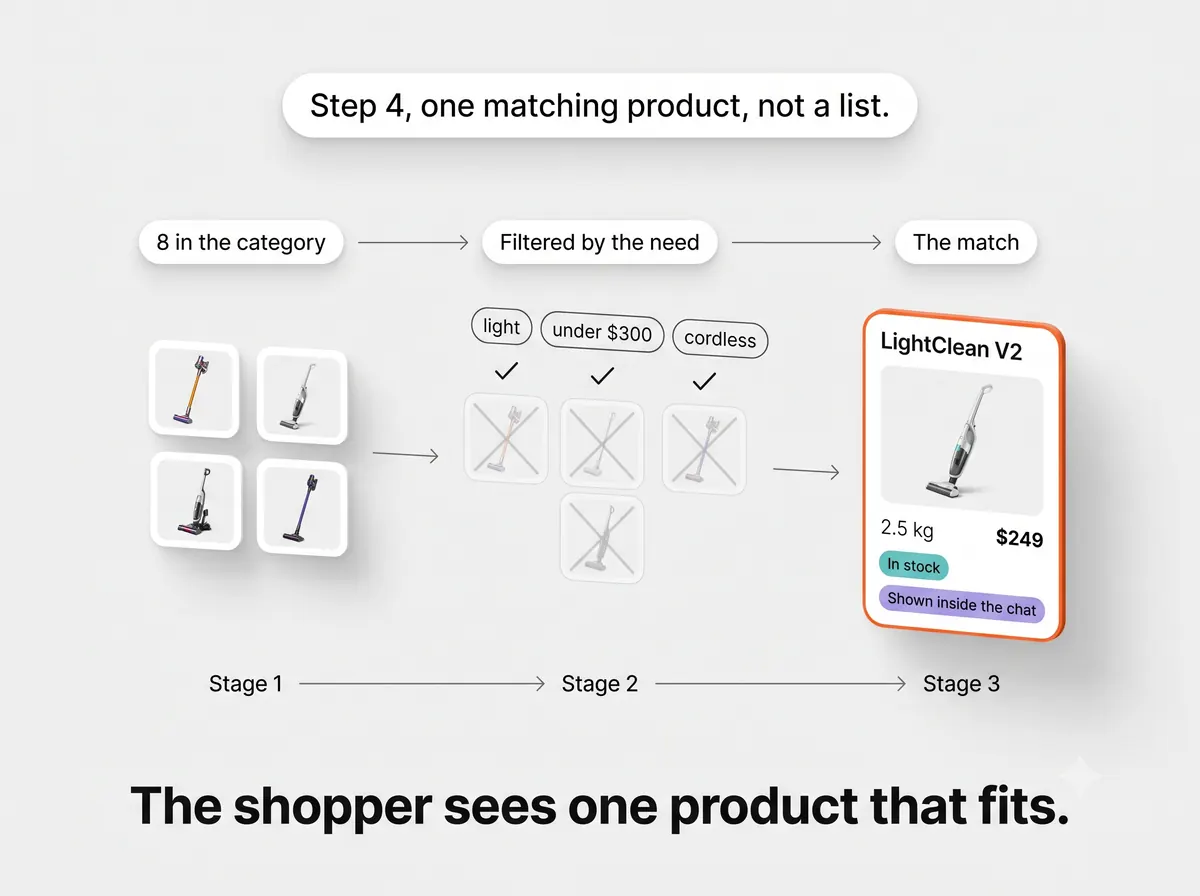
The assistant reduces the shopper’s effort the way the paper describes. It shows one product that fits rather than a list of 48 (fewer alternatives), picks the one feature that matters instead of listing every spec (fewer cues), and translates the raw number into something instantly meaningful, such as “2.5 kg, half the weight of your current vacuum” (an easy-to-process cue). Two suggested follow-ups after each answer keep the next decision small too.

People do not compute; they reach for the easiest-to-process information.

1 of 48products shown: fewer alternatives
1feature that matters, not every spec
2follow-ups after each answer
Figure. Key numbers from the paper, and from how the tool applies it.
Framework 1 of 2AI Shopping Assistant · Stage 3: Product exploration

Jobs to Be Done

Clayton Christensen, Harvard Business School · Introduced in The Innovator’s Solution (Harvard Business Review Press, 2003, with Michael Raynor), set out in “Know Your Customers’ ‘Jobs to Be Done’”, Harvard Business Review, 2016, and the book Competing Against Luck, 2016 · A framework built from case studies of product successes and failures rather than a single experiment.

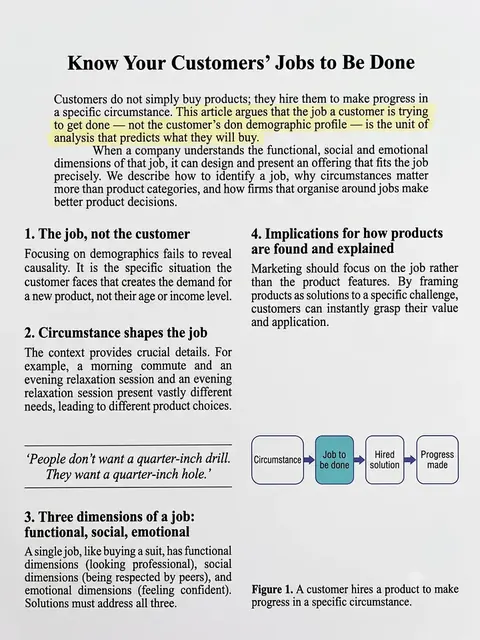
What the paper is. A framework, not a single study. Christensen and his co-authors (Taddy Hall, Karen Dillon and David Duncan in the HBR article) argue that people do not buy products because of who they are; they “hire” a product to make progress in a particular circumstance, the job to be done. A job has functional, social and emotional dimensions. The best-known illustration is the fast-food milkshake hired for a long, boring morning commute, which competes with bananas and bagels, not with other milkshakes. Customers hire products to get a job done in a specific circumstance; understanding the job predicts purchase better than demographics or product attributes.

1. What we took from it

  • Customers hire products to get a job done in a specific circumstance; understanding the job predicts purchase better than demographics or product attributes.
  • A job has functional, social and emotional dimensions, and the circumstance matters as much as the customer.
  • The real competition is anything else that gets the job done, including doing nothing, so a product has to be positioned against the job, not against its category.

2. Where we used it

The AI Shopping Assistant page, research card 1, and steps 2 and 3 of its method (“Buying questions”, “Understand the need”).

3. How we used it

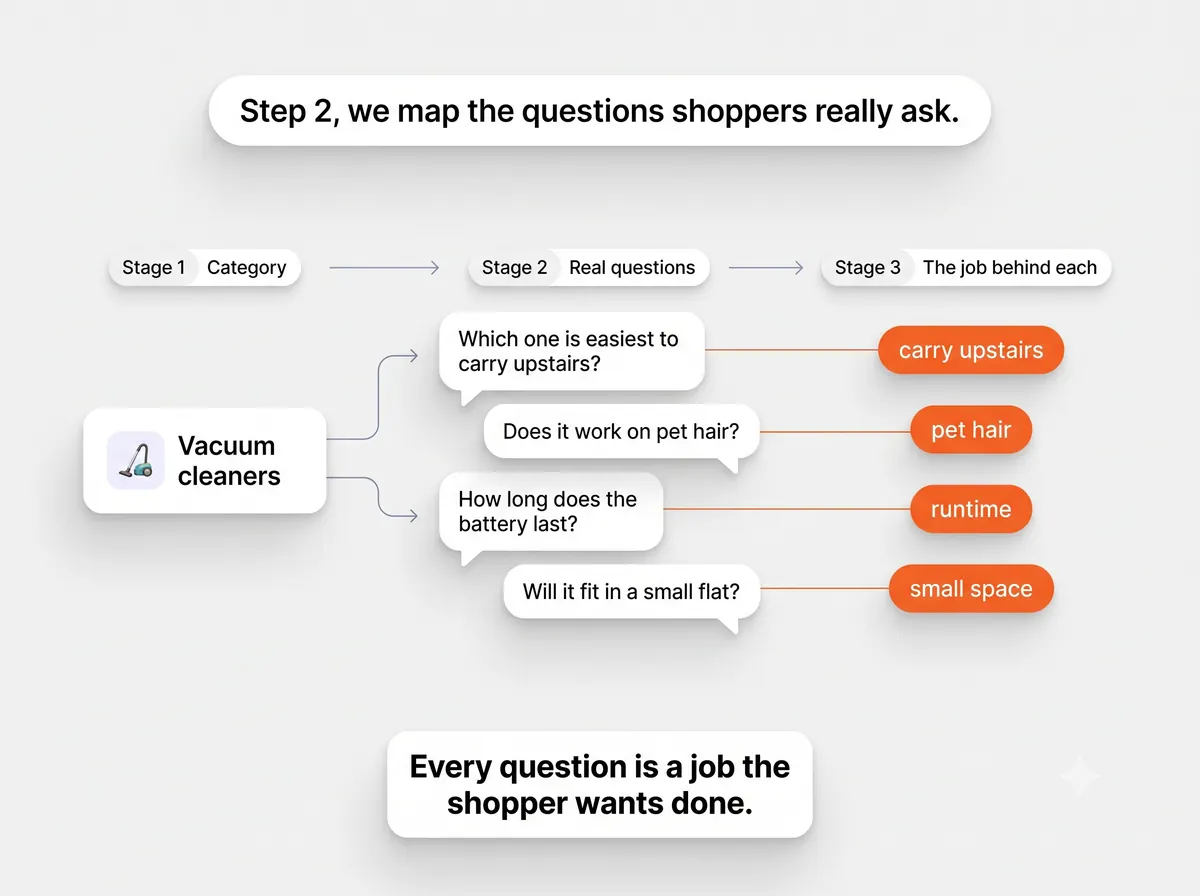
Step 2 maps the real job behind each product category before the assistant ever talks to a shopper: what people are trying to get done when they look for a vacuum, a jacket or a pair of running shoes. Step 3 applies it in the conversation: “my vacuum is heavy” is translated into the job, “easier cleaning upstairs”, and the assistant states that job back to the shopper before it recommends anything. The product it then picks is the one that gets the job done, not the one that scores best on a spec sheet.

People don’t buy products; they hire them to get a job done.

3dimensions of a job: functional, social, emotional
2003 → 2016from The Innovator’s Solution to the HBR article and Competing Against Luck
Figure. Key numbers from the paper, and from how the tool applies it.
Framework 2 of 2AI Shopping Assistant · Stage 3: Product exploration

Means-End Chain Theory

Jonathan Gutman, University of Southern California · “A Means-End Chain Model Based on Consumer Categorization Processes”, Journal of Marketing, 1982, the American Marketing Association’s flagship peer-reviewed journal · A conceptual model that became the basis of the laddering interview method (Reynolds and Gutman, Journal of Advertising Research, 1988), used in advertising and product strategy for four decades.

What the paper is. Jonathan Gutman, Journal of Marketing, 1982. The paper proposes that consumers categorise products by what they lead to: a product’s attributes produce consequences (functional and psychosocial), and consequences are wanted because they serve personal values or end states. Attribute, consequence, value form a chain, the means-end chain, that links what a product is to why a person cares. Reynolds and Gutman later turned the model into the laddering interview, which walks a consumer up the chain by repeatedly asking why an attribute matters. An attribute on its own means nothing to a shopper; it matters through the consequence it produces and the personal outcome that consequence serves.

1. What we took from it

  • An attribute on its own means nothing to a shopper; it matters through the consequence it produces and the personal outcome that consequence serves.
  • The chain runs attribute, then benefit, then personal outcome, and the shopper cares most about the top of the chain.
  • To explain a product convincingly you climb the chain: name the attribute, say what it does for the person, and connect it to what they are trying to achieve.

2. Where we used it

The AI Shopping Assistant page, research card 2, and step 5 of its method (“Explain why”).

3. How we used it

When the assistant explains why a product fits, it does not read out the spec sheet. It picks the one attribute that matters for the job and climbs the chain in one sentence: 2.5 kg (attribute), less to carry (consequence), easier upstairs (the outcome the shopper asked for). Every explanation in the tool follows that attribute, benefit, outcome order, so the number the shopper hears is always tied to the reason they came.

Attribute, then benefit, then personal outcome: the shopper cares most about the top of the chain.

3links in the chain: attribute, consequence, value
1982 → 1988from the model to the laddering interview method
Figure. Key numbers from the paper, and from how the tool applies it.
Stage 4: Conversational shopping

Voice Shopping

Three papers answer three questions: why people shop by voice at all (convenience and enjoyment), what makes them trust the assistant (human-likeness and control) and what builds that trust (social presence and competence).

Paper 4 of 14Voice Shopping · Stage 4: Conversational shopping

Voice Assistant, Buy Coffee Capsules!

Ludwig-Maximilians-Universität München (LMU Munich) and University of Münster · The DATA BASE for Advances in Information Systems, 2023, the peer-reviewed journal of ACM SIGMIS · Mixed methods: 30 user interviews and a 176-person survey.

What the paper is. “Understanding the Determinants of Consumers’ Intention to Use Voice Commerce” by Rzepka, Berger, Koslow and Hess (LMU Munich and University of Münster), The DATA BASE for Advances in Information Systems, 2023. Study 1: 30 interviews with voice-assistant users to build a model of benefits and risks. Study 2: a survey of 176 people to test it. Convenience is by far the strongest reason people value voice shopping (β = .588), with enjoyment second (β = .207). Efficiency on its own did not matter.

1. What we took from it

  • Convenience is by far the strongest reason people value voice shopping (β = .588), with enjoyment second (β = .207). Efficiency on its own did not matter.
  • Three risks hold people back: the assistant being unreliable (β = .430), the shopper losing control (β = .269) and not understanding what it is doing (opacity, β = .171).
  • Benefits raise the intention to use voice commerce and risks lower it; together they explained 61.8% of that intention.

2. Where we used it

The Voice Shopping page, research card 1 (Impact 9/10), and steps 1, 2 and 5 of its method.

3. How we used it

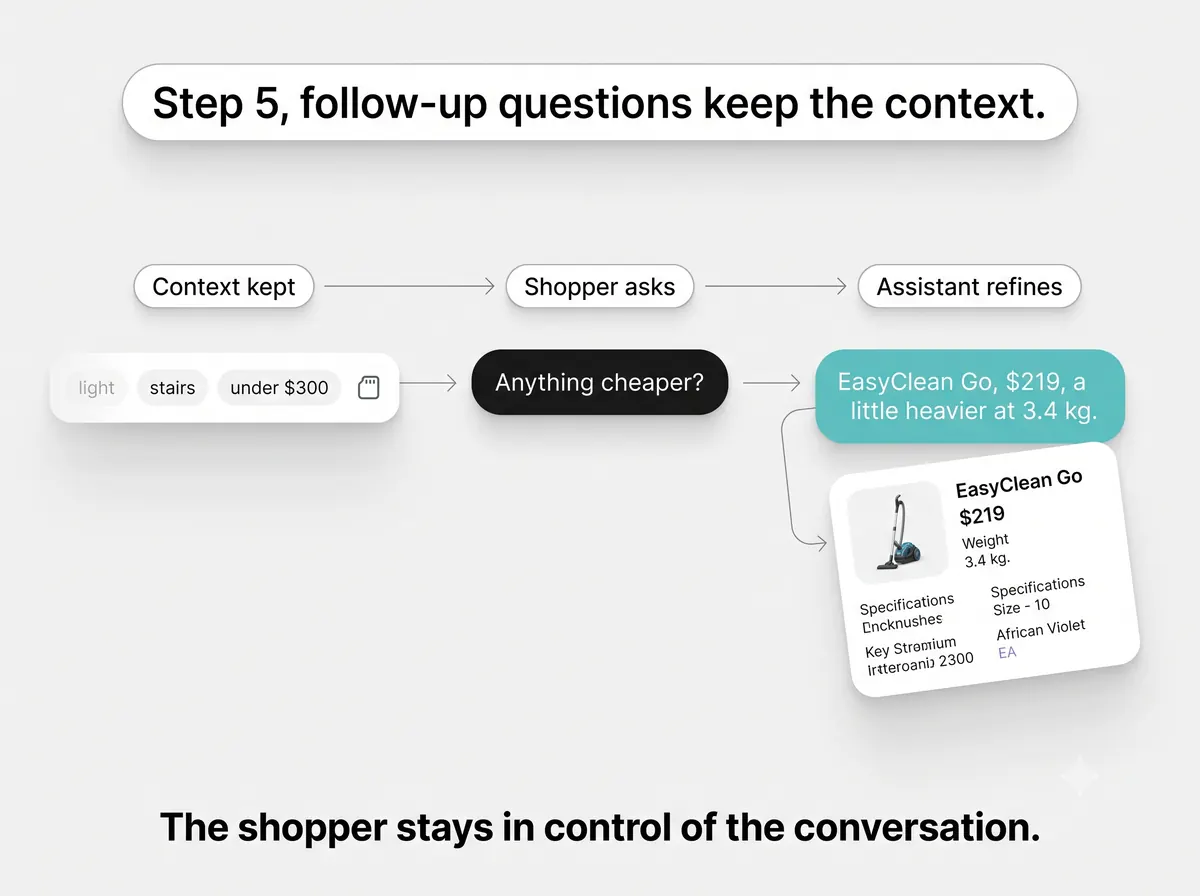
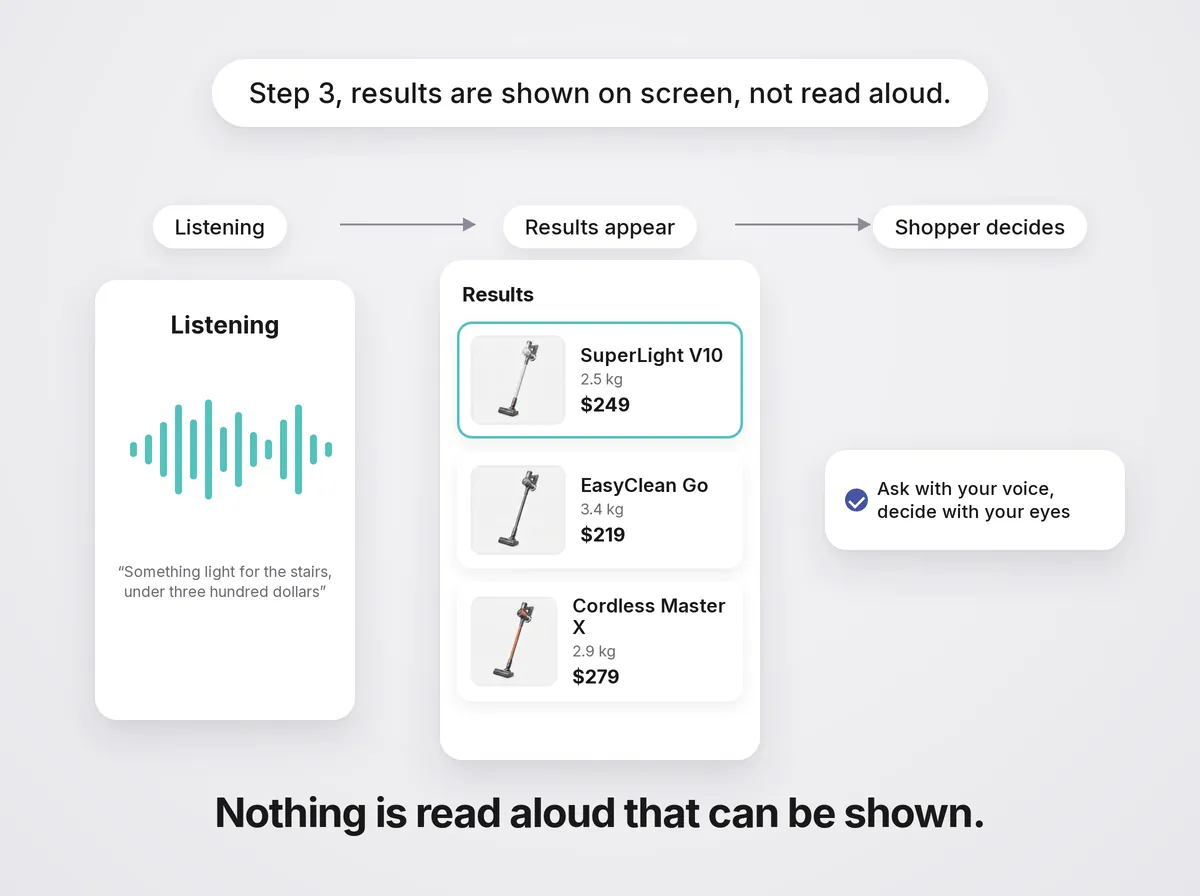
Convenience comes first: one spoken sentence carries several constraints (“light, under $300, for stairs”) and returns three strong matches, not 48. The three risks are designed out. Reliability: product names are mapped to the store’s SKUs, mishearings included, and the assistant asks a clarifying question instead of returning an error. Control: follow-ups such as “anything cheaper?” refine the results and the shopper stays in charge of every step. Opacity: results appear on screen as cards, so the shopper can see what the assistant found and why.

Convenience is by far the strongest reason people value voice shopping.

β = .588convenience, the strongest driver
β = .430unreliability, the strongest risk
61.8%of the intention to use, explained
Figure. Key numbers from the paper, and from how the tool applies it.
Paper 5 of 14Voice Shopping · Stage 4: Conversational shopping

Media Equation Theory

University of Minnesota and California State Polytechnic University, Pomona · Journal of Global Fashion Marketing, 2023, peer-reviewed · Two controlled experiments, 86 and 112 participants, in a real voice-shopping task.

What the paper is. “Building trust with voice assistants for apparel shopping: the effects of social role and user autonomy” by Huh, Whang and Kim (University of Minnesota and Cal Poly Pomona), Journal of Global Fashion Marketing, 2023. Two experiments on voice shopping for clothes, with 86 and 112 participants, built on media equation theory: people respond to machines with human social rules when the machine communicates like a person. Giving the shopper more autonomy (control over the interaction) raised perceived human-likeness, then trust, then purchase intention. That chain (human-likeness, then trust) is what carried the effect.

1. What we took from it

  • Giving the shopper more autonomy (control over the interaction) raised perceived human-likeness, then trust, then purchase intention. That chain (human-likeness, then trust) is what carried the effect.
  • Whether the assistant was framed as a “partner” or a “servant” made little difference on its own; control did.
  • A basic human-like cue, such as natural speech, is enough. Retailers do not need a richer human persona, they need error-free understanding and responsiveness.

2. Where we used it

The Voice Shopping page, research card 2 (Impact 8/10), and steps 4 and 5 of its method (“Sound human”, “Follow-ups”).

3. How we used it

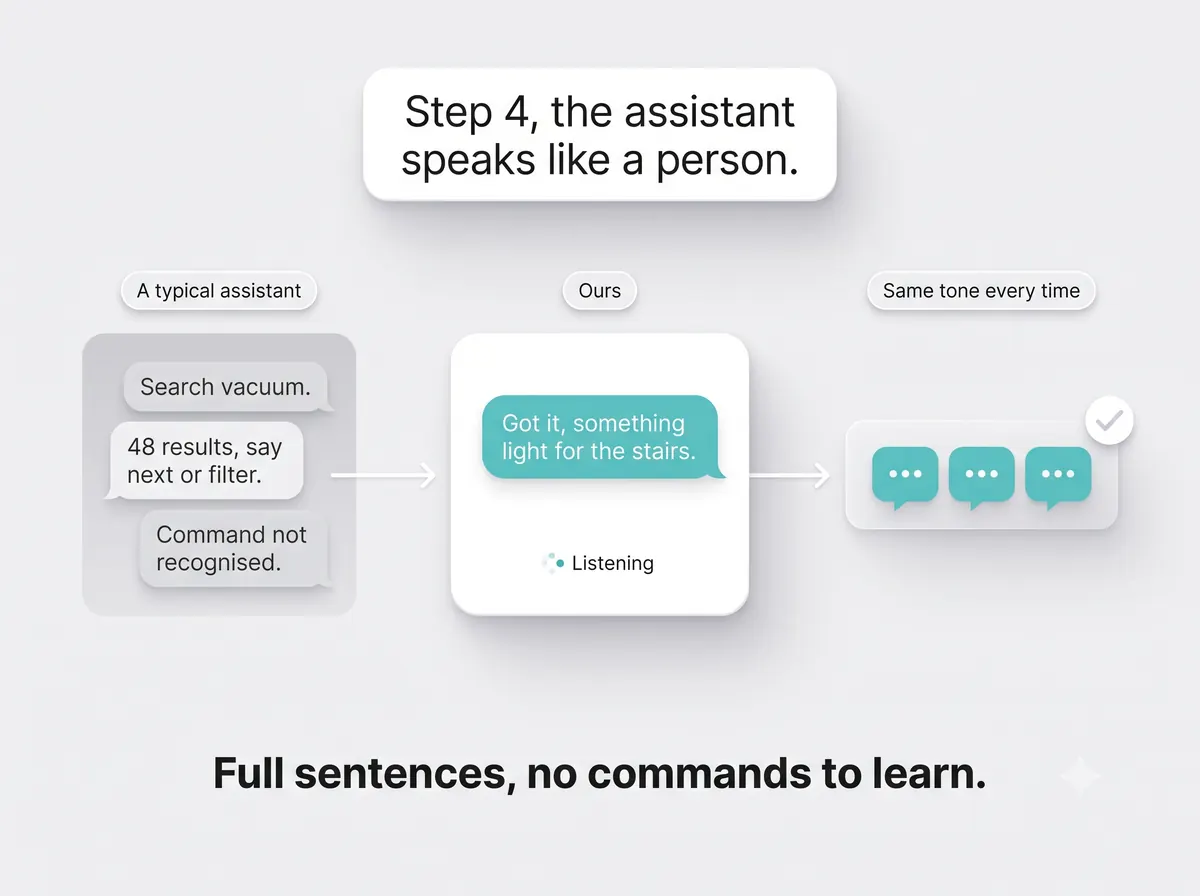
The assistant speaks in full sentences (“Got it, something light for the stairs”) with the same tone every time, so it feels like a person rather than a voice search box. Shopper autonomy is built in: the shopper leads with follow-up questions, refines by price, weight or feature, and adds to cart only when they choose to. Nothing is read aloud that can be shown, so the shopper decides with their eyes.

Autonomy raised human-likeness, then trust, then purchase intention.

86 + 112participants across two experiments
Controlnot persona, is what carried the effect
Figure. Key numbers from the paper, and from how the tool applies it.
Paper 6 of 14Voice Shopping · Stage 4: Conversational shopping

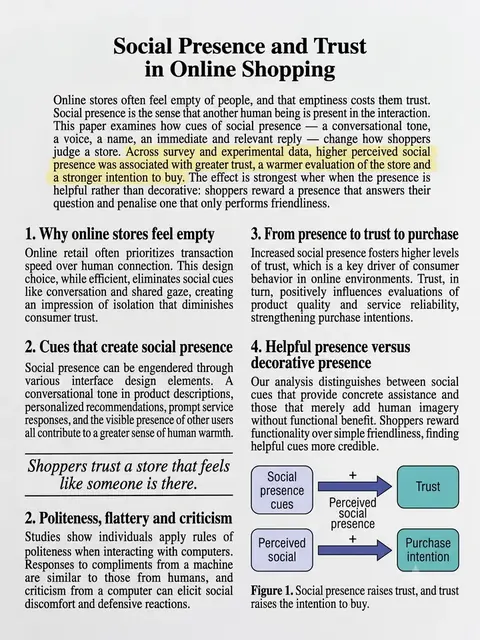
Social Presence and Trust

University of Portsmouth and University of Winchester · Psychology and Marketing, 2021, a long-established peer-reviewed journal · Structural equation model on 466 voice-assistant users, confirmed by a qualitative study.

What the paper is. “Alexa, she’s not human but… Unveiling the drivers of consumers’ trust in voice-based artificial intelligence” by Pitardi and Marriott (University of Portsmouth and University of Winchester), Psychology and Marketing, 2021. A structural model tested on 466 voice-assistant users, followed by interviews. Usefulness and ease of use shape the attitude toward using a voice assistant, but they do not create trust.

1. What we took from it

  • Usefulness and ease of use shape the attitude toward using a voice assistant, but they do not create trust.
  • Trust comes from the social side of the interaction: social presence (the feeling that someone is there) and perceived competence.
  • People apply human social rules to assistants that behave consistently, so a natural, consistent conversational flow is what earns trust and, through it, acceptance of what the assistant suggests.

2. Where we used it

The Voice Shopping page, research card 3 (Impact 8/10), and step 4 of its method (“Sound human”).

3. How we used it

The assistant keeps a consistent speaking and listening behaviour: a visible listening state while the microphone is on, the same tone in every reply, and context carried across turns so it never “forgets” mid-conversation. Competence is shown, not claimed: it searches the same catalogue as the rest of the store, puts in-stock products first and shows image, price and the key spec for each result.

Trust comes from the social side of the interaction.

466voice-assistant users in the structural model
2sources of trust: social presence and competence
Figure. Key numbers from the paper, and from how the tool applies it.
Stage 6: Frictionless purchase

Mobile Experience

Three papers give the mobile layer its permission, its target and its test: a site may change its interface per context (Morphing), each extra step costs a sale (Search Cost), and people keep using what is useful and easy (TAM).

Paper 7 of 14Mobile Experience · Stage 6: Frictionless purchase

Website Morphing

MIT Sloan School of Management · Marketing Science, 2009, the INFORMS journal and one of the most rigorous in the field · Field data from a live BT Group (British Telecom) website, 835 respondents.

What the paper is. John Hauser, Glen Urban, Guilherme Liberali and Michael Braun (MIT Sloan), Marketing Science, 2009. They built a system that infers a visitor’s cognitive style from clickstream data and automatically changes the look, navigation and detail level of a website to match it, tested on an experimental BT Group broadband website with data from 835 respondents. A website does not have to show every visitor the same interface. Its structure, navigation, tools and presentation can adapt to the visitor.

1. What we took from it

  • A website does not have to show every visitor the same interface. Its structure, navigation, tools and presentation can adapt to the visitor.
  • Matching the interface to the visitor raised purchase intentions by 21% with perfect information, and by almost 20% when the system had to learn the style from clicks.
  • The gain came from changing the “look and feel”, not only the content.
2. Where we used it

The Mobile Experience page, research card 1 (Impact 9/10), and step 2 of its method (“Keep the store”).

3. How we used it

The paper morphs the site to cognitive style; we apply the same adaptive-interface principle to context: the phone. The existing store, domain, products, cart and checkout stay exactly as they are, and a layer switches on only for phone visitors, changing how the storefront is presented and operated (bottom navigation, one-screen categories, focused product pages). The desktop site is untouched, so one store serves two interfaces.

The site changes; the visitor does not have to.

+21%purchase intention with perfect information
≈ +20%when the style is learned from clicks
835respondents on a live BT website
Figure. Key numbers from the paper, and from how the tool applies it.
Paper 8 of 14Mobile Experience · Stage 6: Frictionless purchase

Search Cost Theory (WeStore vs. AppStore)

Owen Graduate School of Management, Vanderbilt University, and Fisher College of Business, The Ohio State University · Working paper on SSRN · Customer-level clickstream data from JD.com, one of the largest online retailers in the world.

What the paper is. “WeStore or AppStore: How Customers Shop Differently in Mobile Apps vs. Social Commerce” by Kejia Hu (Vanderbilt) and Nil Karacaoglu (Ohio State), a working paper on SSRN. They modelled the complete shopping journey of a large online retailer’s customers across two channels, its native app and its lightweight WeChat mini-program, using a sequential search model that estimates the cost of starting a search and the cost of each extra search step. Shopping gets harder with every extra search, page change or navigation step; each step is a cost the shopper weighs against giving up.

1. What we took from it

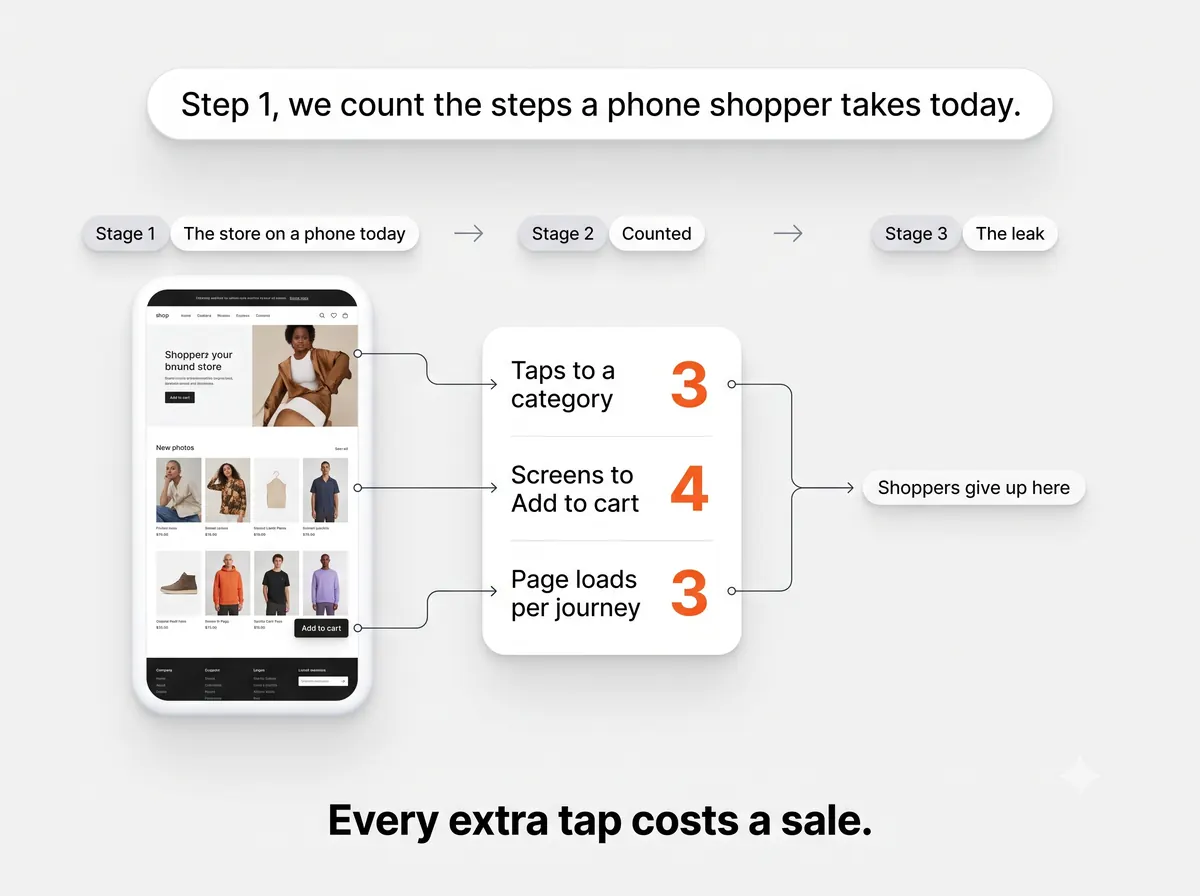
  • Shopping gets harder with every extra search, page change or navigation step; each step is a cost the shopper weighs against giving up.
  • In the lightweight channel the cost of each additional step was lower, and customers explored more products (3.11 versus 2.64 per session) and converted more often: 41% versus 26.8% in the studied dataset.
  • Lowering the cost of each step is a lever a retailer controls.

2. Where we used it

The Mobile Experience page, research card 2 (Impact 9/10), and steps 1, 3, 4, 6 and 7 of its method.

3. How we used it

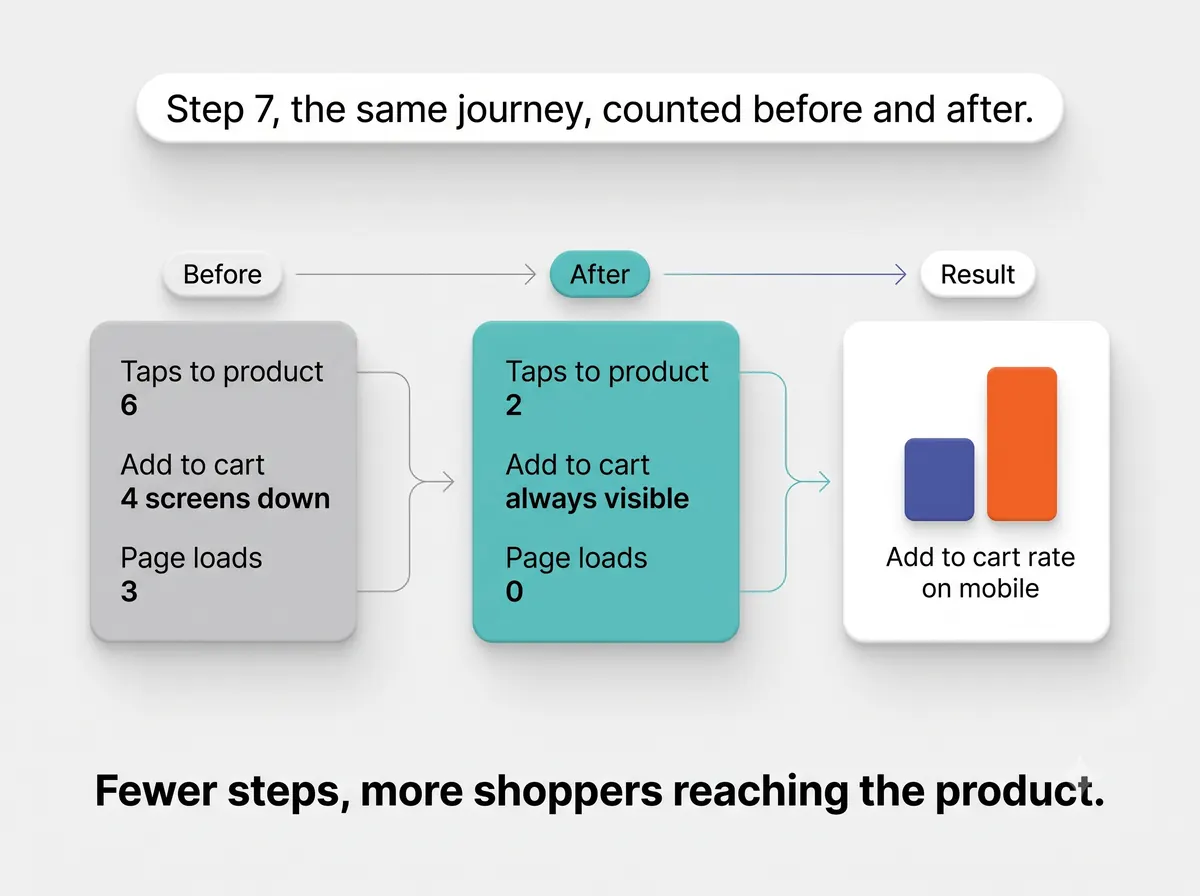
Step 1 counts the taps, screens and page loads between opening the store and buying, which is the paper’s marginal search cost made visible. The layer then removes steps: bottom navigation puts Home, Search, Categories, Cart and Account one tap away; categories open on one screen with products beside them and filters as chips, with no page loads in between; the cart badge and Checkout button are always in view. Step 7 counts taps to product before and after, so the reduction is measured.

Each extra step is a cost the shopper weighs against giving up.

41% vs 26.8%conversion, lightweight channel vs. native app
3.11 vs 2.64products explored per session
Figure. Key numbers from the paper, and from how the tool applies it.
Paper 9 of 14Mobile Experience · Stage 6: Frictionless purchase

Technology Acceptance Model

MIT Sloan School of Management · Fred D. Davis’s PhD dissertation, 1985, the origin of the Technology Acceptance Model, one of the most widely used and cited models in technology-adoption research · A field survey of 100 users and a lab experiment with 40 MBA students.

What the paper is. Fred D. Davis’s PhD dissertation at MIT Sloan, 1985, “A Technology Acceptance Model for Empirically Testing New End-User Information Systems”. It proposed and tested the model behind decades of adoption research, with a field survey of 100 organisational users and a lab experiment with 40 MBA students on two graphics systems. Two beliefs decide whether people accept and keep using a technology: perceived usefulness (it helps me get something done) and perceived ease of use (it takes little effort).

1. What we took from it

  • Two beliefs decide whether people accept and keep using a technology: perceived usefulness (it helps me get something done) and perceived ease of use (it takes little effort).
  • Those beliefs, not novelty or appearance, drive the attitude that leads to actual use.
  • Ease of use also feeds usefulness: something easier to use is judged more useful.

2. Where we used it

The Mobile Experience page, research card 3 (Impact 8/10), and steps 3 to 6 of its method.

3. How we used it

We do not make the site look like an app for appearance’s sake. Every change has to score on the two TAM beliefs: familiar mobile patterns (bottom tabs, large tap targets, sticky Add to cart, collapsed details) for ease of use, and a faster route from opening the store to the product or the cart for usefulness. Because nothing has to be downloaded, the first barrier to use is gone entirely.

People adopt what is useful and easy to use, not what merely looks new.

2beliefs that decide adoption: usefulness and ease of use
100 + 40users in the field survey, MBA students in the lab
Figure. Key numbers from the paper, and from how the tool applies it.
Stage 5: Purchase confidence

Smart Reviews

Three papers answer why reviews must be surfaced (the meta-analysis), which review to surface (review structure) and what must never happen (AI content posing as a customer).

Paper 10 of 14Smart Reviews · Stage 5: Purchase confidence

How Online Reviews Affect Purchase Intention: A Meta-Analysis

Wuhan University, School of Information Management · Data and Information Management, 2024, a peer-reviewed Elsevier journal · A meta-analysis of 156 studies, 214 effect sizes and 69,006 observations, the broadest evidence base in this deck.

What the paper is. Keda Qiu and Liyi Zhang (Wuhan University), Data and Information Management, 2024. A meta-analysis that pools 156 studies, 214 effect sizes and 69,006 observations to settle what actually moves purchase intention in online reviews, and what moderates it (culture, product type, study design). Every review factor studied has a significant effect on purchase intention. Review valence (how positive the review is) is the strongest, r = 0.563.

1. What we took from it

  • Every review factor studied has a significant effect on purchase intention. Review valence (how positive the review is) is the strongest, r = 0.563.
  • Next come review usefulness (r = 0.481), review credibility (r = 0.460) and how similar the reviewer feels to the reader (r = 0.451). Review volume matters less (r = 0.317).
  • Reviews that are useful, credible and relevant to the reader do more than many reviews.

2. Where we used it

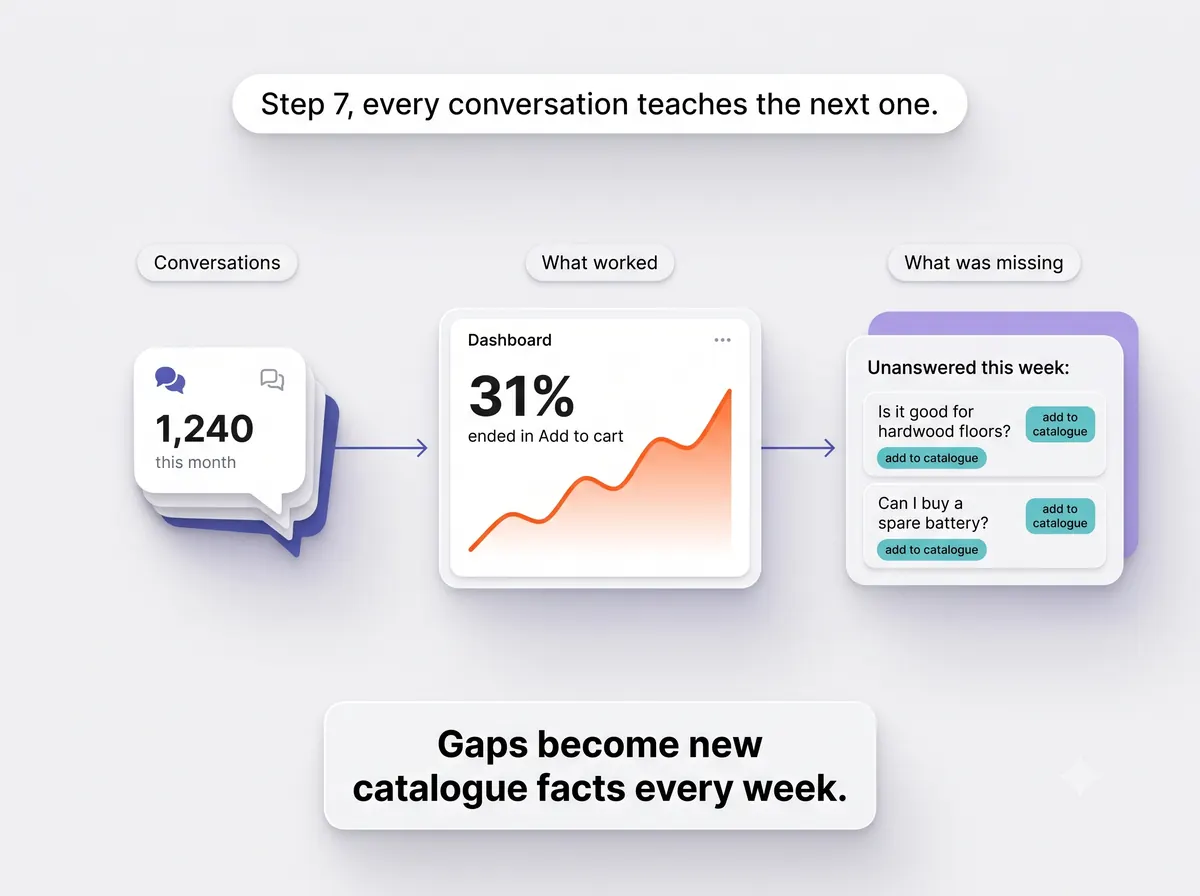
The Smart Reviews page, research card 1 (Impact 9/10), and steps 4 and 6 of its method (“Right moment”, “Rotate and learn”).

3. How we used it

If reviews move the purchase decision this much, they cannot stay hidden below the fold. The popup brings a relevant review into the product page after a suitable interval, near Add to cart, while the shopper is deciding, and rotates a different useful review as browsing continues. It is dismissed with one tap and does not return that session, and helpfulness votes feed the ranking, so the reviews shown are the credible, useful ones the paper found matter most.

Reviews left at the bottom of the page are evidence the shopper never sees.

r = 0.563review valence, the strongest combined effect
156studies, 214 effect sizes
69,006observations
Figure. Key numbers from the paper, and from how the tool applies it.
Paper 11 of 14Smart Reviews · Stage 5: Purchase confidence

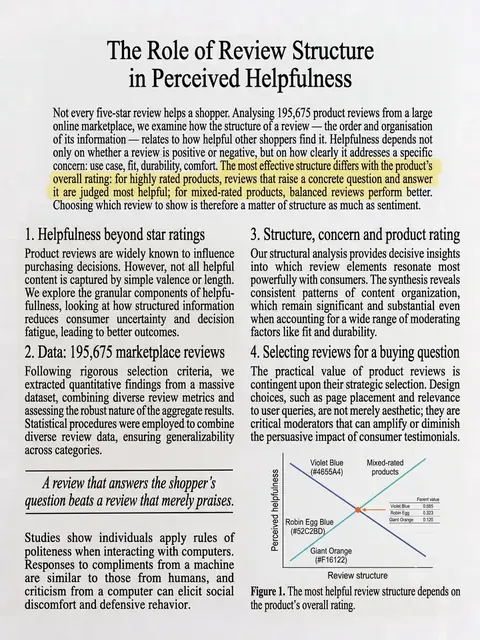
The Role of Review Structure in Perceived Helpfulness

UQ Business School, University of Queensland, and Judge Business School, University of Cambridge · Scientific Reports, 2026, a Nature Portfolio peer-reviewed journal · 195,675 real Amazon reviews across 5,487 products.

What the paper is. Yingyue Luna Luan (University of Queensland) and Yeun Joon Kim (University of Cambridge), Scientific Reports, 2026. They analysed 195,675 Amazon reviews across 5,487 products, modelling each review’s opening tone and how its sentiment moved from start to finish, against the helpfulness votes it received. Helpfulness depends on how a review is structured, not only on whether it is positive or negative.

1. What we took from it

  • Helpfulness depends on how a review is structured, not only on whether it is positive or negative.
  • The best structure depends on the product’s rating: for highly rated products, reviews that grow more positive are most helpful; for average-rated products, reviews that move towards criticism help most; for low-rated products, reviews that open constructively before criticising win.
  • How the information is organised matters as much as what it says.

2. Where we used it

The Smart Reviews page, research card 2 (Impact 9/10), and steps 1 and 3 of its method (“Read the reviews”, “Pick the review”).

3. How we used it

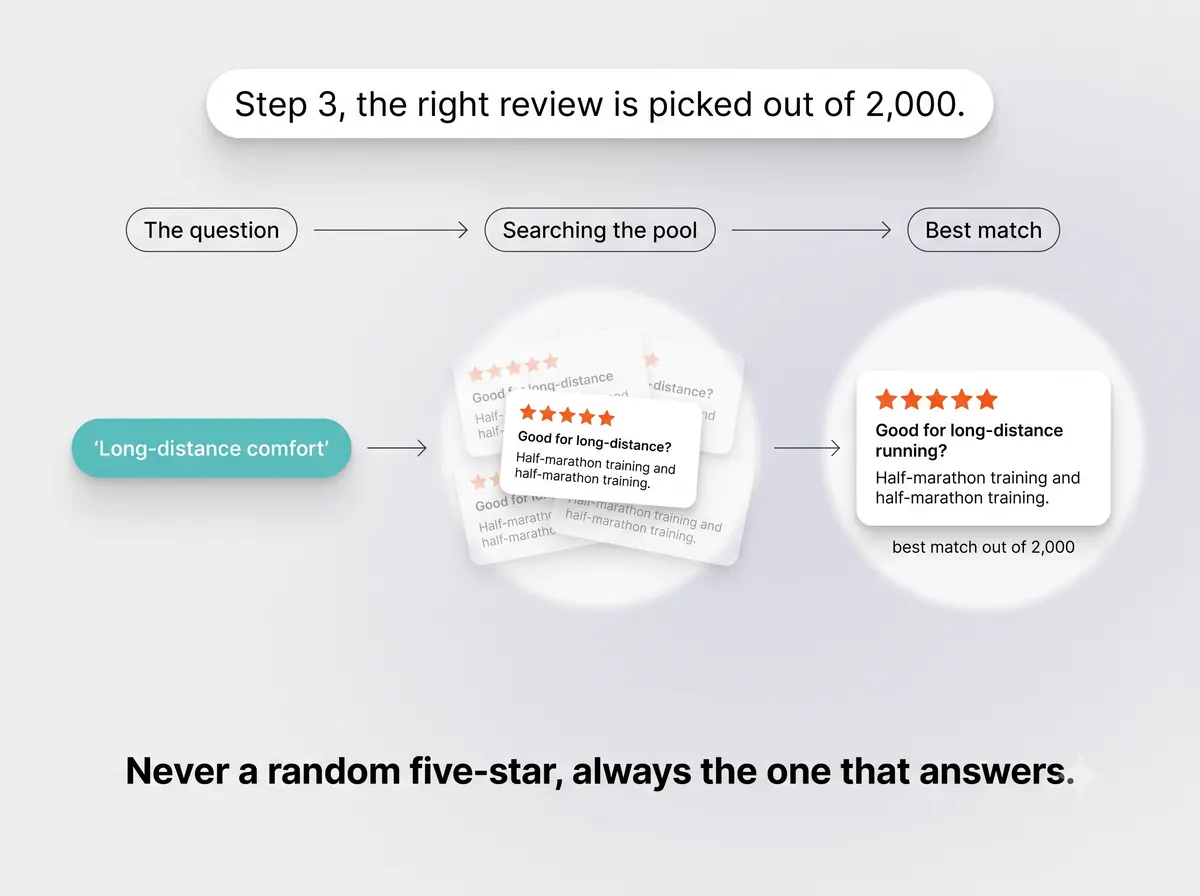
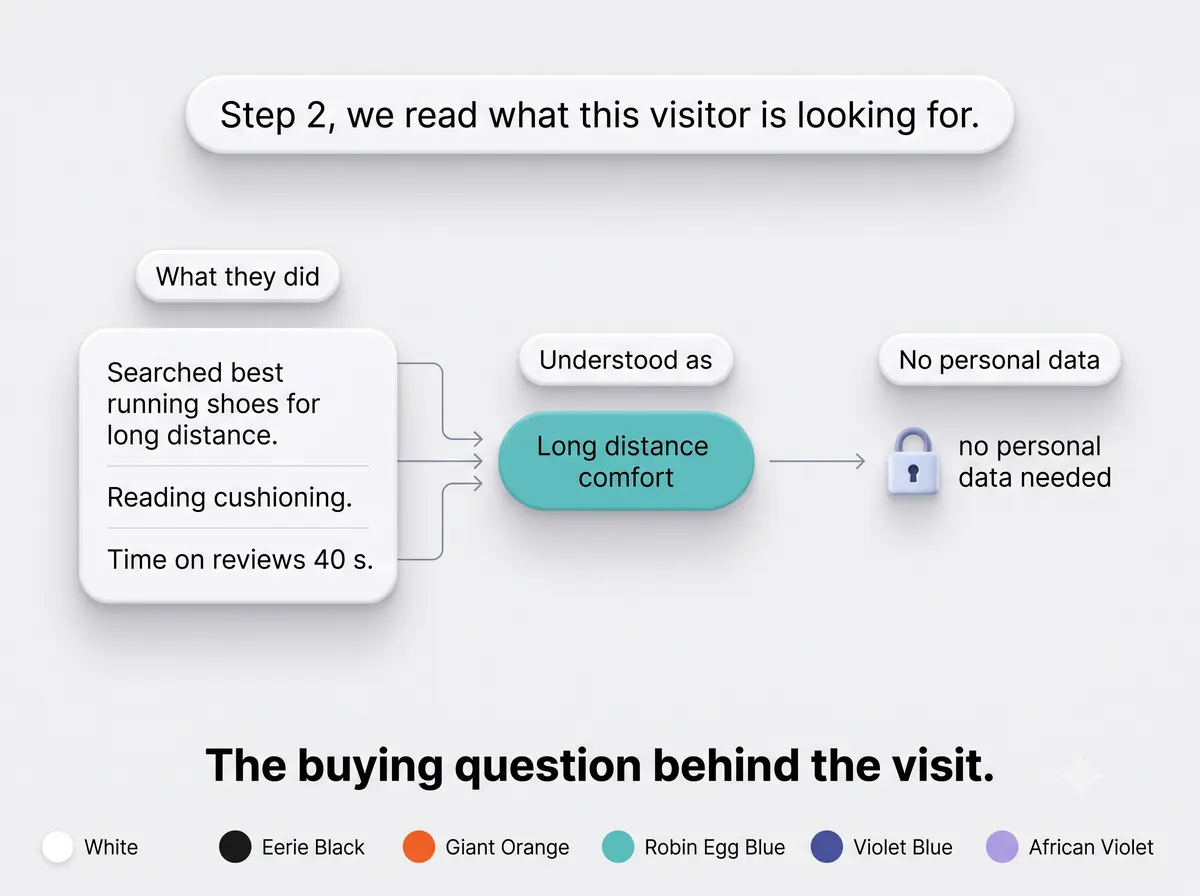
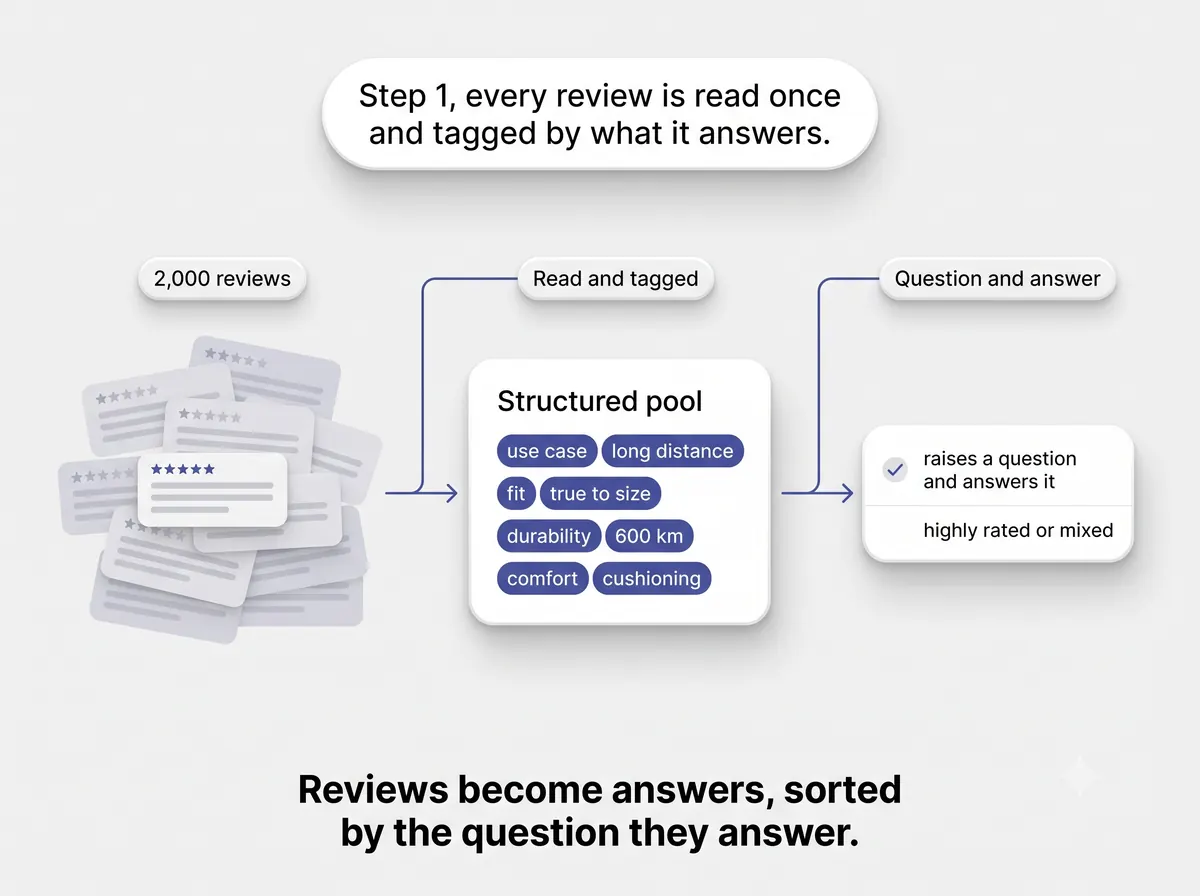
Every review is read once and tagged by what it answers (use case, fit, durability, comfort), whether it raises a question and answers it, and the product’s rating context (highly rated or mixed). When a shopper’s buying question is known, the system picks the review that raises and answers that question, choosing a balanced review for mixed-rated products. It never rotates a random five-star review.

How the information is organised matters as much as what it says.

195,675Amazon reviews analysed
5,487products
Figure. Key numbers from the paper, and from how the tool applies it.
Paper 12 of 14Smart Reviews · Stage 5: Purchase confidence

Consumer Reactions to Perceived Undisclosed ChatGPT Usage in an Online Review Context

Goddard School of Business and Economics, Weber State University · Telematics and Informatics, 2024, a peer-reviewed Elsevier journal (the PDF is the SSRN preprint) · Two controlled experiments with about 400 participants in total.

What the paper is. Clinton Amos and Lixuan Zhang (Weber State University), published in Telematics and Informatics, 2024 (the PDF is the SSRN preprint). Two between-subjects experiments on Prolific, with 194 and about 200 participants, in which people read TripAdvisor hotel reviews and were then told the review was written by a person or by ChatGPT. Reviews people believe were generated by ChatGPT are rated less useful, less trustworthy and less authentic than the same reviews attributed to a human.

1. What we took from it

  • Reviews people believe were generated by ChatGPT are rated less useful, less trustworthy and less authentic than the same reviews attributed to a human.
  • The effect held for positive and negative reviews alike, and even when the reviewer carried a TripAdvisor Expert badge.
  • Perceived authenticity explains the drop: once a review does not feel like a real experience, its value collapses.

2. Where we used it

The Smart Reviews page, research card 3 (Impact 9/10), and step 5 of its method (“Keep it honest”).

3. How we used it

AI does real work in the tool: it reads and tags reviews, matches them to the shopper’s question and can summarise product images, descriptions and specifications. But it never wears a customer’s voice. Real reviews are labelled “Customer Review”, generated summaries are labelled “AI Product Insight”, and the two are visually distinct, always. That separation protects the authenticity that makes reviews worth showing in the first place.

AI does real work in the tool, but it never wears a customer’s voice.

≈ 400participants across two experiments
2experiments: the effect held for positive and negative reviews
Figure. Key numbers from the paper, and from how the tool applies it.
Stage 2: Product recommendation

Recommendations

Two papers, one chain: shoppers choose from a small consideration set (Hauser and Wernerfelt), and recommendations sell because they change that set (Li, Grahl and Hinz). The tool rebuilds the shopper’s set on the next visit.

Paper 13 of 14Recommendations · Stage 2: Product recommendation

Consideration Set Effect

MIT Sloan School of Management · Journal of Consumer Research, 1990, one of the leading peer-reviewed journals in marketing · A foundational paper on consideration sets, still cited in choice research today.

What the paper is. “An Evaluation Cost Model of Consideration Sets” by John Hauser and Birger Wernerfelt (MIT Sloan), Journal of Consumer Research, 1990. A theory paper, checked against published data, on why a rational shopper considers only a few of the options available: evaluating every option costs time and effort, so people screen first and choose second. Buying is a two-stage process. Faced with many products, shoppers use a quick screen to form a small consideration set, then decide only within that set.

1. What we took from it

  • Buying is a two-stage process. Faced with many products, shoppers use a quick screen to form a small consideration set, then decide only within that set.
  • The set is small: a median of four shampoos out of more than 30, two to five cars out of more than 160. Across the studies reviewed, considered sets ran from two to eight items while the available range was 6 to 47.
  • The size of the set is a trade-off between the cost of evaluating one more option and the benefit of having it.

2. Where we used it

The Recommendations page, research card 1, and step 2 of its method (“Build the set”). The deck calls it “the research principle we use”.

3. How we used it

Instead of asking the shopper to rebuild their set from scratch on every visit, the store keeps it. Step 1 records what was viewed, explored, saved and added to cart; step 2 ranks those signals by intent (cart, then saved, then viewed), keeps only in-stock items in the right variant, and caps the set at four to six products, the size the paper says shoppers actually hold in mind. The set refreshes as behaviour changes.

People screen first and choose second.

2–8items in a considered set, out of 6 to 47 available
4 of 30+shampoos: the median considered set
Figure. Key numbers from the paper, and from how the tool applies it.
Paper 14 of 14Recommendations · Stage 2: Product recommendation

How Do Recommender Systems Lead to Consumer Purchases?

HEC Paris, University of Cologne and Goethe University Frankfurt · Information Systems Research, the INFORMS journal and one of the top peer-reviewed journals in information systems · A randomised controlled field experiment on a large European online retailer’s live website.

What the paper is. Xitong Li (HEC Paris), Jörn Grahl (University of Cologne) and Oliver Hinz (Goethe University Frankfurt), Information Systems Research. A randomised controlled field experiment on the website of a large European online book retailer, with two pilot lab experiments first, that switched personalised recommendations on for some visitors and off for others, then traced how the effect reached the purchase. Personalised recommendations raised the odds of placing an order by 12.4% and revenue per session (basket value) by 1.7%, measured against shoppers without recommendations.

1. What we took from it

  • Personalised recommendations raised the odds of placing an order by 12.4% and revenue per session (basket value) by 1.7%, measured against shoppers without recommendations.
  • The whole effect ran through the consideration set: recommendations made the set 3.2% larger (breadth) and got shoppers more involved with each product in it (depth), and those two changes produced the purchases. The direct effect was not significant.
  • Breadth mattered far more than depth: showing the right extra options is what moves the sale.
2. Where we used it

The Recommendations page, research card 2 (Impact 9/10), steps 3 to 6 of its method, and the two headline numbers on the page.

3. How we used it

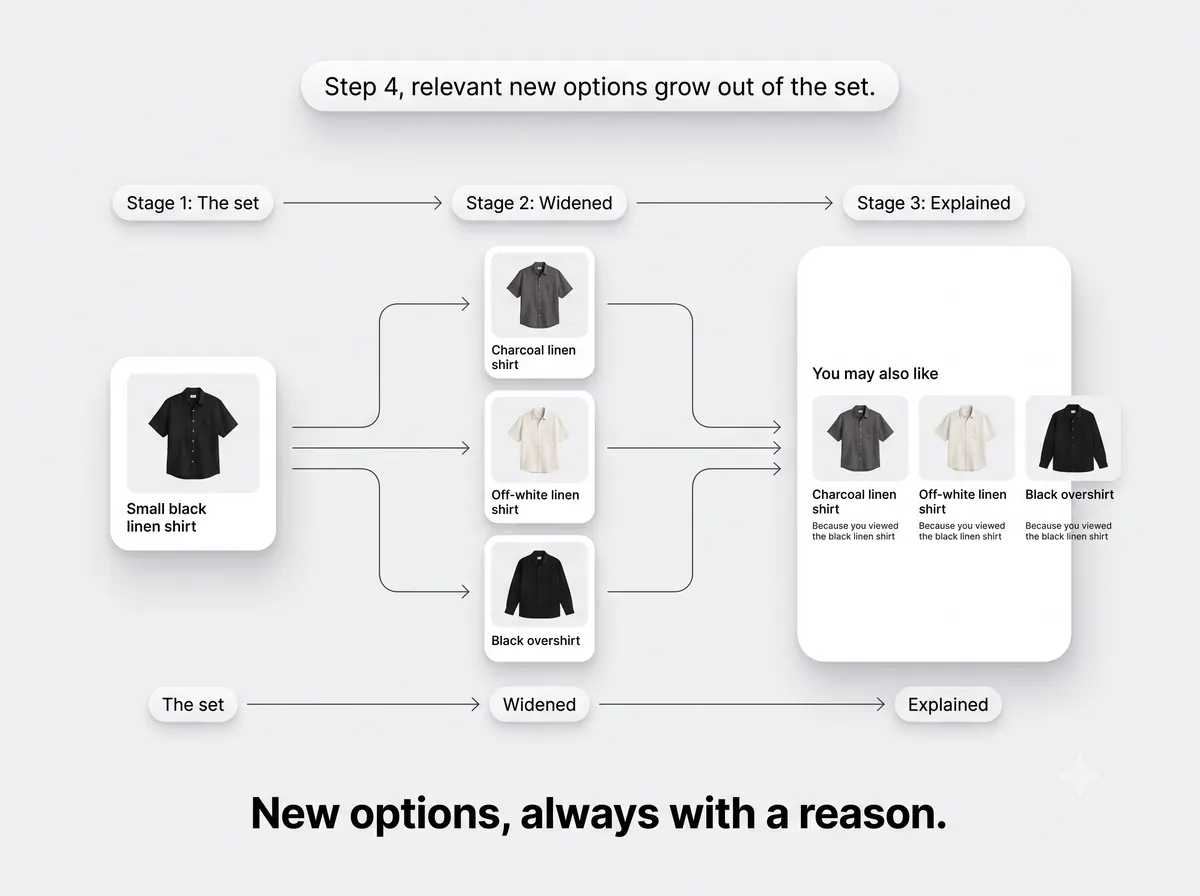
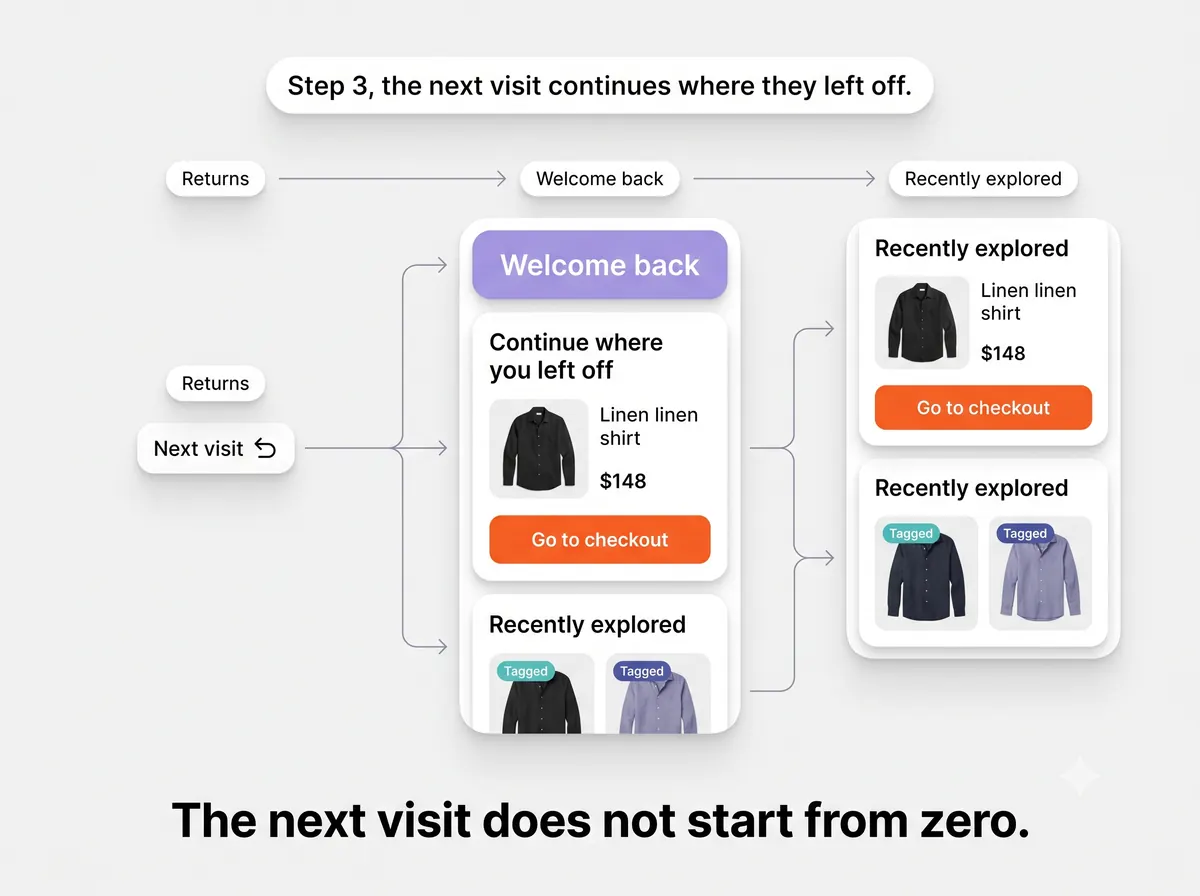
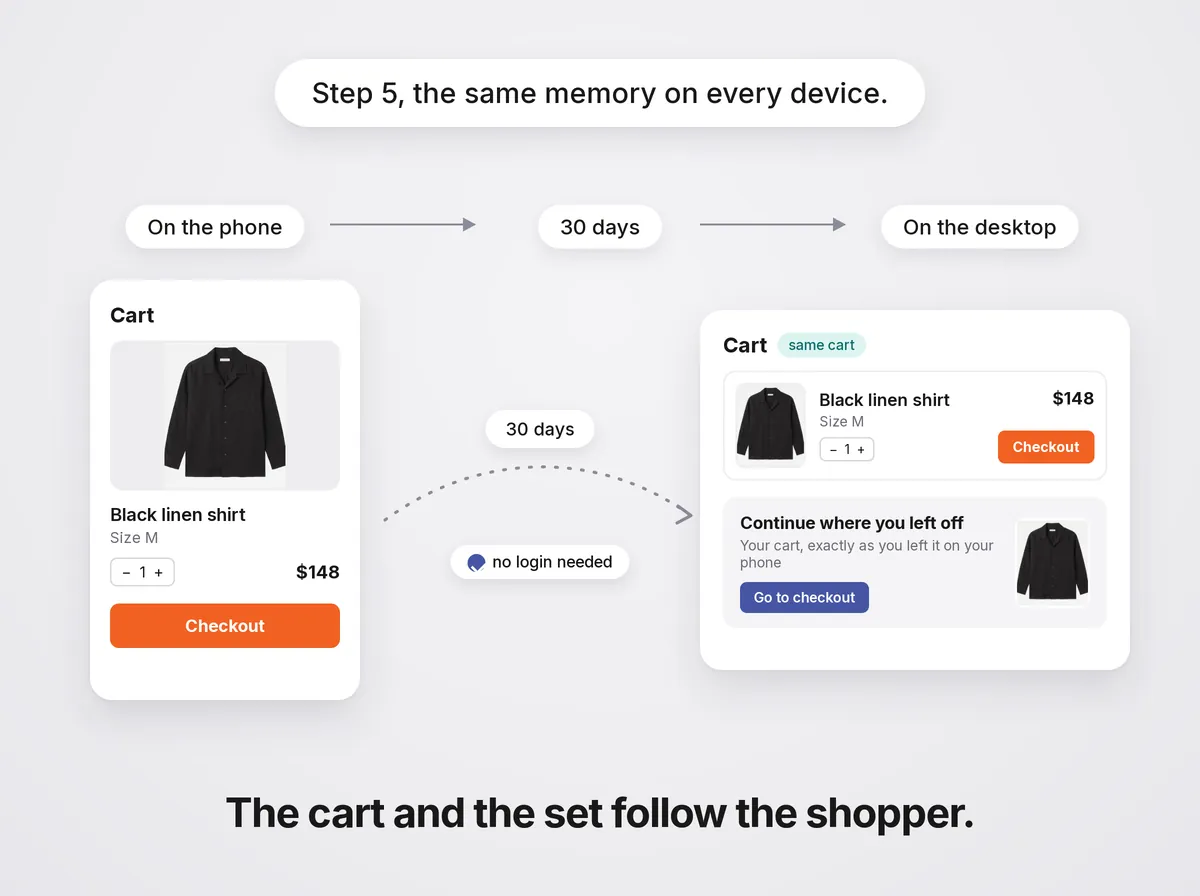
Steps 3 and 4 do the paper’s two jobs. “Welcome back” restores the set the shopper already had, cart item first, above any generic promotion, so the next visit does not start from zero. “You may also like” widens the set outward from what they viewed, same category, adjacent attributes, each item explained (“Because you viewed…”), which is the breadth effect the paper found does most of the work. Step 5 keeps the cart and the set for 30 days across phone and desktop, and step 6 measures recommendations separately: clicks and purchases from recommendations, purchase propensity and basket value, the same two outcomes the experiment measured.

Showing the right extra options is what moves the sale.

+12.4%odds of placing an order
+1.7%revenue per session
+3.2%larger consideration set
Figure. Key numbers from the paper, and from how the tool applies it.